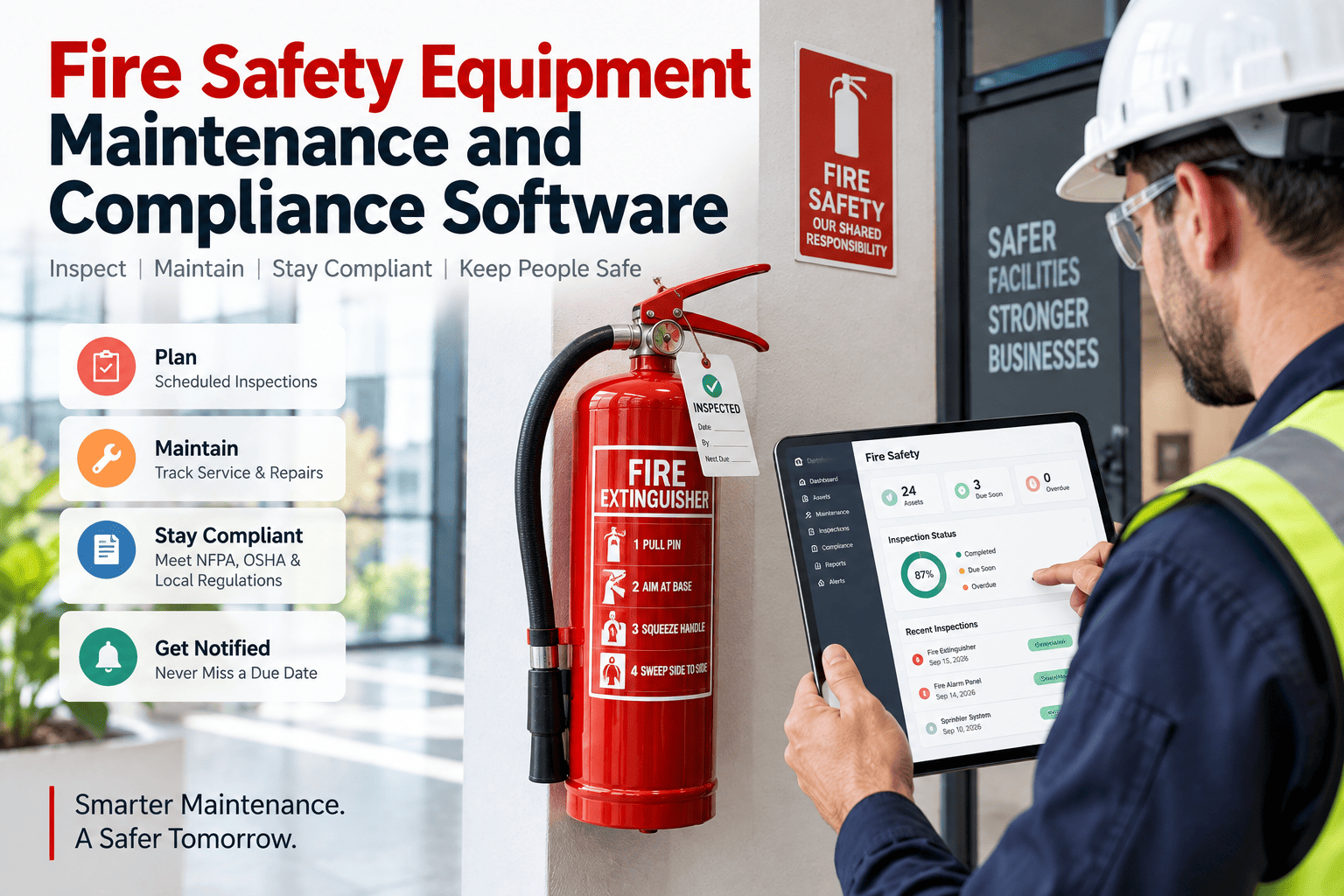
Fire safety is the one maintenance programme where a missed task is not merely an expense — it is a breach of law, an invalidated insurance policy, and a genuine risk to the people inside the building. A responsible person can be fined without limit or imprisoned where failures are serious, and enforcement officers rarely accept good intentions in place of dated, signed evidence. Most organisations do not fail because they neglect fire safety; they fail because the proof lives in three ring binders, two spreadsheets and a contractor's inbox, and nobody can assemble it on the day it is demanded. OxMaint maintenance management software turns every extinguisher, detector, damper and fire door into a tracked asset with a schedule, an owner and a permanent audit trail. Start a free OxMaint trial or book a 30-minute demo to see your compliance position on one screen.
Fire Safety Equipment Maintenance and Compliance Software
Schedule every statutory fire alarm, extinguisher, emergency light, sprinkler and fire door check against a named asset, capture the evidence on a phone at the point of work, and produce an inspection-ready record in seconds instead of days.
What the Responsible Person Is Actually Signing Up To
Fire safety duties in the UK do not sit with a contractor, a landlord or an insurer. They sit with the responsible person — usually the employer, occupier or owner — and they are personal, continuing and non-transferable. You can outsource the work; you cannot outsource the duty. That distinction matters enormously when an enforcement officer arrives, because the question is never "did you pay someone to do this?" but "can you demonstrate that it was done, by a competent person, at the right interval, and that every defect found was put right?" Four pieces of legislation set the shape of that obligation, and each one adds a different documentary burden on top of the last. Understanding them is the difference between a compliance programme that survives scrutiny and one that merely looks busy.
Sitting underneath the legislation are the British Standards that define what "competent maintenance" looks like in practice — BS 5839 for fire detection and alarm systems, BS 5306 for portable extinguishers and hose reels, BS 5266 for emergency lighting, BS 9999 and BS 9991 for design and management, and BS 8214 and the associated guidance for timber fire door sets. An enforcement officer will not usually quote a clause number at you. They will ask to see the service record and judge whether it reflects the standard.
Every Fire Asset, Every Interval, One Register
The single most common cause of a compliance gap is not negligence but frequency drift: an annual service performed at fourteen months, a monthly test that quietly becomes bi-monthly over a summer of holiday cover, a five-year extended service that nobody diarised because the person who commissioned the system left in year two. Frequencies vary by asset family and by building type, and no human memory holds them all. The table below shows the pattern most UK commercial and residential buildings follow. OxMaint stores the interval against each individual asset, so a detector installed in March generates its own due date rather than inheriting a building-wide guess.
| Asset family | Routine check | Formal service | Extended interval | Typical evidence required |
|---|---|---|---|---|
| Fire detection and alarm | Weekly call point test, rotating zones | Quarterly or six-monthly by competent engineer | Annual full system test | Logbook entry, device-level test record, certificate |
| Portable extinguishers | Monthly visual check | Annual basic service | Extended service or overhaul at five or ten years | Tag, service label, defect and replacement history |
| Emergency lighting | Monthly short-duration function test | Annual full-duration discharge test | Battery replacement on manufacturer cycle | Duration result per luminaire, failed-unit list |
| Sprinkler and suppression | Weekly gauge and valve check | Quarterly and annual inspection | Longer-term tank, pump and pipework survey | Pressure readings, pump run data, engineer report |
| Fire doors and door sets | Quarterly common-part checks in taller blocks | Annual flat entrance door checks where applicable | Periodic competent-person survey | Per-door condition record, photo, remedial ticket |
| Dry and wet risers | Six-monthly visual inspection | Annual pressure test | Hose and valve replacement cycle | Test pressure record, outlet-by-outlet results |
| Fire dampers and ductwork | Visual accessibility check | Annual drop test, more often in some settings | Actuator replacement on condition | Damper reference, pass or fail, access notes |
| Firefighting lifts and equipment | Monthly operational check | Service to manufacturer schedule | Statutory examination where applicable | Monthly check log, fault report, reporting evidence |
Frequencies are indicative and vary with building type, occupancy, risk assessment findings, insurer requirements and manufacturer instruction. The value of a system is not that it decides your intervals for you — it is that once your risk assessment and standards have decided them, nothing silently drifts.
OxMaint holds every fire asset, its schedule, its service history, its defects and its remedial closure in one place. Filter by site, by asset family or by date range and export the pack. No chasing contractors for certificates, no reconciling a paper logbook against an email trail, no discovering on the day that a quarter is missing.
Where Paper-Based Fire Compliance Quietly Breaks
Almost every organisation that gets into difficulty over fire safety had a system. It was simply a system that depended on individual diligence rather than structure, and it degraded slowly enough that nobody noticed until it was tested. These are the four failure modes that appear again and again in enforcement notices and insurance disputes, and each has a structural fix rather than a motivational one.
The OxMaint Fire Compliance Cycle
The system is deliberately simple, because a compliance workflow that requires training to operate will be bypassed by the person holding a torch at seven in the morning. Five stages carry a fire asset from registration through to permanent evidence, and the loop repeats itself without anyone needing to remember it.
What Changes Once Fire Safety Runs on a System
The obvious benefit is avoiding enforcement. The benefits that facilities teams actually talk about after a year are quieter and more practical — less administrative time, fewer arguments with contractors, and a much calmer relationship with insurers and auditors.
Frequently Asked Questions
Does OxMaint replace our fire risk assessment?
Can external contractors record work directly in the system?
How does it handle multiple sites with different fire systems?
What happens when an inspection finds a fault?
How long does implementation take?
Fire Safety Evidence Should Be a Byproduct of the Work, Not a Separate Job
OxMaint gives UK responsible persons a live asset register, per-asset statutory scheduling, mobile evidence capture, automatic defect escalation and one-click compliance reporting across every site in the portfolio. Replace the binders, close the remedial gap, and know your position on any building at any moment.







