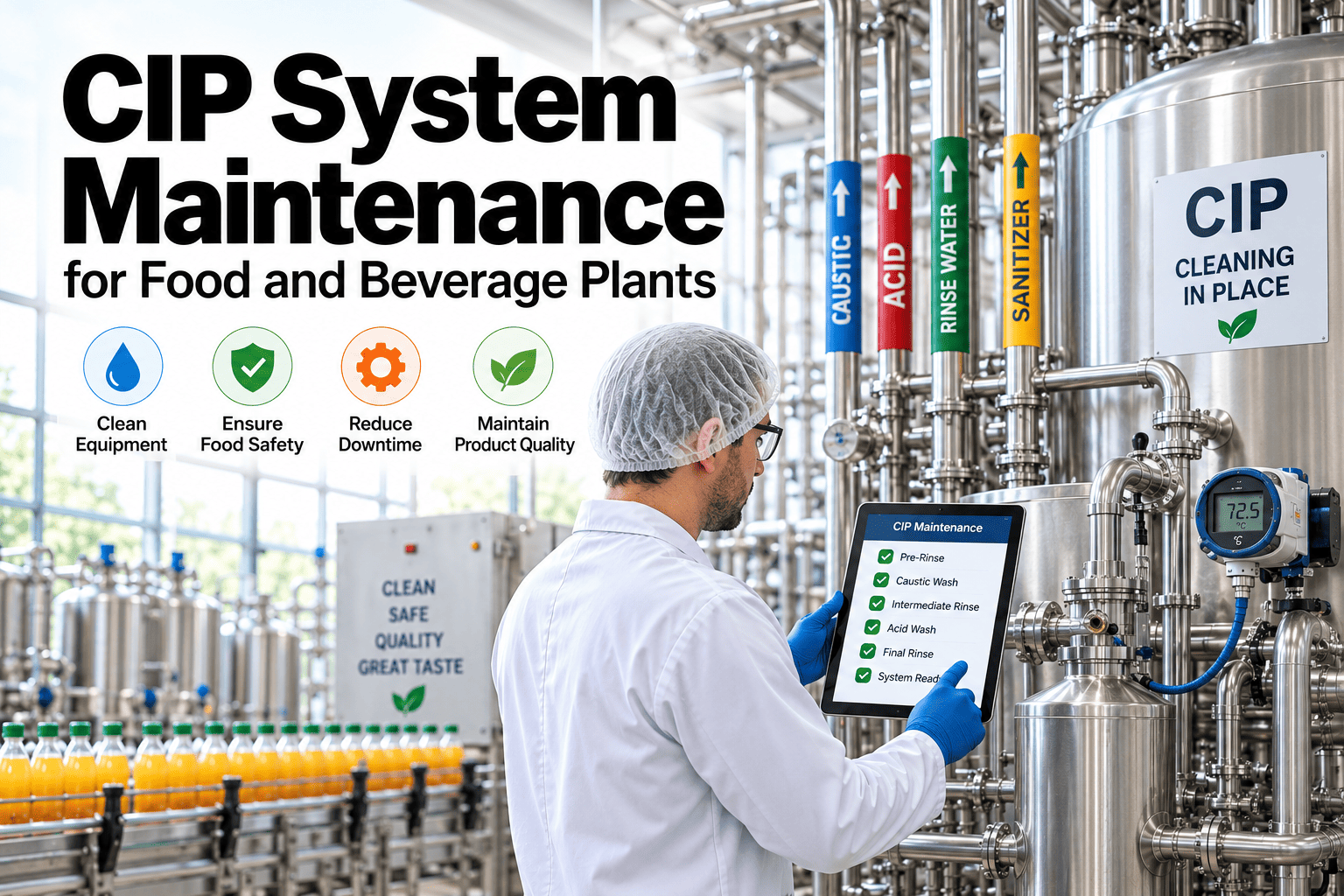
A clean-in-place system is the only piece of plant equipment that can fail completely while appearing to work perfectly. The pumps run, the cycle completes, the panel shows green — and the circuit was never actually cleaned because a spray ball was blocked, a valve seated wrong or the return flow dropped below turbulent. By the time a swab result or a customer complaint reveals it, you are holding product of unknown status. Keeping CIP validated means maintaining the hardware that delivers the clean, not just running the cycle. Start a free trial and see how a maintained CIP set looks in practice.
The four cleaning variables, and the equipment behind each one
Every CIP recipe in a food or beverage plant is built on the same four variables. Reduce any one of them and the others have to compensate, which is why a cleaning failure almost never announces itself as a cleaning failure. It presents as a pump that is a little tired, a valve that is a little slow, a probe that is a little out of calibration. Maintenance owns all four.
Time
Cycle and contact duration
Delivered by the controller, the sequence timers and the valve actuation that holds each phase open. Sticking actuators and slow air supply shorten real contact time even when the recipe on screen is unchanged.
Action
Flow velocity and coverage
Delivered by the supply and return pumps, line sizing, and spray balls or rotary jet heads. Blocked spray holes and worn impellers quietly drop coverage while the cycle still reports complete.
Concentration
Caustic and acid strength
Delivered by dosing pumps, conductivity probes and chemical line integrity. A drifting conductivity probe is one of the most common causes of both under-cleaning and needless chemical overspend.
Temperature
Solution temperature at the circuit
Delivered by the heat exchanger, steam control valve and temperature probes. Fouled plates mean the tank hits setpoint while the far end of the circuit never does.
This is the useful reframe for a maintenance team: you are not maintaining a CIP skid, you are maintaining four cleaning variables. Once the asset list is organised that way, it becomes obvious which components are critical to food safety and which are simply critical to uptime.
Where CIP circuits actually fail validation
Post-CIP failures usually trace back to a short list of causes, and most of them are maintenance-preventable rather than procedural. The pattern worth noticing is that nearly every one produces a cycle that still completes normally, which is exactly why they go undetected without a maintenance and instrument record behind the process data.
| Failure point | What goes wrong | How it shows up | Preventive control |
|---|---|---|---|
| Spray balls and jet heads | Partial blockage or wear widening the holes | Shadowed zones in the vessel, residue at the top head | Scheduled removal, inspection and coverage test |
| Return pump | Impeller wear or cavitation reducing return flow | Flow falls below turbulent, circuit never scours | Flow trending and scheduled pump overhaul |
| Mix-proof and changeover valves | Worn seals allowing cross-leakage between circuits | Solution diluted or product path contaminated | Seal kit replacement on hours or cycle count |
| Conductivity probes | Calibration drift or fouled sensor face | Chemical strength wrong in both directions | Documented calibration at a fixed interval |
| Heat exchanger | Plate fouling reducing heat transfer | Tank at setpoint, circuit return well below it | Differential temperature trending and plate cleaning |
| Air-operated actuators | Slow or incomplete stroke, leaking air supply | Phase timing drifts, dead legs left unflushed | Stroke timing checks and air system maintenance |
| Dead legs and hoses | Manual connections left unswept by the circuit | Biofilm site that no cycle reaches | Circuit mapping and manual strip-down schedule |
The maintenance record an auditor will ask for
Under BRCGS, SQF, FSSC 22000 or a customer's own audit scheme, cleaning validation is only as strong as the evidence that the cleaning equipment was fit to deliver it. The awkward questions are rarely about the CIP recipe. They are about whether the probe reading on the batch record was trustworthy, and whether you can prove it.
Calibration evidence
Certificates and due dates for every temperature probe, conductivity probe and flow meter used to verify a cleaning cycle, with a clear trail showing the instrument was in calibration when the cycle ran.
Preventive maintenance completion
Dated, signed records showing seal changes, spray device inspections, pump servicing and heat exchanger cleaning were completed to schedule, with the technician and parts used recorded.
Deviation and corrective action
Any cycle that failed a parameter, what was found, what was repaired, and what product was held or released as a result — linked to the work order that closed it out.
Change control
A record of when a pump, spray device or probe was replaced with a different specification, and what revalidation was carried out before the circuit returned to routine production.
Circuit definition
An accurate map of what each CIP circuit covers, including hoses and manual connections, kept current as the plant changes rather than as a drawing from the original installation.
Training and competence
Evidence that the technicians completing CIP-critical tasks are trained for them, particularly seal replacement and probe calibration, where the work directly affects food safety.
Plants that keep these six things in a shared drive spend audit week reconstructing them. Plants that keep them attached to the asset in a maintenance system print them in minutes, which is usually the single most visible return from digitising CIP maintenance.
See your CIP skid, circuits and calibration schedule in one place
Book a 30-minute session and we will build a live example from your own layout — the skid and its components, each circuit it serves, the calibration register behind the verification instruments, and the deviation trail that ties it all back to a batch.
A practical CIP maintenance cadence
CIP maintenance intervals are usually set once at commissioning and then left alone, which is why they rarely match how the plant actually runs. Intervals driven by cycle count and product type hold up far better than calendar intervals alone, particularly on skids that serve both high-fat and low-residue circuits.
| Interval | Task | Why it matters to the clean |
|---|---|---|
| Each shift | Chemical tank levels, visible leaks, air pressure, alarm review | Catches the faults that stop a cycle delivering before the next batch runs |
| Weekly | Strainer clean, hose and gasket visual, actuator stroke check | Protects flow rate and phase timing, the two easiest variables to lose |
| Monthly | Conductivity and temperature probe verification, dosing pump output check | Keeps chemical concentration and temperature readings trustworthy |
| Quarterly | Spray ball removal and coverage inspection, pump performance check | Confirms mechanical action is still reaching every surface of the vessel |
| Biannual | Mix-proof valve seal kits, heat exchanger plate inspection | Prevents cross-contamination and recovers lost heat transfer |
| Annual | Full instrument calibration, circuit revalidation, dead leg survey | Refreshes the evidence base the whole validation depends on |
The cadence itself is unremarkable. What changes outcomes is whether each of those lines produces a dated, signed record against the right asset, or whether it produces a tick on a sheet that nobody can find nine months later when it matters.
It is also worth separating tasks that protect food safety from tasks that protect uptime, because they justify themselves differently. A strainer clean protects throughput and can slip a week without consequence. A conductivity probe verification protects the validity of every cleaning record produced since the last check, and slipping it a week means a week of cycles whose chemical strength you cannot fully evidence. Flagging the food-safety-critical subset explicitly, so those tasks escalate when overdue rather than sitting in the same queue as everything else, is one of the smallest changes a plant can make with a disproportionate effect on audit outcomes.
The same logic applies to spares. A pump seal that fails on a non-critical transfer line is an inconvenience, while the equivalent seal on a mix-proof valve separating a cleaning circuit from a product line is a food safety control. Holding the second as a stocked item with a defined material specification, rather than ordering it when it fails, is the difference between a two-hour repair and a production decision nobody wants to make on a Friday afternoon.
How OxMaint supports CIP-critical maintenance
OxMaint is maintenance management software built for plants where equipment condition and food safety are the same conversation. For CIP specifically, it links the hardware, the schedule and the evidence so that cleaning performance stops depending on individual memory.
Circuit-aware asset structure
The skid, its pumps, valves, spray devices and instruments are held as individual assets, each linked to the circuits and vessels they serve, so a failure is instantly traceable to the product lines it affects.
Traceability from component to batch
Calibration register with due alerts
Every verification instrument carries its interval, certificate and next due date, with alerts before expiry rather than a discovery during an audit that a probe has been overdue for two months.
No out-of-calibration surprises
Cycle-count and usage triggers
Seal kits, spray device inspections and pump servicing can be scheduled on cycles run or hours accumulated instead of a fixed calendar date, matching the schedule to real duty.
Intervals that match actual use
Deviation to work order
A failed cleaning parameter raises a work order against the responsible component with the deviation attached, and the investigation, repair and sign-off stay connected to that record permanently.
Corrective actions that close properly
Audit-ready history export
Completion records, parts, technicians, photos and signatures are retrievable by asset and date range, so audit preparation becomes a filter rather than a week of document hunting.
Audit evidence in minutes
Hygienic spares control
Seals, gaskets, diaphragms and spray devices are held against the equipment they fit, with material specification recorded so the correct food-grade part is fitted every time.
Right part, right specification
Signals that CIP maintenance has drifted
CIP problems build slowly, and the plant usually adapts around them before anyone raises them formally. These are the signals that the cleaning system is being propped up by workarounds rather than maintained.
Cycle times have crept upward
Operators extending a rinse or a caustic phase because the circuit does not look right at the shorter setting is compensation for a mechanical problem, usually flow or temperature.
Chemical use is rising with flat production
More caustic for the same output points at dosing accuracy, conductivity drift or solution being lost through leaking seals rather than at a change in soil load.
Swab results are increasingly variable
Occasional out-of-specification results in a circuit that used to be consistent usually indicate coverage loss at a spray device or a dead leg that has appeared through a plant modification.
Calibration dates are being chased
If somebody has to go and find out whether a probe is in date, the register is not doing its job, and the validation resting on that probe is weaker than the paperwork suggests.
CIP system maintenance questions, answered
What is CIP system maintenance?
It is the scheduled upkeep and calibration of the hardware that delivers a clean — pumps, valves, spray devices, heat exchangers and instruments. Without it, a cycle can complete while cleaning nothing. Start a free trial to see it scheduled properly.
How often should spray balls be inspected?
Quarterly removal and inspection suits most food and beverage plants, moving to monthly on high-fat or high-solids circuits. Coverage testing at installation gives you the baseline to judge wear against.
Does maintenance software help with BRCGS or FSSC audits?
Yes. It holds calibration certificates, PM completion records, deviations and corrective actions against each asset, so cleaning evidence is retrievable by date and equipment. Book a demo to see an audit export.
Should CIP tasks run on calendar or cycle count?
Both. Calibration and statutory items suit calendar intervals, while seals, spray devices and pumps wear with use and are better scheduled on cycles run or hours accumulated on that skid.
How quickly can a CIP asset structure be set up?
Most plants have the skid, circuits, instruments and PM schedule configured within two to three weeks, with the calibration register usually the first piece to deliver visible value.
Make the clean provable, not assumed
Put every CIP pump, valve, spray device and probe on a schedule, keep the calibration and completion evidence attached to the asset, and walk into your next audit with the records already assembled.
Free 14-day trial. No credit card required.