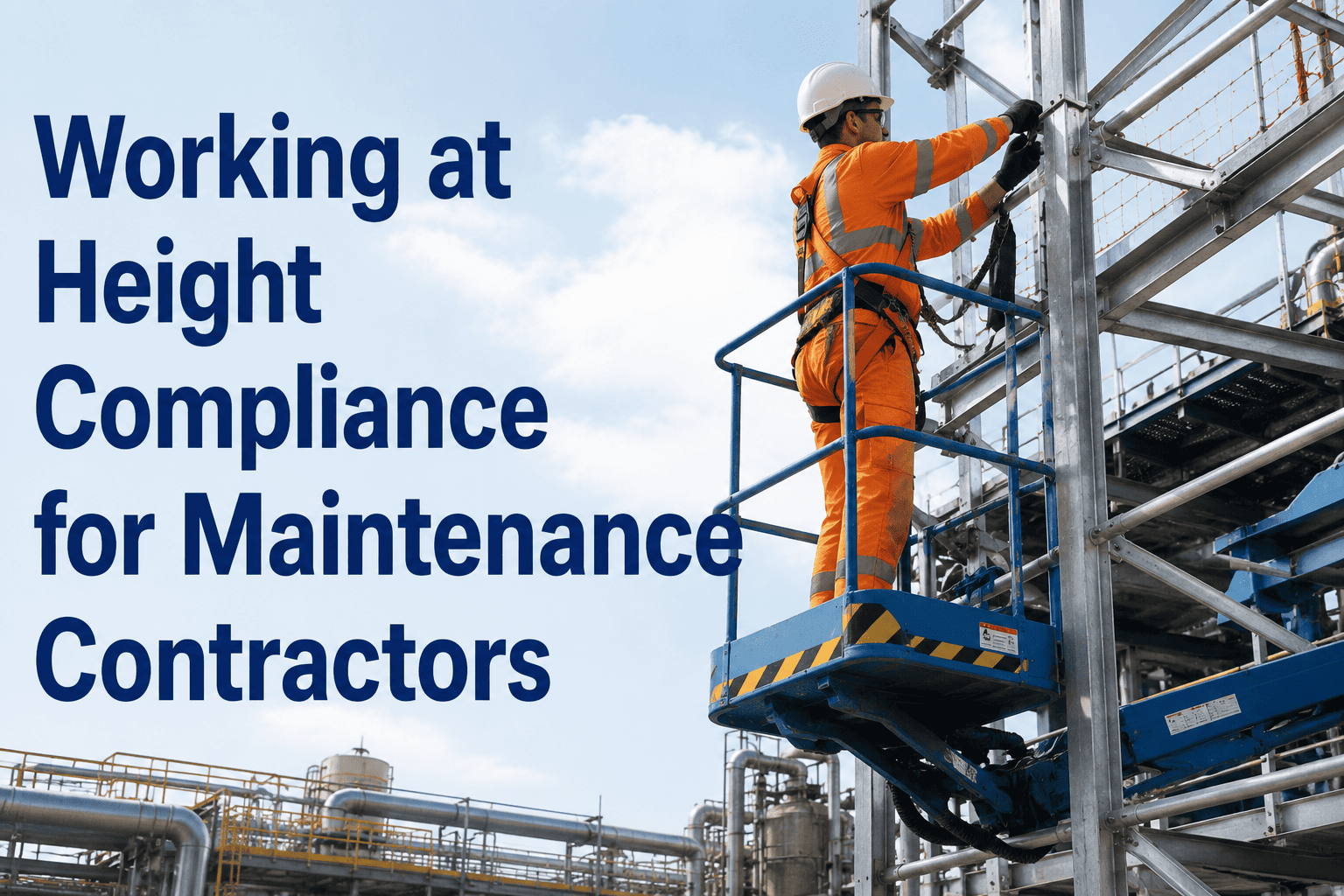
Thirty-five workers died from falls from height in Great Britain last year. That is 28% of every workplace fatality recorded — making falls from height the single biggest killer on UK job sites, ahead of vehicles, machinery, and everything else combined into second place. For maintenance contractors sending crews onto roofs, into MEWPs, and up ladders every single day, the Work at Height Regulations 2005 are not paperwork to file away. They are the difference between a routine job and a fatality investigation. A CMMS like OxMaint turns RAMS, contractor competency records, rescue plans, and harness inspection evidence into a single digital trail that stands up when HSE comes asking.
Stop Managing Height Safety on Spreadsheets and Paper Permits
Contractor RAMS, harness inspection logs, rescue plans, and permit-to-work records — all in one CMMS built for maintenance teams working at height.
Why Working at Height Still Kills Maintenance Engineers
The Work at Height Regulations 2005 have not changed since they were written — but how HSE enforces them in 2026 has. Inspectors no longer accept "we installed guardrails years ago" as proof of compliance. They want to see current risk assessments, dated inspection records, and proof that the contractor on your roof today is actually competent to be there. Missing documentation is now treated as non-compliance on its own, even when the physical equipment looks fine.
There is no minimum height threshold in the law. A five-minute job on a one-metre stepladder carries the same legal duties as a week-long job on a six-metre roof. Duration does not lower the risk, and "it was only a quick job" has never been an accepted defence in an HSE prosecution.
The Hierarchy of Control: What the Law Actually Requires
Avoid
Eliminate the climb entirely. Inspect from the ground. Use extendable tools or drones for roof checks before assuming a person needs to go up.
Prevent
Where height cannot be avoided, use guardrails, edge protection, or a MEWP — collective measures that protect everyone, not just one harnessed engineer.
Minimise
If a fall still cannot be ruled out, fall-arrest systems, nets, or airbags must reduce the consequences — backed by a rescue plan, not just a harness.
Skipping straight to "give the engineer a harness" without first ruling out steps one and two is a compliance failure on its own — even if nobody gets hurt. HSE inspectors are trained to check the order, not just the outcome. Book a demo to see how OxMaint builds this hierarchy directly into your permit-to-work approval flow.
Contractor Selection: Where Most Liability Actually Sits
If you bring in a roofing crew, a window cleaning contractor, or a HVAC engineer who needs roof access, you remain a duty holder under the Regulations. You cannot hand the legal responsibility to the contractor's invoice. The law requires you to prove the contractor you appointed was competent before they ever climbed a ladder on your site.
RAMS on File
A task-specific Risk Assessment and Method Statement for the actual job, not a generic template reused for every site visit.
Training Evidence
IPAF cards for MEWP operators, harness training certificates, and proof that induction-level instruction has not gone stale.
Equipment Records
Current LOLER thorough examination certificates for any MEWP, and a logged harness inspection history for every operative attending.
Permit Sign-Off
A permit-to-work that names the supervisor, the rescue plan, and the weather conditions under which work must stop.
Equipment Inspection Cycles Your Records Must Prove
| Equipment | Inspection Type | Minimum Frequency | Who Carries It Out |
|---|---|---|---|
| MEWP / Cherry Picker | LOLER Thorough Examination | Every 6 months | Competent person (IPAF CAP) |
| MEWP / Cherry Picker | Pre-use daily check | Before every shift | Trained operator |
| Safety Harness & Lanyard | Detailed recorded inspection | Every 6–12 months (BS EN 365) | PFPE-trained inspector |
| Safety Harness & Lanyard | Pre-use visual check | Before every use | The wearer |
| Lifting Accessories (slings, anchors) | LOLER Thorough Examination | Every 6 months | Competent person |
| Ladders | Detailed visual inspection | Every 3–6 months | Trained user |
A LOLER certificate proves the equipment was safe six months ago. It does not prove the engineer checked the hydraulics this morning. HSE inspectors increasingly ask for both layers of evidence — the periodic thorough examination and the daily pre-use log — because gaps between the two are exactly where accidents happen. Sign up free to start logging both inspection layers against every asset automatically.
Rescue Plans: The Step Most Sites Skip
A Plan Before the Climb
Wherever a fall-arrest system is deployed, a rescue plan must exist before the operative goes up — not be improvised after someone is hanging from a lanyard.
Suspension Trauma Awareness
A worker suspended in a harness after a fall can lose consciousness within minutes. Rescue must be achievable in that window, not after the fire service arrives.
Named, Trained Rescuers
The plan must name who performs the rescue, with what equipment, and confirm they have practised the procedure — not just read about it in an induction pack.
The Real Cost of Getting This Wrong
How OxMaint Builds Working at Height Compliance Into Daily Work
Digital Permit-to-Work
Generate a height-work permit that forces sign-off on the hierarchy of control, named supervisor, and rescue plan before the job can be started.
Contractor Compliance Vault
Store RAMS, IPAF cards, harness training certificates, and insurance documents per contractor, with automatic expiry alerts.
LOLER & Harness Inspection Tracking
Schedule six-month thorough examinations and daily pre-use checks against every MEWP, harness, and lanyard in your fleet.
Audit-Ready Evidence Trail
Every risk assessment, permit, and inspection is timestamped and exportable — the exact documentation HSE inspectors now expect on request.
Give Every Working-at-Height Job a Compliant Digital Trail
Permits, contractor RAMS, rescue plans, and harness inspection logs — built for maintenance teams who cannot afford a missing record.
Frequently Asked Questions
Does the Work at Height Regulations 2005 apply to short, quick jobs?
Yes. There is no minimum height and no minimum duration. A five-minute task on a stepladder carries the same legal duties as a multi-day roof project if a fall could cause injury.
Who is legally responsible when a contractor works at height on our site?
You remain a duty holder as the building owner or facilities manager. Appointing a contractor does not transfer your duty to ensure the work is properly planned and the contractor is competent.
How often does a MEWP need a LOLER thorough examination?
At least every six months for any MEWP used to lift people, carried out by a competent person such as an IPAF CAP-certified engineer, in addition to daily pre-use checks by the operator.
Is a rescue plan a legal requirement?
Yes. Wherever a fall-arrest system is used, a rescue plan must be in place before work begins, naming who will perform the rescue and confirming they are trained to do so.
What does HSE look for during a 2026 inspection?
Current risk assessments matching actual site conditions, dated inspection records for fall protection equipment, training evidence for operatives, and a rescue plan wherever fall-arrest systems are deployed.