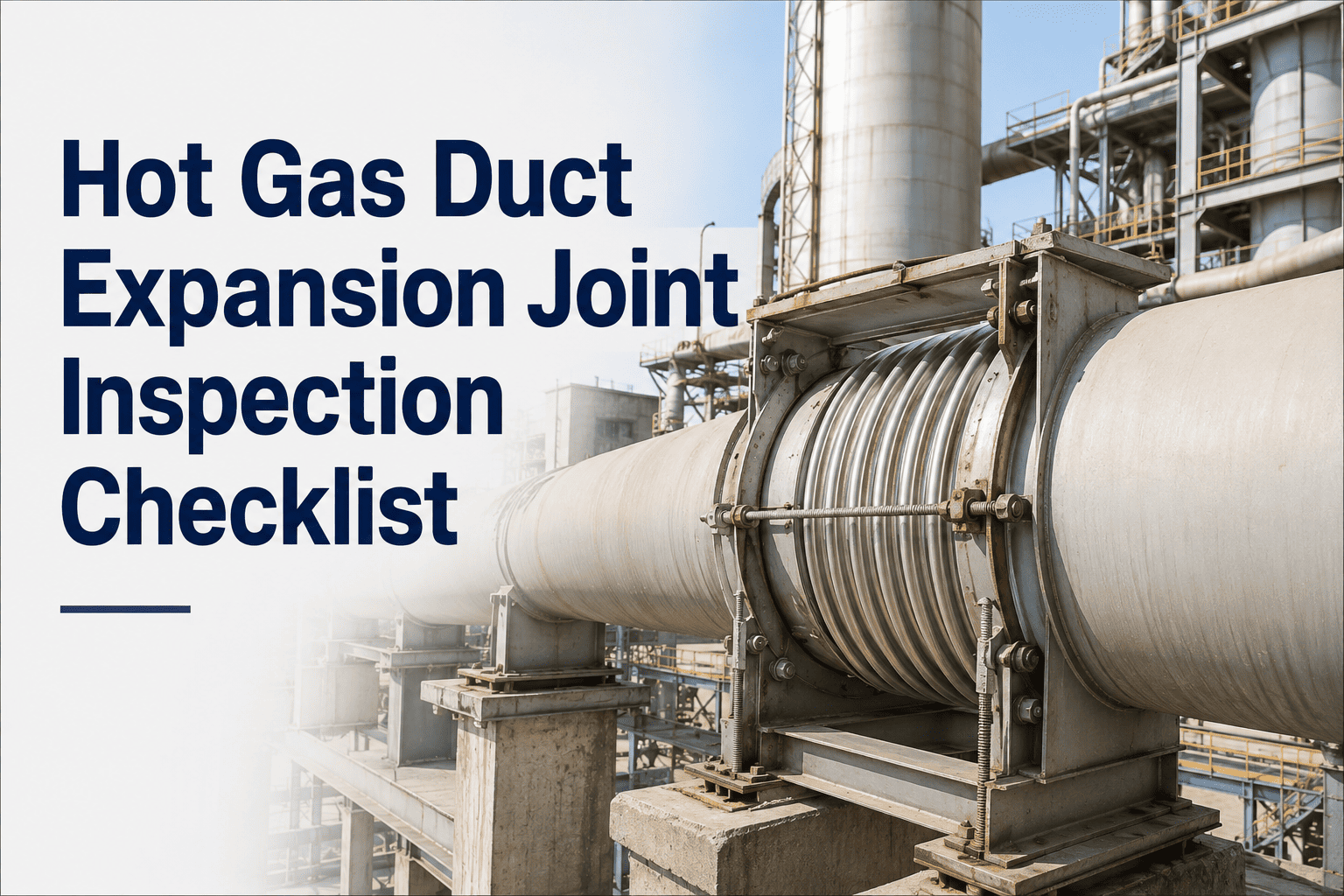
An expansion joint's whole job is to move, which is exactly why it wears differently from almost everything else in a hot gas duct. Thermal cycling flexes the fabric thousands of times a year, particulate loading abrades it from the inside, and by the time a leak is visible from the outside, the joint has usually been degrading quietly for months. Sign up to track fabric condition, anchor checks, and gap measurements against every duct expansion joint in your plant.
Why It Matters
A failed expansion joint doesn't stay a local problem. Pressure and heat redistribute through the surrounding ductwork the moment a joint gives way, straining fans, casings, and supports that were never sized for that load, which turns a single joint failure into a much bigger repair scope.
What Every Expansion Joint Round Should Cover
Fabric Condition
Checked for gouges, cracks, or thinning that expose the carcass beneath the cover
Anchors & Guides
Confirmed free of warping, flexing, or loosening that restricts intended movement
Movement Gap
Joint width measured against rated movement to confirm the duct is expanding as designed
Insulation & Backup
Pillows, cuffs, and backup bars checked for fit and coverage against particulate and heat
Leak & Hot Spot
External casing scanned for heat bleed or dust staining around the joint perimeter
Bolt Tightness
Flange bolts rechecked periodically, rubber and fabric relax after repeated hot-cold cycles
The Inspection Round, Step By Step
Walk the joint perimeter and look for surface damage: gouges, cracks, or scorch marks on the fabric cover are the earliest visible sign something needs attention
Measure the actual gap against rated movement: a joint sitting fully compressed or fully elongated outside its design range is being overworked and heading toward premature failure
Check anchors and guides for binding: a joint that can't move freely in its intended direction transfers stress into the fabric instead of the frame it was designed to move against
Scan the external casing for heat bleed and dust staining: both point to a leak developing at the seal interface before it's visible from inside the duct
Recheck flange bolt tightness: rubber and fabric relax over repeated thermal cycles, a bolt torqued correctly at install can be loose months later
Catch Fabric Wear Before It Becomes A Shutdown
Oxmaint logs fabric condition, gap measurements, and anchor checks for every duct expansion joint in your plant, and flags a joint the moment its inspection history shows a developing pattern. Sign up for a free trial to run it on your own duct data, or book a demo to see it configured for your plant.
Why These Joints Wear Unlike The Duct Around Them
A fabric expansion joint is deliberately the most flexible part of the duct, absorbing thermal growth and vibration so the rigid sections around it don't have to. That flexibility is also what wears it out faster than the steel it's connected to, every hot-cold cycle flexes the fabric, and cement dust is abrasive enough to work its way into that flex point over time. A joint sized correctly for its rated movement and inspected on a fixed schedule can run for years, but one pushed past its design range or left unchecked degrades quietly until a leak or a tear forces an unplanned repair.
Sign, Likely Cause & Action
| Sign |
Likely Cause |
Action |
| Small gouge or crack in cover |
Abrasion from dust loading or accidental contact |
Seal promptly to prevent moisture or gas penetrating the carcass |
| Joint fully compressed or stretched |
Movement exceeding rated design range |
Reassess duct alignment and movement calculations before next relining |
| Heat bleed on outer casing |
Insulation gap or seal degradation at the joint interface |
Verify insulation pillow fit, inspect seal for wear |
| Loose flange bolts |
Fabric relaxation after repeated thermal cycling |
Retorque to spec and add to the periodic recheck schedule |
The Takeaway
Expansion joints fail from the inside out and from the outside in at the same time, thermal cycling working the fabric while dust abrades it. A fixed inspection routine that checks fabric, gap, and anchors together catches the pattern early enough to plan a repair instead of reacting to a failure.
Frequently Asked Questions
Q
How often should hot gas duct expansion joints be inspected?
A visual walk during normal operation is a good baseline routine, with a closer inspection at every planned shutdown when the duct can be accessed safely. Bolt tightness specifically should be rechecked periodically after installation, since rubber and fabric relax over the first weeks of hot-cold cycling.
Q
Is some leakage through a fabric expansion joint normal?
Fabric expansion joints are inherently somewhat gas-permeable by design, so minor leakage isn't automatically a failure. The distinction is between the low-level permeability the joint was engineered for and a growing leak from a specific tear, gap, or seal failure that needs attention.
Q
What happens if an expansion joint fails without warning?
Pressure and heat redistribute into the surrounding ductwork immediately, straining fans, casings, and supports that weren't designed to carry that load. Extended downtime while the joint is replaced also creates ongoing thermal and structural stress on nearby equipment, which is why a scheduled inspection is far cheaper than an unplanned failure.
Keep Every Duct Joint On A Verified Inspection Trail
Oxmaint tracks fabric condition, anchor checks, and movement gap readings for every hot gas duct expansion joint, so wear gets caught on a routine inspection instead of an unplanned outage. Sign up for a free trial to run it on your own duct data, or book a demo to see it configured for your plant.