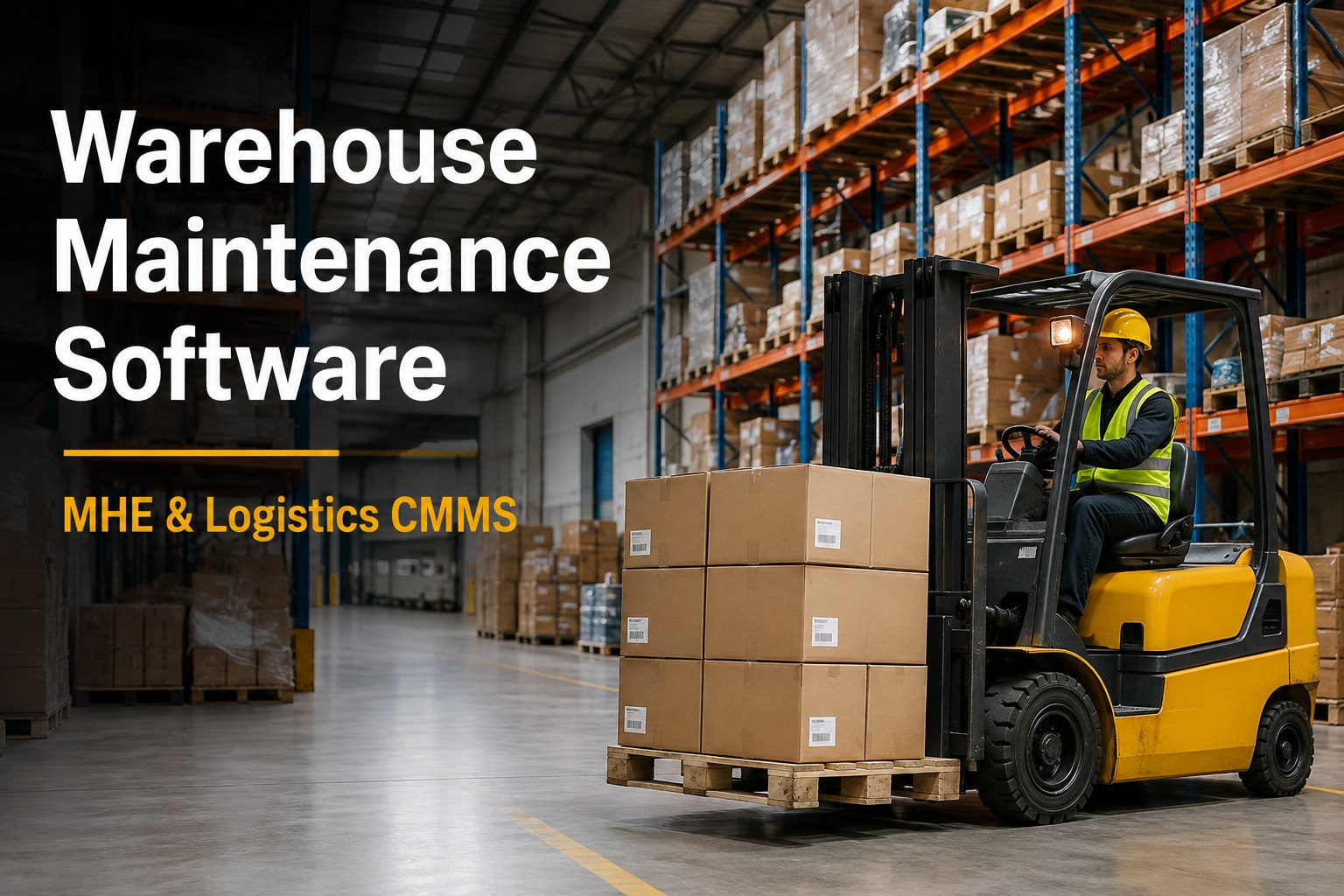
A UK distribution centre is a continuous flow machine. Goods land at inbound dock, move through put-away, sit in racking, get picked, get consolidated, get loaded and leave outbound — often within four hours. Anywhere along that path, an unserviced forklift, damaged racking upright, dock leveller stuck at half height or slipping conveyor belt turns the flow into a queue. DCs that hit SLAs run structured PPM across MHE, conveyors, racking, dock equipment and building services on one platform. Book a demo to see DC maintenance workflows in action.
◆ WAREHOUSE · MHE · SEMA · DOCK · PEAK-SEASON READINESS
A DC is a flow machine. Every asset in that flow either keeps goods moving or stops them cold — and the SLA doesn't care which asset failed.
Every forklift, every conveyor metre, every racking upright, every dock leveller, every fan — under one flow-critical maintenance platform.
GOODS FLOW · DOCK-IN TO DOCK-OUT · WHERE EACH ZONE STRESSES DIFFERENTLY
▼
INBOUND
Dock levellers · Vehicle restraints · Trailer skirts
◆
PUT-AWAY
Reach trucks · VNA trucks · Conveyors · WMS scanners
■
STORAGE
Racking · Sprinklers · Lighting · Roof · Cold zones
◆
PICK & PACK
PPTs · Order pickers · Sorters · Scanners · Voice
▲
OUTBOUND
Dock levellers · Loading arms · Yard mgmt · Barriers
4hr
Typical dock-in to dock-out time · Every hour matters
99%
SLA target for MHE availability during peak season
12mo
SEMA statutory racking inspection interval
MHE Fleet — Every Truck, Every Cycle, Every Battery
Material handling equipment is the moving-parts heart of a DC — and typically also the biggest single maintenance spend line. Different truck classes carry different PPM cycles, different service intervals, and (crucially for electric fleets) different battery lifecycle management. Structured MHE management is what stops the daily "which trucks are actually working today" scramble. Sign up free to run structured MHE cycles across your fleet.
MHE CLASS MATRIX · SERVICE REGIME PER TRUCK TYPE
Class → Application → Cycle
CB TRUCKS
Counterbalance
Dock loading, yard movement · Diesel or electric · 500-hour service intervals · Daily driver check
500 hrs
REACH TRUCKS
Narrow-Aisle Storage
High-density racking · 8-11m lift · Electric · Battery-critical asset · Hydraulic ram cycles
500 hrs + battery
VNA
Very Narrow Aisle
Wire-guided or rail-guided · 11-15m lift · Man-up or man-down · High utilisation asset
250 hrs
PPTs
Powered Pallet Trucks
Ground-level movement · Pick-and-drop · High cycle count · Battery-swap fleets
250 hrs
ORDER PICKERS
Man-Up Picking
Person on platform at height · LOLER-scope thorough exam · Safety-critical asset
6-mo LOLER
AGVs / AMRs
Autonomous Vehicles
Autonomous mobile robots · LiDAR sensors · Charging infrastructure · Firmware update cycles
OEM cycle
Racking Inspection — SEMA and the Damage Classification Ladder
UK racking must be inspected annually to SEMA (Storage Equipment Manufacturers' Association) standard by a competent person, plus weekly visual checks by warehouse staff. The critical discipline is damage classification — Green / Amber / Red — because a Red-tagged upright can bring the racking down under load, and pretending it's Amber to avoid the aisle closure is exactly how catastrophic collapses happen. Book a demo to see SEMA inspection workflow live.
GREEN
Minor Cosmetic · Rack Serviceable
Paint scuffs, minor surface damage, no structural deformation · No load restriction · Photograph and log for trending only
RACK IN USE
AMBER
Non-Critical Damage · Monitor and Repair
Damage above SEMA limits but not immediately dangerous · Repair scheduled within 4 weeks · Damage logged and monitored for progression
REPAIR < 28 DAYS
RED
Immediate Off-Load · Structural Compromise
Damage exceeds SEMA maximum limits · Immediate risk of failure under load · Off-load required before any further use · Repair or replacement mandatory before re-loading
RACK OFF-LOAD IMMEDIATE
ANNUAL
SEMA Approved Inspector Audit
Full statutory annual inspection · Report per aisle · Repair recommendations classified · Certificate held for insurance and SEMA compliance
STATUTORY RECORD
Dock Equipment — Levellers, Restraints and the Cost of a Stuck Bay
Dock equipment is the pinch point where DC flow either works or doesn't. A single stuck dock leveller during peak reduces the DC's inbound receiving capacity by 8-12 percent depending on total bay count. Structured PPM across levellers, dock shelters, vehicle restraints and traffic signals is where SLA discipline actually lives. Sign up free to bring dock equipment into structured PPM.
DOCK LEVELLERS
Hydraulic dock levellers with lip mechanism · Weekly visual check · 6-monthly service · Annual LOLER thorough examination · Structural weld inspection
£2-4k · Stuck bay = 8-12% inbound capacity loss
VEHICLE RESTRAINTS
Automatic vehicle restraints preventing trailer creep · Safety-critical for driver safety · Interlock with dock leveller · Monthly function check · Annual full service
Trailer creep incident potential = £250k+ HSE exposure
DOCK SHELTERS
Inflatable or foam dock shelters sealing vehicle to building · Weather integrity · Energy loss prevention · Weekly visual · Annual service
£800-2k · Energy cost impact if failed
DOOR MOTORS & SIGNALS
High-speed insulated doors · Motor control panels · Traffic light interlocks · Barriers · Vehicle detection systems
£500-3k · Slow doors kill flow rate
◆ WAREHOUSE & LOGISTICS DEMO
See the Full DC Workflow in 30 Minutes
Zone-based asset hierarchies, MHE fleet management with battery cycles, SEMA racking inspection workflow with Green/Amber/Red classification, dock equipment PPM, mobile inspection app and peak-season readiness reporting.
Peak Season Readiness — The 6-Month Countdown That Matters
Peak (typically September through January for retail DCs) is when the year's operational reputation gets made or lost. Reaching peak with fully-serviced MHE, current SEMA certificates, working dock equipment and stable conveyor uptime doesn't happen by accident — it happens through a 6-month structured pre-peak readiness programme. The gauge below shows the disciplined approach.
-180 DAYS
Deep Service Window
Every MHE unit due deep service · Every conveyor overhauled · Every dock leveller full service · Racking repairs closed
-120 DAYS
SEMA Audit & Repairs
Annual SEMA inspection scheduled · Amber and Red repairs completed · Certificate held before peak recruit-up
-90 DAYS
Battery & Spare Position
Battery bank health verified · Spare MHE units confirmed · Consumable stock levels doubled · Critical spares pre-positioned
-30 DAYS
Final Verification
Every safety-critical asset re-verified · Emergency generator load test · Fire system test · No outstanding open defects on flow-critical kit
DAY ZERO
Peak Live
SLA discipline holds because the preparation ran · Reactive response only to genuine failures · Not surprise firefighting on foreseeable issues
Expert Perspective — Why DC Uptime Rewards Structural PPM
"
Every DC engineering manager knows the difference between the sites that hit their peak SLAs and the ones that don't, and it isn't about equipment quality or headcount. The winners run structural pre-peak readiness programmes starting six months out. They know exactly which MHE units are due deep service in July, which racking bays flagged Amber in the April SEMA inspection, which dock levellers need seal replacement in August, which conveyor sections are due belt renewal in September. The losers arrive at October with a hopeful spreadsheet, discover in week two of peak that three reach trucks are down for want of battery replacements they didn't schedule, one aisle is off-load because a Red-tagged racking upright never got repaired, and two dock bays are stuck because seals failed under increased usage. By week six, the SLA is missed, agency workers are being paid overtime to work around broken kit, and the finance director wants a post-mortem. The pattern is entirely avoidable. Structured PPM on a single platform, six-month rolling visibility, disciplined pre-peak readiness. That's the whole story. Peak either gets planned into or gets survived.
— UK Warehousing & DC Engineering Practice
01
Zone-based asset tree
Inbound / Put-away / Storage / Pick / Outbound zones as one asset hierarchy · Flow-critical assets prioritised.
02
MHE fleet cycles
Hours-based service triggers per truck class · Battery lifecycle · LOLER 6-monthly for man-up trucks.
03
SEMA GAR workflow
Green/Amber/Red racking classification with immediate off-load workflow · Weekly visual + annual SEMA audit.
04
Peak readiness rolling
6-month rolling pre-peak calendar · Deep service, SEMA, spares, batteries all sequenced.
Who Uses Oxmaint for UK Warehouse & DC Maintenance
The platform is used by the UK roles that keep goods moving day-to-day: DC engineering managers running national fulfilment and distribution operations, retail supply chain maintenance directors overseeing multi-site DC portfolios, 3PL engineering teams supporting multiple customer contracts under separate SLAs, e-commerce fulfilment centre engineers managing high-cycle-count MHE and sortation kit, cold-chain DC operators with combined refrigeration and MHE responsibilities, food and beverage distribution managers, automotive parts DCs with high-value inventory, and pharmaceutical wholesalers under MHRA GDP requirements alongside standard warehouse maintenance.
Getting Warehouse Maintenance Live in 45-75 Days
Deployment starts with the zone-based asset hierarchy — inbound, put-away, storage, pick and outbound as the top-level structure with MHE fleets, conveyor systems, racking, dock equipment and building services underneath. MHE fleet import brings in every truck with class, serial number, hours reading and service history. SEMA racking inspection workflow deploys with Green/Amber/Red classification and off-load routing. Dock equipment PPM cycles configure per equipment class with LOLER integration. Mobile inspection app deploys for weekly visual checks. Peak readiness calendar rolls forward with 6-month lead time. Most UK DCs go live within 45-75 days with full flow-critical asset visibility from the first shift. Sign up free to scope your DC deployment.
◆ EVERY TRUCK. EVERY BAY. EVERY UPRIGHT INSPECTED.
One DC. One Platform. Every Peak Ready.
Oxmaint gives UK warehouse operators the complete flow-critical maintenance platform — zone-based asset hierarchies, MHE fleet cycles, SEMA GAR racking workflow, dock equipment PPM, mobile inspection and peak-season readiness discipline built in.
Frequently Asked Questions
What is warehouse maintenance software?
Warehouse maintenance software is a CMMS configured specifically for UK distribution centres and fulfilment operations. It holds each DC as a zone-based asset hierarchy (inbound, put-away, storage, pick, outbound) with flow-critical assets tagged for priority response. It manages material handling equipment (counterbalance trucks, reach trucks, VNA, PPTs, order pickers, AGVs) with hours-based service cycles and battery lifecycle tracking. It runs SEMA racking inspection workflow with Green/Amber/Red damage classification and off-load routing. It manages dock equipment PPM including LOLER cycles for dock levellers. And it structures peak-season readiness through a 6-month rolling calendar that surfaces deep-service due dates, SEMA audit windows, spare positioning and battery-bank health well before peak begins.
How does the SEMA GAR classification workflow work?
The Storage Equipment Manufacturers' Association (SEMA) requires racking damage to be classified against defined tolerance limits by a competent person. Oxmaint structures this as a three-tier workflow. Green: minor cosmetic damage, no structural concern, log for trending only, rack remains in normal use. Amber: damage exceeds SEMA limits but is not immediately dangerous, repair scheduled within 28 days, damage progression monitored on weekly visual checks. Red: damage exceeds SEMA maximum and rack must be off-loaded immediately before any further use — the workflow triggers automatic aisle-closure notification to operations, off-load work order to warehouse team, repair or replacement scheduling, and re-inspection sign-off before reloading. Annual SEMA-approved inspector audit results ingest per aisle. The whole chain is auditable for insurance and any HSE post-incident review.
Does the platform integrate with WMS and BMS?
Yes. Integration with the major warehouse management systems (Manhattan, Blue Yonder, Körber, Infor, SAP EWM) allows maintenance and inspection status to feed into operational planning — flow-critical assets that are VOR or under repair reflect in slot allocation and pick optimisation. Integration with building management systems (Trend, JCI, Siemens Desigo) ingests HVAC, lighting, refrigeration and fire system alarm data with severity classification and auto-work-order generation. Conveyor SCADA integrations from the major suppliers (Vanderlande, Dematic, TGW, KNAPP, Swisslog) feed real-time asset status. The pattern is CMMS-as-central-spine consuming operational data from other systems and generating scheduled work rather than acting as another siloed system.
Can it manage battery lifecycle across an electric MHE fleet?
Yes. For electric MHE fleets (reach trucks, VNA, PPTs, order pickers), battery lifecycle is often the largest single reliability variable. The platform holds each battery as its own asset with cycle count, capacity trend, charging pattern history and expected end-of-life. Battery-swap fleets track handoff between truck and battery so the truck-hours and battery-hours are counted separately. Charging infrastructure (single-point, opportunity, fast-charge) tracks as its own PPM cycle with health monitoring. Fleet managers see battery-bank health as a fleet-level KPI rather than discovering degradation only when performance falls below acceptable levels during peak — turning battery replacement from a reactive scramble into a planned capital cycle synchronised with the pre-peak readiness programme.
How long does deployment typically take for a UK distribution centre?
A single mid-size UK DC (100,000-500,000 sq ft, 60-200 MHE assets, 3-8 conveyor systems, 20-60 dock bays) typically goes live within 45-75 days. The sequence: weeks 1-2 zone-based asset hierarchy configuration and MHE fleet import with class, serial, hours reading, service history and criticality; weeks 2-4 SEMA racking workflow setup with GAR classification and off-load routing; weeks 4-6 dock equipment PPM with LOLER integration, conveyor system asset registration and SCADA data feeds; weeks 6-8 mobile inspection app deployment for weekly visual checks and driver walk-arounds; weeks 8-10 peak-readiness calendar rolling forward with 6-month lead time. Multi-DC operators (national retail chains, 3PL portfolios) typically complete within a quarter with per-site templating. Automated warehouses with heavy conveyor and sortation kit typically extend to 90-120 days for the additional SCADA integration scope.