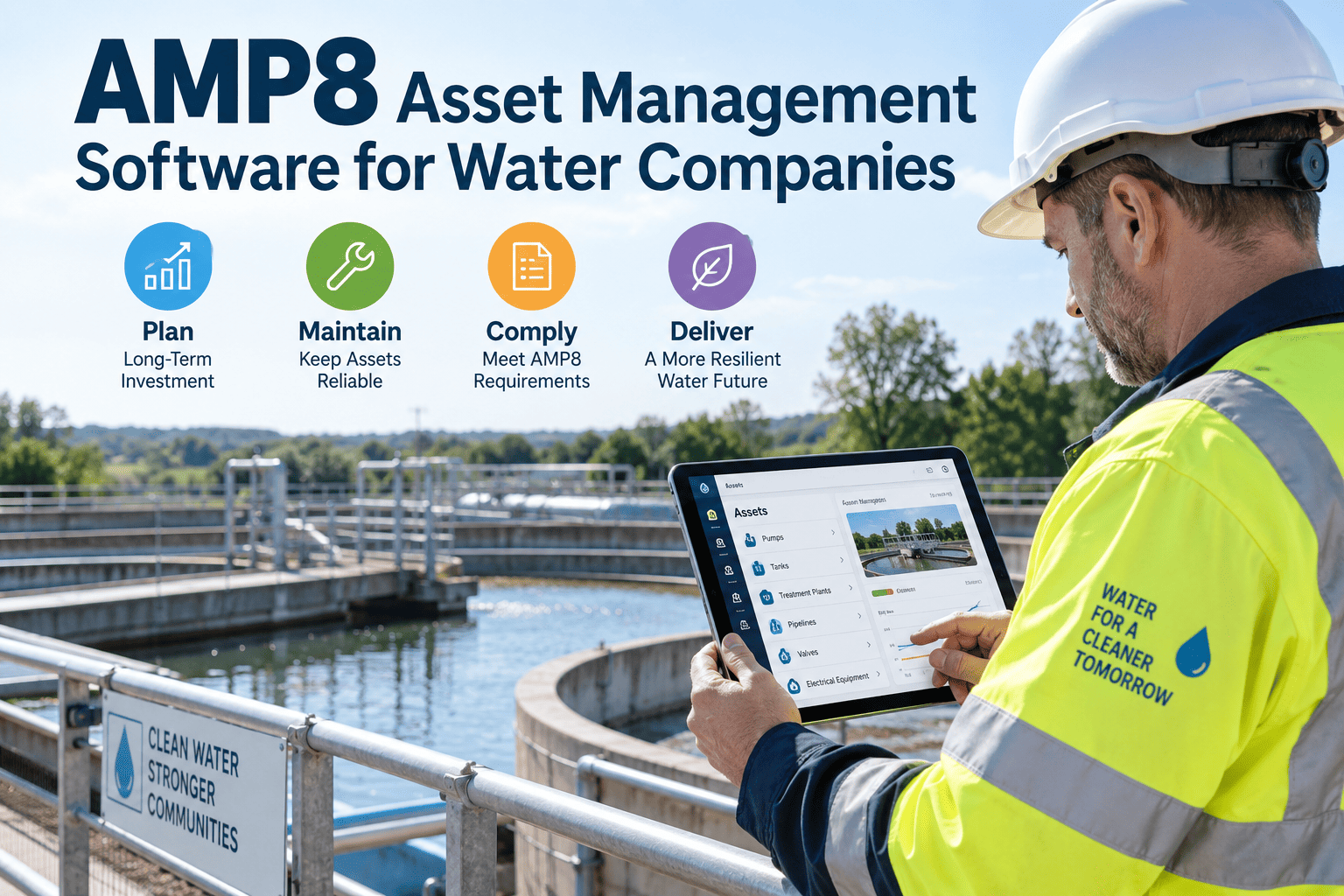
AMP8 has changed what "good enough" looks like for a water company's asset base. Performance commitments are tighter, penalties for missed targets are steeper, and Ofwat's expectations around leakage, pollution incidents, and supply interruptions leave very little room for an asset register that is out of date or a maintenance programme that runs on assumption rather than evidence. Oxmaint gives water utilities a live, auditable record of asset condition and maintenance history, built specifically to stand up to the kind of scrutiny AMP8 now demands. Start a free trial to see your own asset data organised this way.
AMP8 Asset Management Software for Water Companies
AMP8 performance commitments are not just a reporting exercise. They are a direct test of whether an asset management programme can actually deliver reliability, and whether the evidence behind that reliability holds up when Ofwat comes asking. Oxmaint connects asset data, predictive upkeep, and penalty tracking in one place, purpose-built for that test.
What AMP8 Actually Demands From an Asset Management Programme
Every regulatory period tightens expectations somewhat, but AMP8 has moved further and faster than most water companies were prepared for. Performance commitments around leakage reduction, pollution incident frequency, and supply interruption minutes are now tied directly to financial outcomes, which means an asset failure is no longer just an operational problem, it is a financial and reputational one that shows up in the next regulatory review.
The teams under the most pressure are the ones still managing asset condition through a mix of spreadsheets, paper inspection sheets, and institutional memory held by a handful of long-serving engineers. That approach might have been workable under looser performance regimes, but it does not generate the kind of consistent, timestamped, auditable evidence that AMP8 reporting now requires, and it puts an enormous amount of regulatory risk on whoever happens to be holding that knowledge in their head.
Asset management software built for this period needs to do more than track work orders. It needs to tie every maintenance action back to a specific performance commitment, so a utility can show not just that work was done, but that the work directly supported the target being reported against, in a form that survives an external audit rather than just an internal review.
Four Areas Where AMP8 Puts Real Pressure on Asset Teams
The performance commitments themselves get most of the attention, but the harder challenge for most utilities is building the underlying asset management discipline needed to consistently hit them, quarter after quarter, across a network that has often been growing older and more complex for decades.
The Asset Data Water Utilities Need at Their Fingertips
When Ofwat or an independent auditor asks a specific question about a specific asset, the answer needs to be retrievable in minutes, not assembled over several days by pulling together spreadsheets, engineer notes, and whatever paper records happen to still be on file at the depot.
What Falling Behind on AMP8 Readiness Actually Costs
The cost of an unready asset management programme rarely shows up as a single dramatic event. It shows up gradually, through missed targets, harder audits, and a widening gap between what the utility can prove and what the regulator expects to see documented.
Turn Asset Data Into AMP8-Ready Evidence
Oxmaint ties every work order and inspection back to the specific performance commitment it supports, so reporting season stops being a scramble to reconstruct history from memory and paper files.
How a Water Utility Gets to AMP8-Ready Asset Management
Utilities rarely need to replace every existing system to meet AMP8 expectations. Most of the work is about connecting data that already exists into a single, continuously updated record that can be pulled at any time, rather than assembled under pressure right before a reporting deadline arrives.
Legacy Asset Tracking vs an AMP8-Ready Platform
The comparison below is less about swapping one tool for another and more about whether asset data can actually answer a regulator's question the moment it is asked, rather than days later after a manual reconstruction effort.
| Factor | Legacy Tracking | Oxmaint AMP8-Ready Platform |
|---|---|---|
| Asset Records | Spread across spreadsheets and paper files | Consolidated in one continuously updated register |
| Maintenance Evidence | Reconstructed manually before reporting deadlines | Available instantly, tagged to each commitment |
| Failure Response | Reactive, after an incident has already occurred | Predictive, based on ongoing condition monitoring |
| Audit Trail | Dependent on institutional memory and notes | Timestamped and traceable for every action taken |
| Regulatory Risk | Concentrated in a handful of long-serving staff | Distributed across a shared, accessible system |
Moving from the left column to the right does not require a wholesale replacement of field operations. It requires channelling the inspection and repair data already being generated every day into a structure that can answer a regulator's question in minutes rather than weeks, whenever that question arrives.
What Water Utilities Typically See After Adopting Oxmaint
These are the outcomes utility asset teams most often describe once their maintenance and performance commitment data are finally connected under one system.
AMP8 Asset Management — What Water Utility Teams Ask
A few direct answers to the questions asset managers and compliance teams most commonly raise before adopting a new asset management platform under AMP8.
Does Oxmaint replace our existing GIS or asset register systems? +
How does this help specifically with Ofwat performance commitment reporting? +
Can this be rolled out gradually rather than across the whole network at once? +
Does this help reduce reliance on long-serving staff who hold institutional knowledge? +
What happens if a pollution incident or supply interruption still occurs? +
Get Ahead of AMP8 Reporting, Not Behind It
Oxmaint keeps asset condition, maintenance history, and performance commitment evidence connected continuously, so reporting season is a formality rather than a scramble, and regulatory risk stops sitting quietly in someone's memory.