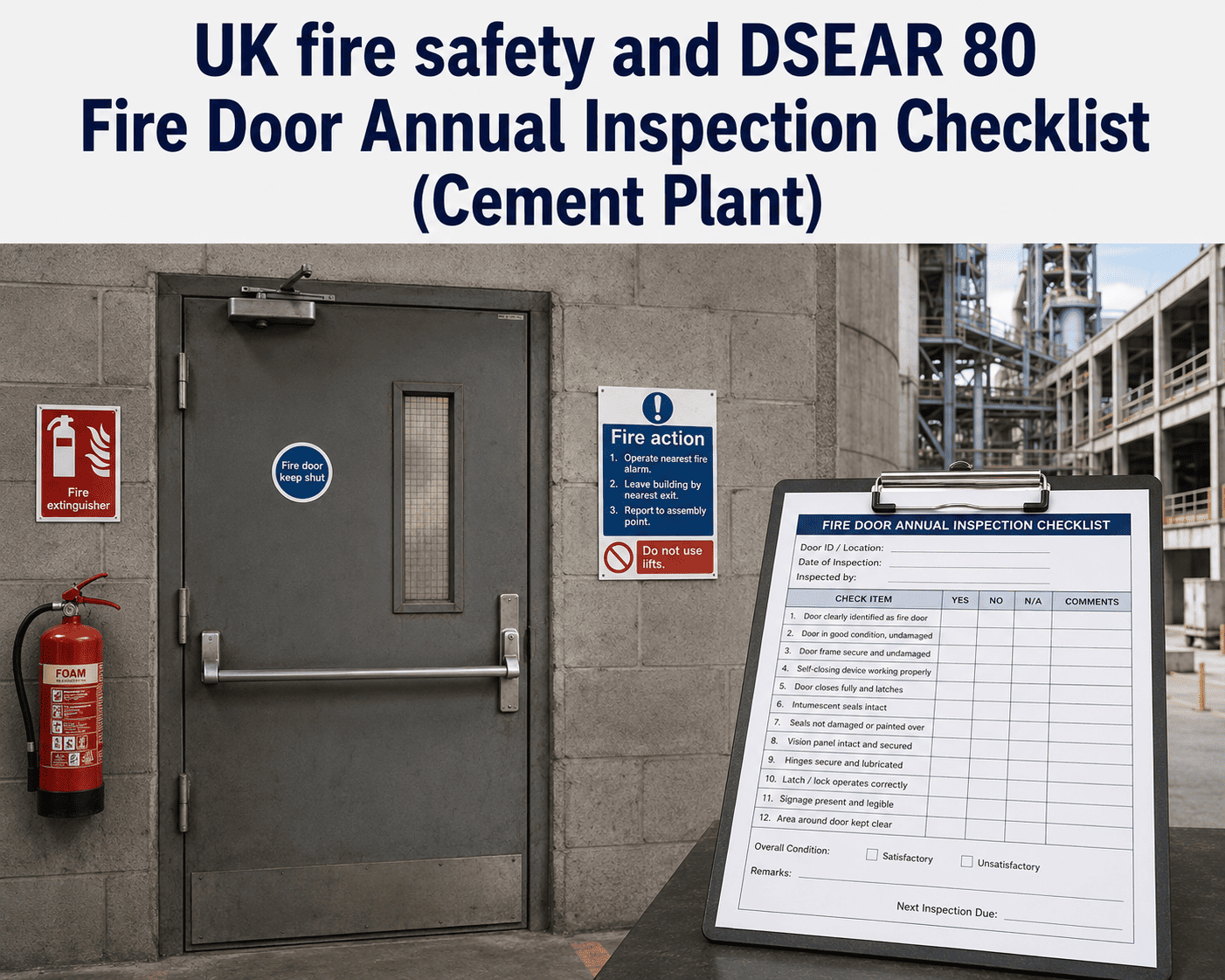
A cement plant runs conveyor galleries, electrical switchrooms, and dust-prone process areas side by side, which is exactly the layout DSEAR was written for — zones where a spark or an escalating fire needs to be contained fast, not allowed to travel between buildings. The fire door is the physical boundary that makes that containment real, but only if it actually closes, latches, and seals the way it did on the day it was certified. Sign up to run every fire door's annual inspection against its own 11-point check and keep a defensible record for every door on site.
Why It Matters
Fire doors are only effective when they still match the specification they were tested against. A gap trimmed too wide, a painted-over intumescent seal, or a closer that no longer latches from every angle can all look fine at a glance while quietly failing the one job the door has. An undocumented check carries no legal weight either — inspection is only complete once the result is recorded.
Two Tiers Of Checking, Not One
Routine Visual Check
Carried out by trained plant staff — does the door close, is damage visible, are seals present. Quick, frequent, and enough to catch obvious defects between full inspections.
Annual Detailed Inspection
Carried out by a competent person against the full 11-point check — precise gap measurement, closer testing from multiple angles, and a written pass or fail against BS 8214.
The 11-Point Annual Check
Certification label: present, legible, and not painted over on the hinge edge of the leaf
Door leaf condition: both faces free of cracks, holes, warping, or unauthorised modification
Frame and frame-to-wall junction: secure, square, undamaged, and fully sealed with intumescent material
Perimeter gaps: measured with a calibrated shim gauge, within tolerance on sides and top
Threshold gap: within tolerance for the certified threshold type
Intumescent seals: present, continuous, and undamaged around the full perimeter
Cold smoke seals: present and undamaged where the door's rating requires them
Hinges: minimum three fitted, no missing screws, no excessive movement
Self-closing and latching: closes and latches fully from 90°, 45°, and 10° with no assistance
Glazing: fire-rated, seals intact, no cracks or damage
Signage: correct "Fire Door — Keep Shut" or "Keep Locked" sign, legible on both faces
A Record For Every Door, Every Year
Oxmaint tracks every fire door as its own asset, schedules the annual inspection automatically, and logs the 11-point result with door reference, inspector, date, and defect detail attached. Sign up for a free trial to run it on your own door register, or book a demo to see it configured for your plant.
Why Gaps Fail More Doors Than Anything Else
A gap that's too wide is one of the most common defects found on a UK fire door inspection, and it's also one of the easiest to miss without a calibrated shim gauge, since a wedge can force the gap open and give a false reading. Once a gap exceeds tolerance, an intumescent seal that would normally expand to bridge it can no longer close the space fast enough in a real fire. The fix is rarely dramatic — most gap failures are corrected by adjusting hinges or resetting the frame rather than replacing the door — but it has to be measured properly to be caught at all.
Perimeter Gap Tolerance Reference
| Location |
General Tolerance |
Check Method |
| Sides and top |
Approximately 3-4mm, per certification evidence |
Calibrated flat shim gauge |
| Threshold |
Up to approximately 8mm, depending on threshold type |
Calibrated flat shim gauge |
| Frame-to-wall junction |
No open voids, fully sealed |
Visual inspection around full perimeter |
Frequently Asked Questions
Q
Who is allowed to carry out the annual detailed inspection?
A competent person with relevant fire door knowledge, training, and understanding of the applicable standards and certification evidence. Competence attaches to the individual carrying out the check, not just to a company's third-party accreditation.
Q
Why is the door tested at 90°, 45°, and 10° instead of just from fully open?
A closer can have enough force to shut a door from wide open but not enough to overcome friction and latch it from a shallower angle. Testing from all three positions confirms the door will actually close and latch regardless of how far it was open when a fire starts.
Q
What should happen if a certification label is missing or illegible?
The door's rating status needs investigating before a pass can be recorded. Without a legible label, there's no way to confirm what the door was actually tested and certified to, which puts the whole basis of the inspection in question.
Compartmentation You Can Prove, Not Just Assume
Oxmaint keeps every fire door on site as a tracked asset with its own inspection history, schedules the annual 11-point check automatically, and routes any defect straight to a corrective work order. Sign up for a free trial to run it on your own door register, or book a demo to see it configured for your plant.