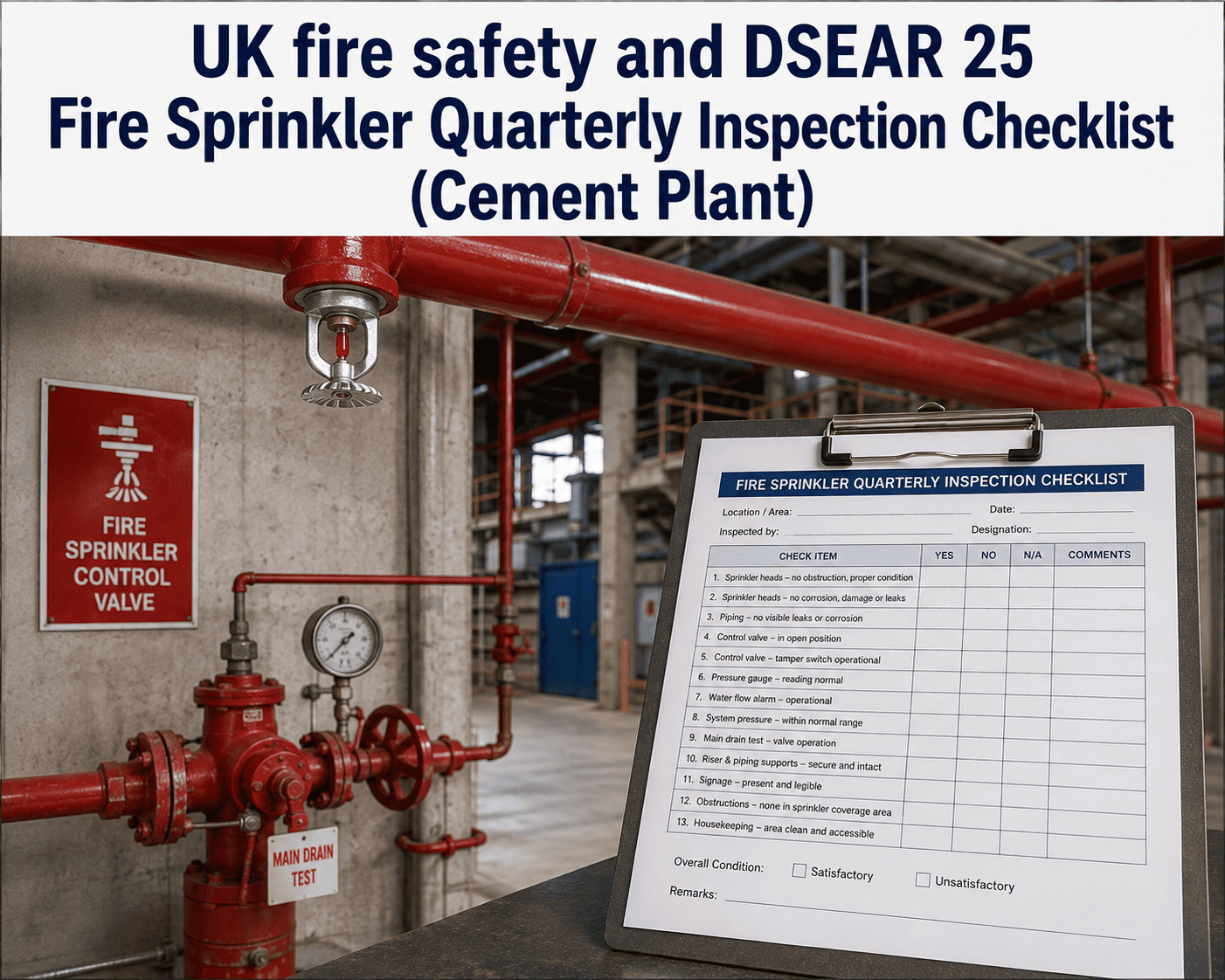
A cement plant's sprinkler system spends most of its life doing nothing visible — sitting pressurised, waiting. The only time anyone finds out a control valve was left partly closed, or a gauge had drifted out of range, is either at inspection or during an actual fire, and only one of those is a good time to discover it. Quarterly checks are what catch a seized valve or a failed alarm test while it's still a five-minute fix. Sign up to schedule every gauge, valve, and alarm check on its BS EN 12845 cycle and keep sign-off documentation for every round.
Why It Matters
Sprinkler systems are mechanical, which means faults build slowly and invisibly. Valves seize, gauges drift, and pipework corrodes from the inside without any outward sign. In a plant with dust-prone process areas and DSEAR-relevant zones sitting close to electrical and conveyor infrastructure, a sprinkler system that doesn't activate on demand turns a contained incident into an escalating one.
The Four-Tier Inspection Cycle
Weekly
Visual check of control valves, water pressure gauges, and a test of the alarm gong to confirm it sounds correctly.
Monthly
Water pumps run and tested, system pressure verified against design parameters for the installation.
Quarterly
Professional-level inspection covering alarm testing, flow switch verification, and a full valve position check.
Annually
Full system inspection by a competent, independent third party, including hydraulic performance testing.
The Quarterly Round
Confirm every control valve is fully open: a partly closed valve can look normal at a glance while still restricting flow to the head that needs it
Read every pressure gauge against its commissioned range: a needle sitting outside the normal band flags a supply issue before it becomes a failure
Test flow switches for correct activation: verifying the switch actually signals when water moves, not just that it's wired in
Run the alarm devices: water-driven motor alarm and any electrical alarm signal tested to confirm both trigger correctly
Sign off and log the result: inspector, date, valve positions, gauge readings, and any defect recorded together as evidence of the check
If Your Records Can't Prove It, It Didn't Happen
An insurer can dispute a claim after a fire if inspection records don't demonstrate compliance, and an authority having jurisdiction can issue enforcement action on the same basis. Sign up for a free trial to build a defensible sign-off history for every sprinkler zone, or book a demo to see it configured for your plant.
Why A Closed Valve Is The Most Dangerous Defect
Every other sprinkler defect tends to reduce performance. A closed or partly closed control valve removes it entirely for everything downstream of that point, and it's also one of the easiest defects to introduce by accident, during unrelated maintenance work nearby, and one of the hardest to notice without a deliberate check, because the system still looks pressurised and normal from the outside. This is why valve position gets checked at every tier of the inspection cycle, not just at the annual service, and why it's usually the first thing a quarterly round confirms.
What Gets Checked, And How Often
| Component |
Check Point |
Frequency |
| Control valves |
Fully open, correctly positioned |
Weekly, verified quarterly |
| Pressure gauges |
Reading within commissioned normal range |
Weekly, verified quarterly |
| Water pumps |
Runs correctly, pressure matches design |
Monthly |
| Flow switches |
Activates and signals correctly |
Quarterly |
| Full hydraulic system |
Water supply, valves, and pressure under load |
Annually, by independent third party |
Frequently Asked Questions
Q
Can plant staff carry out the quarterly inspection themselves?
Weekly and monthly visual checks can be carried out internally, but BS EN 12845 requires the full annual service to be performed by a competent, independent third party. Quarterly checks sit between the two and are often carried out professionally as well, depending on the insurer's requirements.
Q
What happens if a pressure gauge reading is outside the normal range?
It signals a possible supply, pump, or leak issue upstream and should be investigated before the next scheduled check, not left for the following quarter. A gauge drifting out of range is often the earliest visible sign of a developing fault elsewhere in the system.
Q
Why does a closed control valve matter more than a single blocked sprinkler head?
A blocked head affects one location. A closed or partly closed control valve can remove water supply from an entire zone, and because the system still looks pressurised from the outside, it's one of the easiest faults to miss without checking valve position deliberately at every inspection tier.
Every Gauge, Valve, And Alarm Check, On Record
Oxmaint schedules your weekly, monthly, quarterly, and annual sprinkler checks automatically, tracks control valve position and gauge readings against normal range, and keeps a fully auditable sign-off trail for every inspection round. Sign up for a free trial to run it on your own sprinkler zones, or book a demo to see it configured for your plant.