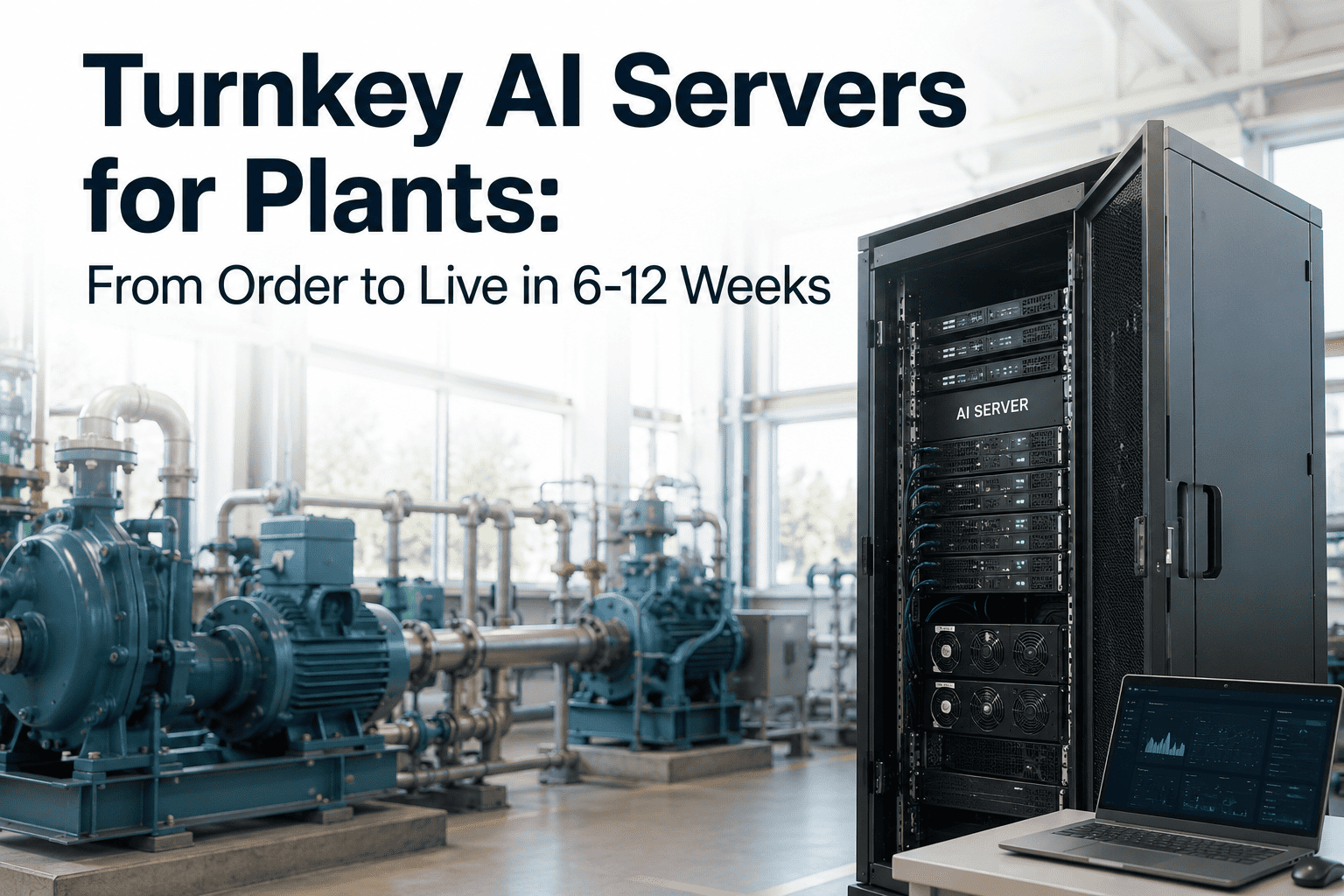
The gap between "we decided to deploy AI" and "AI is running on our plant floor" routinely stretches to 12–18 months when organisations build custom. Data science teams, cloud architecture debates, sensor procurement, DCS integration scope, network redesigns — each step adds weeks. Turnkey AI server bundles compress that entire runway to 6–12 weeks by shipping pre-configured, pre-loaded hardware ready to rack, power up, and connect. For plant directors under pressure to show measurable results before the next budget cycle, it is the only realistic path to live AI this calendar year. Sign up free to see how OxMaint connects to edge AI infrastructure and turns sensor signals into work orders automatically.
AI on Your Plant Floor in 6–12 Weeks — Not 18 Months
Pre-configured NVIDIA edge servers, full deployment support, technician training, and 24/7 plant support — delivered as a single contracted scope. OxMaint connects the inference layer to the work order system where action happens.
Why Custom Builds Take 18 Months and Turnkey Takes 12 Weeks
Custom AI deployments fail the timeline test not because the technology is hard — but because the integration sequencing is. Every component dependency adds a critical path item. Turnkey bundles pre-resolve those dependencies before the hardware ships. The vendor has already validated the AI stack against the server hardware, certified the sensor integration protocols, and pre-loaded the software — your team's job is to rack it, connect it, and configure it to your assets, not to build and test each layer from scratch.
Custom Build Path — 12–18 Months
Hardware procurement and GPU server specification — 6–10 weeks
Software stack assembly, driver compatibility, and AI framework installation — 4–8 weeks
DCS and sensor integration development and testing — 8–16 weeks
Network architecture and cybersecurity review — 4–8 weeks
Model training, validation, and technician training — 6–12 weeks
Turnkey Path — 6–12 Weeks
Hardware arrives pre-racked, NVIDIA stack pre-loaded, validated against your asset class — Week 1–2
Sensor and DCS connection using pre-certified OPC-UA and MQTT integration — Week 2–4
Baseline learning period on critical assets — AI maps normal operating signatures — Week 4–8
Live AI inference running, CMMS connected, technicians trained — Week 8–12
24/7 support active from go-live — no internal team required to sustain operation
What a Turnkey AI Bundle Actually Includes
The term "turnkey" is overused. For a plant director evaluating the procurement decision, the definition that matters is contractual: everything required to go from delivery to live AI inference is inside a single contracted scope, with a single accountable vendor and a defined go-live date. Here is what that scope covers at each layer. Book a demo to see a full bundle scope mapped to your plant's infrastructure.
Hardware Layer
NVIDIA GPU server — Blackwell-class or Jetson edge compute depending on deployment model. Pre-racked, cabled, and power-verified before shipping. No additional hardware procurement required.
Software Stack
AI inference engine, anomaly detection models, remaining useful life predictors, and CMMS integration layer — pre-installed, validated, and ready to configure to your asset classes on arrival.
Integration Services
OPC-UA and MQTT connections to existing PLCs, SCADA, and DCS. Sensor mapping, data pipeline verification, and network configuration — all within the contracted deployment scope.
Training Programme
Operator and technician training delivered on-site before go-live. Engineers understand how to interpret AI alerts, validate predictions, and feed outcomes back into the system — no external data science team required to run it.
24/7 Support
Round-the-clock remote monitoring and engineering support from go-live. Model drift, false positive rate monitoring, and alert threshold tuning managed by the vendor — not an internal team.
Data Sovereignty
On-premise deployment means all sensor data, model inference, and maintenance records stay inside your facility perimeter. No cloud dependency, no data egress — critical for plants with OT network air-gap requirements.
The 3-Phase Deployment Model — What Happens Each Month
On-Premise vs Cloud-Mode — Which Deployment Fits Your Plant
Both deployment modes use the same turnkey hardware and the same 6–12 week timeline. The choice is not about capability — it is about your data governance posture and whether you are managing one site or scaling to a fleet. Sign up free to work through the right deployment model for your specific plant context.
| Factor | On-Premise (Air-Gapped) | Cloud-Mode (Hybrid Edge) |
|---|---|---|
| Data Sovereignty | All data stays within facility perimeter — no egress to cloud or external network | Filtered insights (not raw data) transmitted to cloud — data residency requirements must be reviewed |
| Latency | Sub-50ms local inference — suitable for real-time asset protection and emergency stop triggers | Edge appliance handles time-critical inference locally; cloud layer adds trend analysis and cross-site benchmarking |
| Multi-Site Scaling | Each site operates independently — no cross-site visibility without additional network architecture | Fleet-wide performance dashboard across all sites — KPIs, model accuracy, and alert volumes visible centrally |
| Best Fit | Single-site plants with OT network isolation requirements, defence, pharma, or regulated industries | Multi-site operators, contract manufacturers scaling across facilities, or plants preferring an OPEX model |
The ROI Case — Numbers a Plant Director Can Take to a Capital Committee
Capital committees need a defensible number, not a technology narrative. The ROI framework for turnkey AI server deployments in manufacturing plants has enough documented precedent to build a credible business case from published benchmarks — before the pilot has even started. Most high-impact AI maintenance systems achieve payback within 6–18 months, with the first measurable value appearing within 6–10 weeks of go-live on modular deployments. Book a demo to work through the ROI projection for your specific asset profile.
What Plant Directors Should Verify Before Signing a Turnkey Contract
Verify 01
Existing Sensor Reuse — Not Replacement
Vendors that require new sensor deployment add months and significant hardware cost to the timeline. A genuine turnkey AI deployment connects to your existing vibration, temperature, and pressure sensors via federation protocols — and ships with that integration already validated.
Verify 02
CMMS Connection as Part of Scope
An AI server that generates alerts into a dashboard is a notification system. One that creates a prioritised work order in your CMMS is a maintenance system. Confirm the CMMS integration is inside the contracted scope — not a future phase.
Verify 03
Multi-Model Confidence Fusion
Single-model platforms generate false positive rates of 35–40% — high enough to erode engineer trust within weeks. Multi-sensor fusion models combining vibration, thermal, and acoustic data achieve false positive rates below 8%. Ask for documented false positive performance, not just accuracy figures.
Verify 04
A Defined Go-Live Date in the Contract
A genuine turnkey vendor commits to a go-live date, not a "target timeline." If the vendor is unwilling to put a live inference date in the contract with defined remedies for delay, the 6–12 week claim is a marketing statement, not an operational commitment.
How OxMaint Connects to Your Turnkey AI Infrastructure
The edge AI server generates predictions. OxMaint closes the loop to action. When the NVIDIA inference engine detects a developing bearing fault or thermal anomaly, OxMaint receives the signal and automatically creates a prioritised, asset-linked work order — with the sensor evidence attached, the recommended procedure populated, and the relevant parts flagged from inventory. The technician sees a task, not a dashboard alert. Sign up free to connect OxMaint to your existing or planned edge AI infrastructure today.
Alert-to-Work-Order Automation
Every AI anomaly signal creates a work order in OxMaint automatically — diagnosed failure mode, recommended procedure, required parts, and optimal intervention timing relative to production schedule.
SCADA and PLC Integration
OxMaint connects to your existing control infrastructure using standard OPC-UA and MQTT protocols. PLC fault codes create work orders in under 60 seconds of alarm — no dispatcher required, no manual transcription.
AI Queue Prioritisation
OxMaint AI sorts each technician's work queue by asset criticality, failure probability, and shift time remaining — the highest-impact task appears at the top automatically, without a planner manually triaging alerts.
Outcome Feedback to Improve Model Accuracy
Every work order closed in OxMaint feeds the repair outcome back to the AI model — confirmed failures, false positives, and repair findings continuously refine prediction accuracy over the weeks following go-live.
Live AI on Your Plant Floor This Quarter — Not Next Year
OxMaint connects to your turnkey AI infrastructure and turns every anomaly signal into an assigned work order — the last mile that turns AI investment into operational results plant directors can report on.
Frequently Asked Questions
Do we need to replace our existing sensors to use a turnkey AI server?
No — and this is a critical procurement question to ask every vendor. Turnkey deployments that require new sensor infrastructure add months and significant hardware cost to the timeline. Validated turnkey bundles connect to your existing vibration, temperature, pressure, and current sensors via OPC-UA or MQTT federation. New sensors are only required where genuine coverage gaps exist, not as a default starting point.
What happens to plant data — does it leave the site?
In on-premise deployment mode, all sensor data, model inference, and maintenance records remain inside the facility network perimeter. There is no cloud dependency and no data egress — which is the deployment model required for plants with OT network air-gap requirements or data residency obligations. Cloud-mode deployments transmit only filtered insights, not raw sensor data, and require a data governance review before selection.
How many assets can a turnkey AI server monitor from go-live?
Most deployments begin with 5–20 critical assets during the baseline learning phase and expand to full plant coverage within 3–6 months. Starting with fewer assets intentionally produces a cleaner baseline model and faster trust-building with the maintenance team. Expanding the asset scope uses the same infrastructure and pipeline — it is a configuration step, not a new project.
What is the minimum historical data needed before the AI can generate useful predictions?
Modern edge AI systems can begin providing anomaly detection value from day one using transfer learning models built on industry-standard asset failure signatures — they do not require months of site-specific data before generating their first useful signal. Asset-specific accuracy improves as the system accumulates operating history from your plant. Most deployments reach reliable performance within 30–60 days of continuous operation on target assets.
Do we need an internal data science team to run this after go-live?
No. The turnkey model explicitly removes that requirement. Model monitoring, drift detection, alert threshold tuning, and retraining are managed by the vendor's 24/7 support team after go-live. Your maintenance engineers interpret and act on alerts — they do not manage the AI infrastructure. This is the core operational difference between turnkey AI and a custom-built deployment that requires an embedded data science capability to sustain.