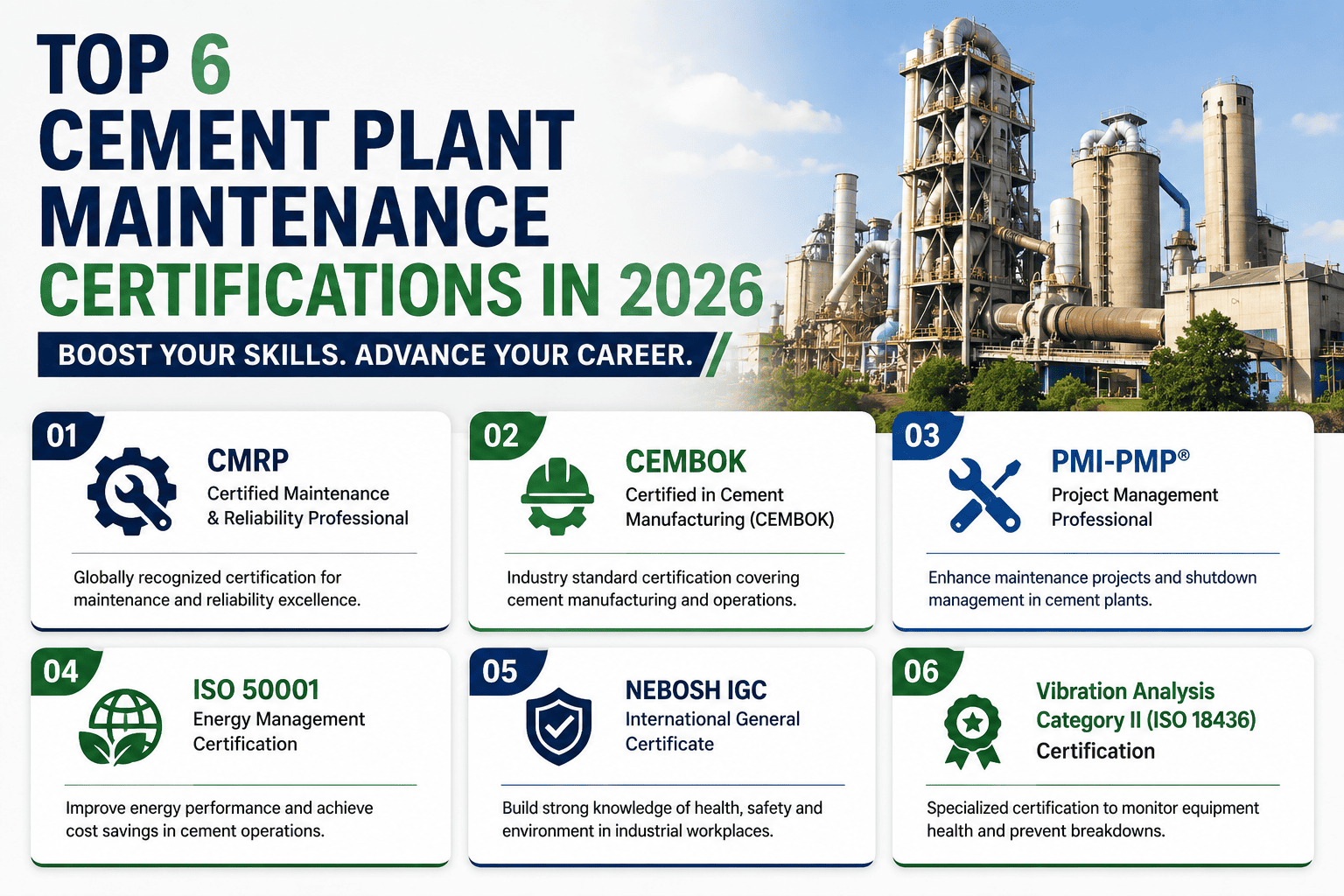
A maintenance technician with ten years on a kiln floor and no certification often gets passed over for a promotion in favor of someone with three years of experience and a CMRP after their name. Certifications are how plants verify that a reliability claim on a resume is actually backed by tested knowledge. Here are the six certifications worth pursuing in 2026 if you work in or manage cement plant maintenance. Sign up to see how a cement-ready CMMS supports the reliability practices these certifications teach.
Why It Matters
Cement plants run on rotating equipment with six and seven figure failure costs, so hiring managers increasingly treat a reliability certification as proof that a candidate understands root cause analysis and asset criticality, not just how to swap a bearing.
The 6 Certifications Worth Earning
CMRP - Certified Maintenance and Reliability Professional
Issued by SMRP. Covers business management, manufacturing process reliability, and work management. Best for maintenance managers and reliability engineers looking to move into leadership.
CMRT - Certified Maintenance and Reliability Technician
Issued by SMRP. Focused on hands-on skills including preventive maintenance, troubleshooting, and precision maintenance. Best for technicians who want a recognized entry point into reliability work.
ISO 55000 Asset Management Certification
An international standard for asset management systems. Best for plant managers and asset managers who need to align maintenance strategy with corporate risk and investment planning.
NDT Certification, ASNT Level I to III
Non-destructive testing certification covering ultrasonic, magnetic particle, and radiographic inspection. Best for inspectors responsible for kiln shell integrity and refractory condition checks.
CRL - Certified Reliability Leader
Focused on the leadership and culture side of reliability rather than technical skills alone. Best for supervisors building a reliability program from the ground up.
Vibration Analysis Certification, ISO 18436 Category I to IV
Covers condition monitoring on rotating equipment like kiln drives, fans, and grinding mills. Best for predictive maintenance technicians and condition monitoring specialists.
Signs You Are Ready For A Reliability Certification
You already track failure modes and downtime causes informally, even without a formal system
You have at least one to three years of hands-on maintenance or reliability experience
Your plant is asking you to justify PM intervals or spare parts stocking decisions with data
You want a credential that transfers if you move between cement, steel, or power plants
Put Your Certification Into Practice
A certification teaches the theory behind failure analysis and PM optimization. Sign up for a free trial to apply it in a real cement plant CMMS, or book a demo to see how OxMaint tracks the metrics your certification exam covers.
Certification Comparison At A Glance
| Certification |
Level |
Typical Prep Time |
| CMRP |
Professional / Management |
3 to 6 months |
| CMRT |
Technician |
2 to 4 months |
| ISO 55000 |
Management / Systems |
4 to 8 months |
| NDT Level I to III |
Technical / Inspection |
6 months to 2 years by level |
| CRL |
Leadership |
2 to 3 months |
| Vibration Analysis I to IV |
Technical / Predictive Maintenance |
3 months to 1 year by level |
The Takeaway
Pick the certification that matches where you sit today, technician, engineer, or manager, rather than chasing the most advanced credential first. A CMRT earned early often leads naturally into a CMRP a few years later.
Frequently Asked Questions
Q
Which certification should a new maintenance technician start with?
CMRT is the most accessible starting point for technicians. It validates hands-on skills without requiring years of management experience.
Q
Is ISO 55000 certification for individuals or for the plant?
ISO 55000 is primarily a management systems standard that plants certify against, though individuals can also earn lead auditor or practitioner credentials tied to the standard.
Q
Do certifications expire?
Most reliability certifications, including CMRP and CMRT, require renewal every three to five years through continuing education credits or re-examination.
Turn Certified Knowledge Into Plant Results
Sign up for a free trial to apply reliability best practices in a real cement plant CMMS, or book a demo to see how OxMaint supports the metrics behind every certification on this list.