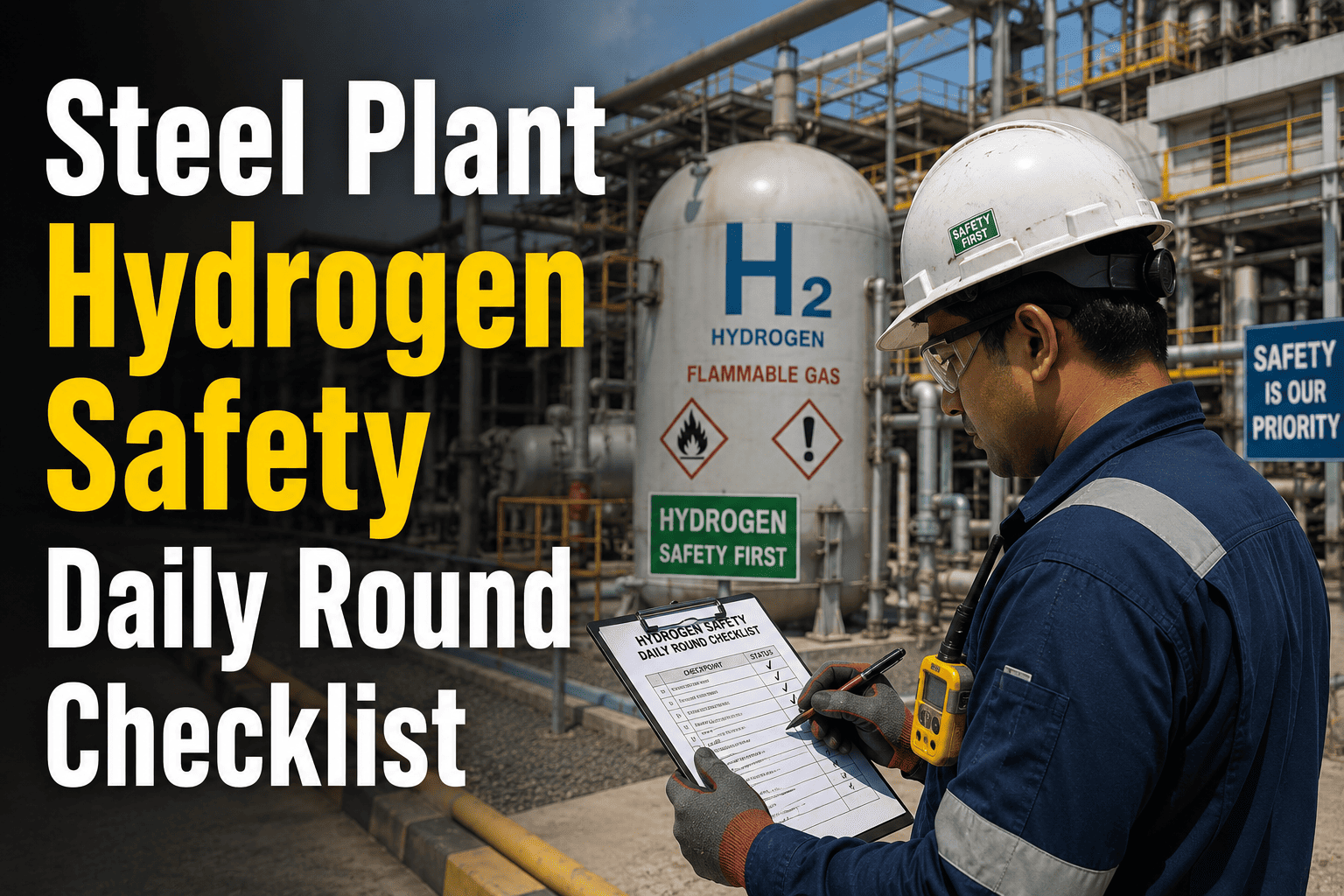
Hydrogen doesn't smell, doesn't show colour, and burns with a flame you can barely see in daylight — which is exactly why a daily round matters more on a hydrogen-fed steel line than almost anywhere else in the plant. On a DRI shaft furnace, a continuous annealing line, or a continuous galvanizing line, a hydrogen atmosphere is doing real metallurgical work every shift, and the same molecule that reduces iron ore or protects a steel strip from oxidation is also small enough to slip through fittings that would hold natural gas without issue. Sign up to run the daily hydrogen safety round as a CMMS record instead of a paper sheet — leak checks, ATEX zone status, and embrittlement watch points logged against each asset, every shift.
Why It Matters
Hydrogen's lower flammability limit is close to methane's, but it gets there faster — it diffuses through gaps roughly four times quicker than natural gas and needs almost no energy to ignite, sometimes just a static spark. A daily round isn't a paperwork step here; it's the check that catches a slow leak, a drifting sensor, or a stressed weld before a shift change turns it into an incident.
Where Hydrogen Risk Actually Hides In A Steel Plant
| Area |
Hydrogen Hazard |
Daily Round Focus |
| DRI Shaft Furnace |
High-temperature H2 injection, bustle pipe stress |
Bustle pipe joints, gas heater seals, seal gas flow |
| CAL (Annealing Line) |
H2 furnace atmosphere, radiant tube integrity |
Furnace shell seals, purge valve function, HRSG lines |
| CGL (Galvanizing Line) |
H2-N2 protective atmosphere near molten zinc |
Snout seal condition, atmosphere ratio, flare stack check |
| H2 Storage & Piping |
High-pressure storage, embrittlement of fittings |
Valve packing, pressure relief devices, weld points |
Four Checks The Daily Round Can't Skip
Leak Detection
Fittings, flanges, and seal points scanned with a calibrated detector, not judged by ear or by smell.
ATEX Zone Integrity
Ex-rated equipment confirmed as Gas Group IIC, the stricter class hydrogen requires over methane or propane gear.
Embrittlement Watch
High-strength piping and fasteners checked for surface cracking before it turns into a fracture.
Sensor Calibration
H2 detectors bump-tested on a shorter interval than CH4 sensors, since a colourless gas gives no second warning.
The Daily Round Checklist
Walk every H2 line joint, flange, and valve stem: checked with a calibrated portable detector, working from the storage skid toward the furnace or line
Confirm fixed H2 detectors are in calibration: bump-test log checked, not assumed current from last month's record
Verify ATEX-rated equipment in classified zones: markings checked for IIC rating, not just a general ATEX label
Inspect high-strength fittings for surface cracking: weld points and fasteners on pressure boundaries given a close visual pass, flagged for NDT if anything looks off
Check ventilation and flare stack function: confirmed live and unobstructed before the shift's H2 flow is increased
Sign off the round against the asset's safety record: reading, time, and inspector logged so drift across shifts is visible, not buried in separate sheets
One Record For Leak Checks, ATEX Status, And Embrittlement Watch
Oxmaint ties every daily hydrogen round on your DRI, CAL, or CGL line to the asset's own safety history, so a sensor that's overdue for calibration or a fitting flagged twice in a row gets caught before it becomes a bigger problem. Sign up for a free trial to run it on your own site, or book a demo to see it configured for your plant.
Frequently Asked Questions
Q
Why is hydrogen harder to catch on a daily round than natural gas?
Hydrogen has no colour and no smell, so it gives none of the warning signs a natural gas leak would. Its molecule is also small enough to escape through gaps that hold natural gas without issue, which is why detection relies on calibrated sensors rather than the senses of the person doing the round.
Q
What makes ATEX compliance stricter for hydrogen than for other plant gases?
Hydrogen sits in ATEX Gas Group IIC, the most demanding classification, above the group that covers methane or propane equipment. Equipment rated for those gases isn't automatically suitable for hydrogen service, so a daily check needs to confirm the IIC rating specifically, not just an ATEX marking in general.
Q
Why does hydrogen embrittlement need a daily visual check at all?
Hydrogen atoms can work their way into high-strength steel over time and reduce its ability to tolerate stress, which shows up as slow cracking rather than sudden failure. A daily visual pass on welds and fasteners catches early surface cracking while it's still a flag for further testing, not an unplanned shutdown.
Make The Hydrogen Daily Round A Recorded, Repeatable System
Oxmaint keeps leak checks, ATEX status, sensor calibration, and embrittlement watch points tied to the asset's own history, so a safety audit is a search through records, not a hunt through separate logbooks across shifts. Sign up for a free trial to run it on your own site, or book a demo to see it configured for your plant.