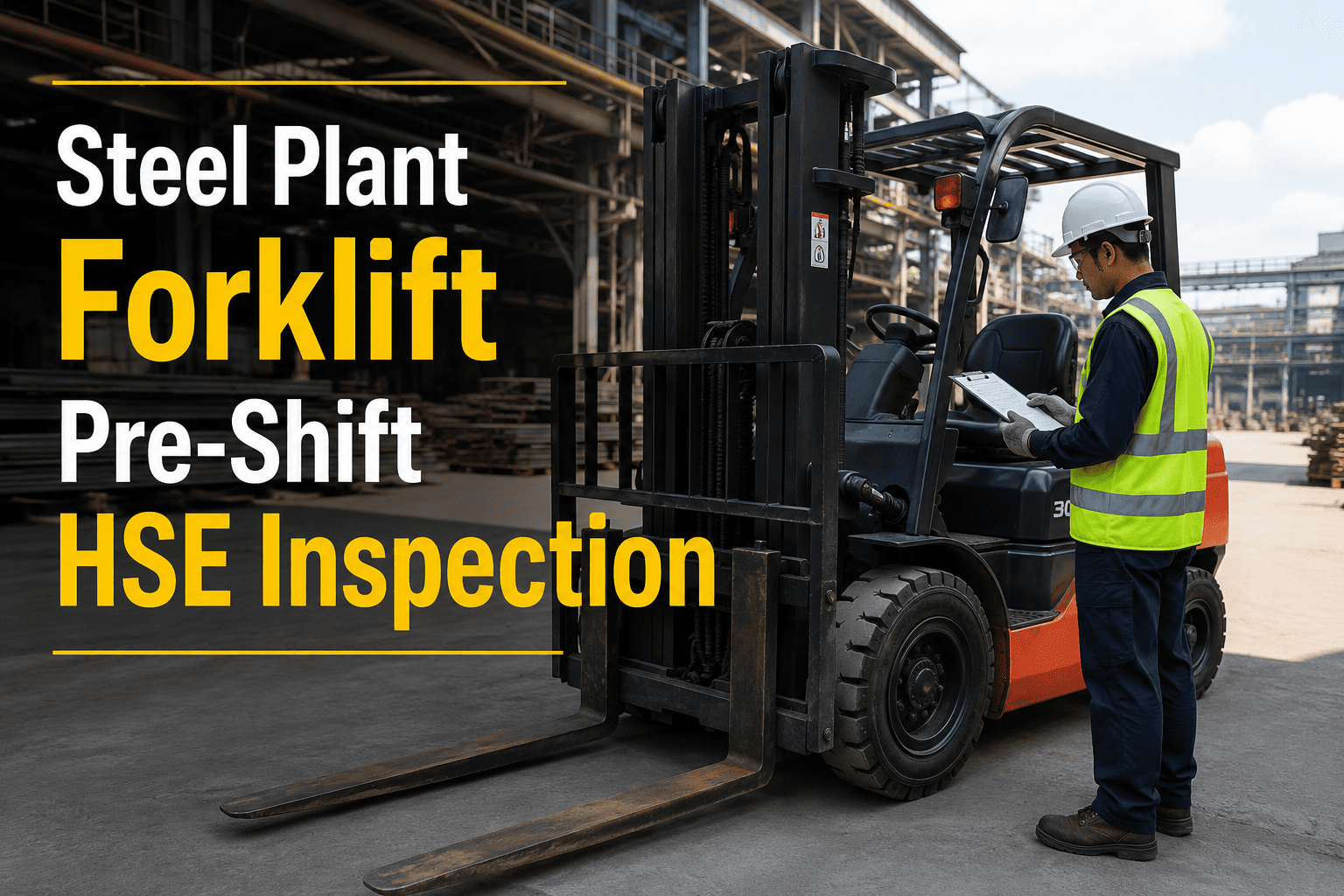
A forklift that rolls out for the first move of the shift with worn brake pads or a hairline hydraulic leak doesn't fail in an empty yard — it fails between two coil stacks, in a narrow aisle, with a crew walking past. In a steel plant, the pre-shift forklift check is one of the few OSHA 1910.178 requirements that stands directly between a five-minute walk-around and a lost-time incident. Sign up to log every pre-shift inspection against the operator, the shift, and the forklift's full service history in one CMMS record instead of a clipboard that never leaves the cab.
Why It Matters
A forklift is one of the most inspected machines on paper and one of the least inspected in practice. Brakes, tires, mast, and fluid levels degrade quietly between shifts, and a defect that looks minor at walk-around speed can fail under a loaded lift, on a ramp, or in a tight aisle where there's no room to recover.
What A Proper Pre-Shift Check Protects
Brakes And Steering
Soft pedal travel or a weak parking brake turns a routine stop into a rollaway near loading docks and pedestrian crossings.
Tires And Mast
Cut or worn tires shift stability on ramps, and a mast that binds mid-lift can drop a load without warning.
Fluids And Leaks
Low hydraulic fluid rarely shows up until the forks stop responding, usually with a load already raised.
Daily Pre-Shift Inspection Checklist
Confirm the sign-off matches the operator and shift: checklist logged against the actual driver on the actual unit, not carried over from the previous shift
Test brake pedal travel and parking brake: checked static before the first move, not assumed fine because the unit stopped yesterday
Walk all four tires for cuts, wear, and embedded metal: full 360-degree check, not a glance from the driver's seat
Cycle the mast and chains through full range: raised and lowered without load before the shift starts, watching for binding or chain slack
Check fluid levels and scan the ground for leaks: hydraulic, fuel, and coolant levels confirmed, not topped up from memory
Log the completed inspection against the forklift's service record: time-stamped sign-off saved so a defect trend is visible before it becomes a failure
Every Pre-Shift Check Logged Against The Forklift, Not A Clipboard
Oxmaint ties every pre-shift inspection to the specific forklift, the operator on shift, and the exact 1910.178 items checked, so a defect that gets missed once is caught before it repeats. Sign up for a free trial to run it on your own fleet, or book a demo to see it configured for your plant.
What Gets Checked, And Why It Can't Be Rushed
A pre-shift check done from the driver's seat in ninety seconds misses exactly the things it exists to catch. Brakes, tires, mast, and fluids each fail differently, and each one needs its own point of inspection rather than one quick visual sweep. You can sign up to standardise these checkpoints across every forklift on the floor, or book a demo to see how the checklist maps to your shift pattern.
| Parameter |
Checked At |
Why It Matters |
| Brakes |
Static test before first move |
Prevents rollaway in loading and unloading zones |
| Tires |
Full walk-around, all four wheels |
Uneven wear raises tip-over risk on ramps and slopes |
| Mast And Chains |
Full raise and lower cycle, no load |
Chain slack or a bent fork fails once weight is added |
| Fluids |
Ground beneath the unit and dipstick level |
Low hydraulic fluid causes lift failure mid-lift |
Frequently Asked Questions
Q
Why does OSHA 1910.178 require a check before every shift instead of a periodic one?
A forklift can develop a brake or hydraulic fault in a single shift of hard use, so a periodic check leaves it exposed for hours or days at a time. A pre-shift check catches a defect before it's ever loaded onto a moving unit.
Q
What's the difference between a pre-shift check and a full forklift audit?
A pre-shift check is a short operational check of brakes, tires, mast, and fluids done by the operator before driving. A full audit is a deeper mechanical inspection done on a set schedule by maintenance, covering items an operator isn't expected to assess.
Q
Why log the inspection in a CMMS instead of a paper checklist?
A paper checklist proves a box was ticked, not that a defect trend is visible. A CMMS record ties every check to the specific unit and operator, so a recurring fault on the same forklift shows up before it turns into an incident.
Turn Pre-Shift Checks Into An Audit-Ready Record
Oxmaint keeps every forklift's pre-shift sign-off, defect flags, and service history in one system, so a compliance audit is a search, not a scramble through old clipboards. Sign up for a free trial to run it on your own fleet, or book a demo to see it configured for your plant.