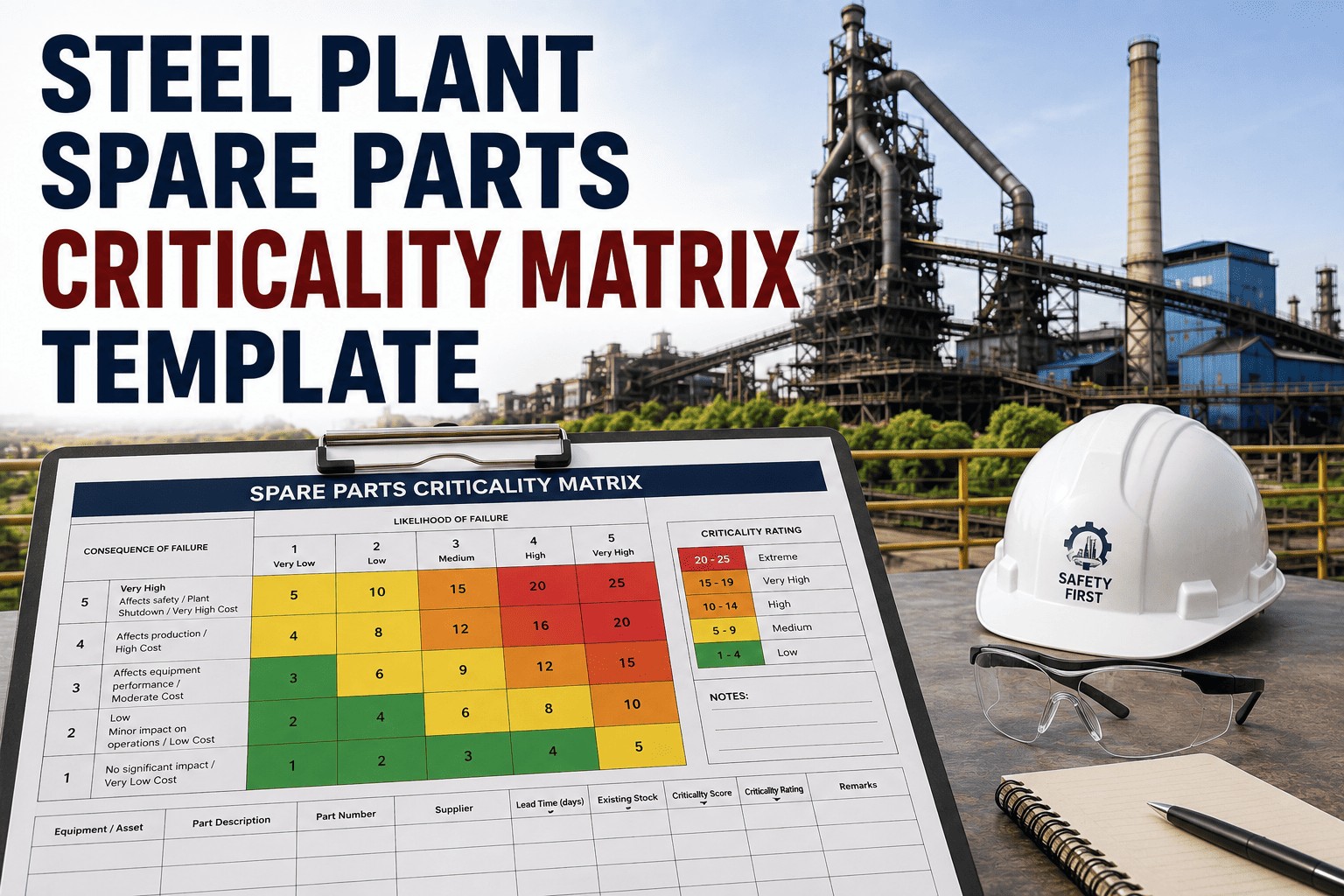
Every steel plant stores too much of some spare parts and not enough of others, usually because stocking decisions were made part by part instead of against a shared standard. A criticality matrix fixes that by scoring every spare on two things that actually matter, how badly its failure hurts production and how long it takes to get a replacement. This free template gives you that matrix, ready to sort your entire MRO inventory into a clear stocking strategy. Sign up to build your criticality matrix inside OxMaint.
Why A Matrix Matters
Without a shared standard, stocking decisions come down to whoever last got burned by a stockout. Cheap, easy-to-source parts pile up on the shelf while a long-lead bearing that could stop a rolling mill sits unstocked. A criticality matrix scores every part the same way, so stock levels match actual risk instead of habit or guesswork.
What The Matrix Scores
Equipment Criticality
How central the parent asset is to production if it stops running
Failure Probability
How often this specific part actually fails or wears out
Lead Time
Days to weeks between ordering and having the part on-site
Cost Impact
Unit cost weighed against the cost of downtime if it's not on hand
Stocking Strategy
The quadrant result, translated into a min/max stock level
Review Frequency
How often the score gets revisited as usage and lead times shift
The Criticality Matrix
Short Lead Time
Long Lead Time
High Impact
Buffer Stock
e.g. mill roll bearing, kept at a set minimum on-site
Critical Stock
e.g. oxygen lance nozzle, always on-hand, no exceptions
Low Impact
Order On Demand
e.g. standard fastener, sourced locally as needed
Review Periodically
e.g. rarely-used sensor, checked but not always stocked
Every spare lands in one of four quadrants based on how badly a stockout hurts production and how long a replacement takes to arrive, which sets the stocking rule without a case-by-case argument.
Without A Matrix vs With This Template
| Area |
Without A Matrix |
With This Template |
| Stocking decisions |
Based on habit or the last stockout that hurt |
Based on impact and lead time, applied consistently |
| Inventory spend |
Tied up in low-risk parts that rarely move |
Concentrated on the parts that actually justify it |
| Long-lead risk |
Discovered only when the part is actually needed |
Flagged in advance and stocked before it's an emergency |
| New parts |
Added to inventory with no clear stocking rule |
Scored against the same matrix before stock is set |
Stock Spares By Risk, Not By Guesswork
OxMaint scores every spare against impact and lead time, then sets the min/max stock level automatically so critical parts never run short. Sign up for a free trial to build your matrix today, or book a demo and we'll walk through it with your team.
Frequently Asked Questions
Q
What counts as "high impact" for a spare part?
A part is high impact if its failure stops a critical production line or safety system, not just because it belongs to an expensive machine. A cheap seal on a critical pump can outrank an expensive part on redundant equipment.
Q
How often should the matrix be reviewed?
Quarterly for critical and buffer stock parts is typical, since supplier lead times and failure rates shift, and an annual full review helps catch parts that have quietly become more or less critical.
Q
Does this replace a full ABC inventory analysis?
No, they work together. ABC analysis ranks parts by spend, while this matrix ranks them by operational risk, and a low-spend part can still land in Critical Stock if downtime cost is high enough.
Get The Free Spare Parts Criticality Matrix Template
Score every spare by impact and lead time, then set stock levels that actually match production risk. Sign up for a free trial to build your matrix today, or book a demo to see it applied to your MRO inventory.