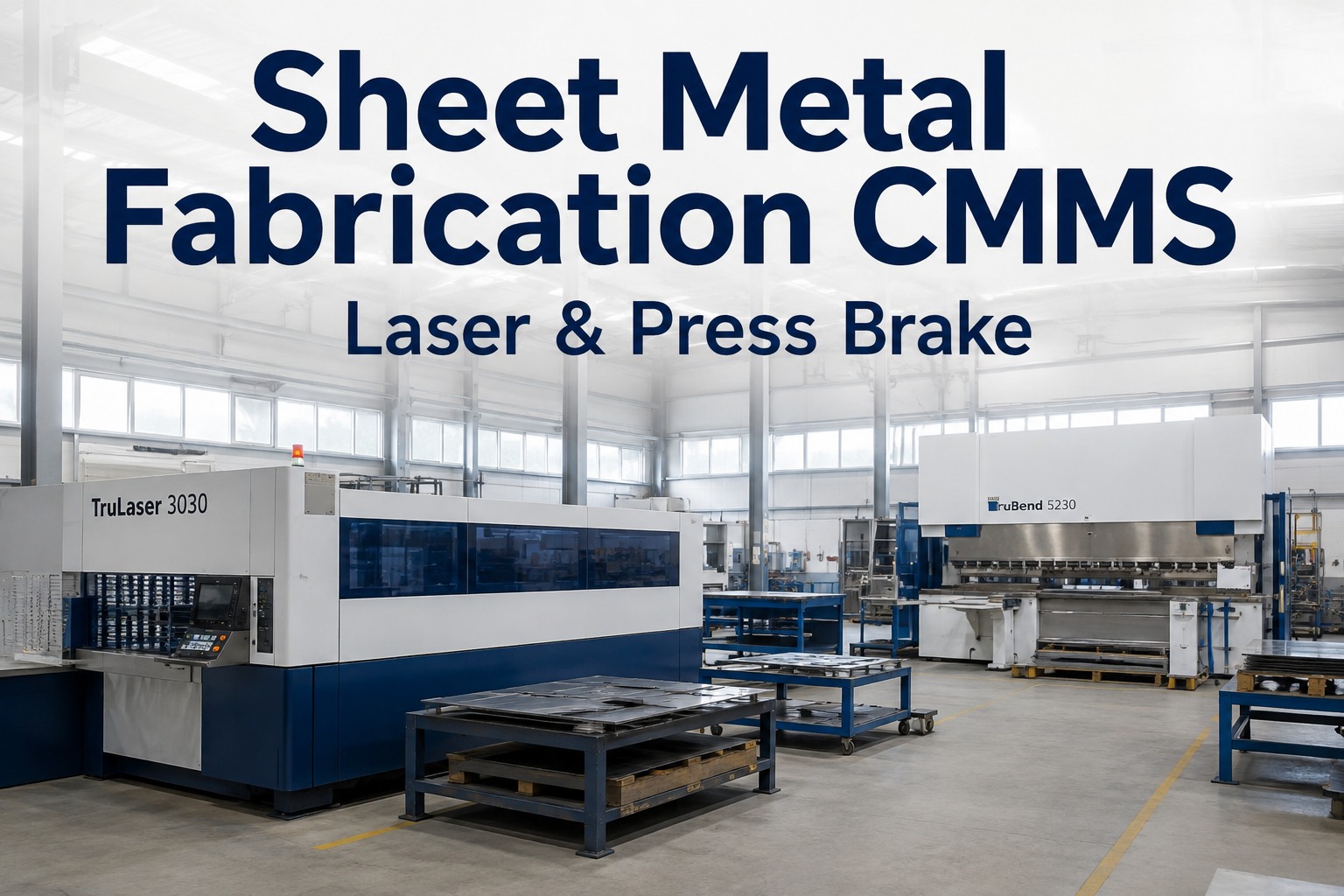
A 40,000 square foot fabrication shop in Wisconsin lost 19 production days across a single year to unplanned downtime — a seized press brake hydraulic system, a laser cutter resonator failure, a welding robot calibration drift, and three separate compressed air collapse events. The direct repair bill was £270,000. The missed shipments added another £220,000. One customer left permanently. Every one of those failures was preventable — but every one required a different maintenance discipline. An sheet metal fabrication CMMS demo — book a free Oxmaint walkthrough shows the workflow live.
Asset Wear Signatures
Five Asset Classes. Five Different Maintenance Disciplines.
The biggest mistake in fab shops: running the same PM cadence across every machine
01
Fibre laser cutter
Optics-critical asset
WearResonator hours · nozzle erosion · focus lens contamination · chiller performance
SignalCut edge quality drift · assist gas pressure variance · beam alignment loss
CadenceDaily nozzle · weekly optics · quarterly resonator
02
Press brake
Hydraulic-critical asset
WearRam parallelism · hydraulic oil condition · backgauge servo · tooling wear
SignalBend angle drift · oil temperature climb · sluggish return stroke
CadenceShift-start parallelism check · monthly oil sample · quarterly seal inspection
03
Welding robot
Calibration-critical asset
WearTCP calibration drift · torch consumables · wire feed rollers · gas delivery
SignalWeld seam quality drift · arc voltage variance · positioner repeatability loss
CadenceWeekly TCP verify · daily consumables · monthly full calibration
04
CNC machining centre
Spindle-critical asset
WearSpindle bearings · tool changer indexing · coolant condition · way lubrication
SignalSurface finish drift · dimensional variance · spindle vibration signature
CadenceDaily coolant check · monthly tool changer · quarterly spindle vibration
05
Compressed air
Single-point-of-failure utility
WearCompressor loading · dryer capacity · filter differential pressure · receiver drain
SignalLine pressure drop · dew point rise · condensate accumulation
CadenceDaily pressure log · weekly drains · quarterly full service
The critical insight
A fibre laser needs weekly optics attention. A press brake needs shift-start parallelism verification. A welding robot needs TCP verification tied to production runs. Running one calendar cadence across all three misses at least two of the three signals.
The Wisconsin Autopsy: Four Failures, One Missing System
The Wisconsin shop's 19 days of downtime did not come from one catastrophic event — they came from four separate failures across the year, each preventable if the right signal had been watched. This is the pattern in most job-shop fab operations. Not one big breakdown but a slow accumulation of avoidable losses that leadership only sees as a year-end number. Reconstructing each failure back to the missing maintenance signal is how prevention actually starts. Teams evaluating the signal-mapping workflow in a live workspace can book a free demo of the failure-signal linkage.
The Four Failures — And What Would Have Caught Each
Q1
Press brake hydraulic system seized
7 production days · £95k impact
Missing signal: Hydraulic oil sample analysis was 8 months overdue. Metal wear particle count would have flagged the issue in Q4 the previous year.
Q2
Laser cutter resonator failure
5 production days · £140k impact
Missing signal: Beam alignment log showed 6 weeks of drift. Chiller performance had degraded 12%. Neither was being trended.
Q3
Welding robot TCP calibration drift
3 production days + rework · £75k impact
Missing signal: Weld seam quality complaints had been rising for 4 weeks. No linkage back to robot calibration cadence.
Q4
Compressed air system collapse (x3)
4 production days across 3 events · £180k impact
Missing signal: Dryer capacity had been marginal for months. Line pressure drops during full-load runs were dismissed as "operator issues."
The Real Cost of Downtime: The 4× to 6× Multiplier
Shop owners routinely underestimate the cost of unplanned downtime because they count only the repair bill. The full impact — lost production hours, rush freight to catch up, overtime, rework, customer penalties, and reputation cost — typically runs four to six times the direct repair number. When maintenance investment is framed against the repair bill alone, PM programmes look like overhead. When framed against the full impact, they look like the highest-ROI decision in the business.
The Full Downtime Cost Stack — £50k Direct Repair
Direct repair (what owners count)
£50k
Lost production hours
£85k
Rush freight + overtime
£55k
Customer penalty + reputation
£40k
Full stack impact
£275k
5.5× the repair bill
Job Shop Reality: Cadence Follows the Machine, Not the Calendar
A fab shop running mixed jobs cannot manage maintenance on a fixed calendar the way a single-line food plant can. The laser might run 22 hours yesterday and 4 hours today. The press brake might run one shift or three. The welding cell might sit idle for two days then run flat out for a week. Time-based PM programmes waste maintenance capacity on idle assets and starve heavy-usage assets of attention. Usage-driven and condition-driven cadences match maintenance to the actual wear pattern — which is exactly what job shops need. Teams evaluating usage-based cadence configuration can book a free demo of the usage-linked PM workflow.
Cadence Model per Asset — Job Shop Reality
Fibre laser
Usage-based
Resonator hours · pierce count · beam-on time
Press brake
Condition-based
Parallelism deviation · oil analysis result · cycle count
Welding robot
Condition-based
TCP verification result · consumables count · weld quality trend
CNC centre
Hybrid
Spindle hours + vibration trend + tool changer cycle count
Compressed air
Time + condition
Calendar service + line pressure trend + dew point log
Powder coating oven
Time-based
Cure time hours · burner efficiency check
See a Live Fabrication Shop Workspace
Watch a 30-minute demo of Oxmaint configured for lasers, press brakes, welding cells, CNC and compressed air — with per-asset cadence types built in.
Tooling and Consumables: The Second Asset Register
Every serious fab shop runs a second asset register beneath the equipment — the tooling and consumables. Press brake dies, laser nozzles, weld torch consumables, CNC cutters, coolant, hydraulic oil, welding wire spools. Each has a usage life, a re-order lead time, and a criticality profile. Shops that manage tooling on spreadsheets and personal knowledge routinely run out of the wrong consumable on the wrong shift. The CMMS that holds tooling and consumables as first-class assets — with usage triggers and re-order automation — removes an entire category of preventable downtime. Teams new to holding tooling as tracked assets can sign up free to explore the tooling register workspace before rolling across all cells.
Expert Perspective: Different Machines, Different Systems
The failure mode I see over and over in mid-market fab shops is treating every asset the same way. A fibre laser is an optics-critical asset that needs weekly attention to nozzles, lenses, and beam alignment. A press brake is a hydraulic-critical asset that needs shift-start parallelism checks and quarterly oil analysis. A welding robot is a calibration-critical asset where the TCP drifts silently between production runs. Running one calendar-based PM programme across all three misses the actual wear signal on at least two of them. The shops that recover this ground do it by holding each asset class as its own maintenance sub-programme with its own cadence type — not by buying more people.
Per-asset
Cadence per asset class
Fibre laser · press brake · welding robot · CNC · compressed air — each with its own cadence type and trigger set.
Usage
Usage-driven triggers
Beam hours · pierce count · cycle count · arc-on time · spindle hours — real usage drives real PM · not the calendar.
Second reg
Tooling as first-class assets
Dies · nozzles · torch consumables · cutters — each tracked with usage life and re-order automation.
UK Fab Shop Context: MOD, Aerospace and Data Centre Demand
UK sheet metal fabrication sits at the intersection of several demanding customer sectors. MOD contracts through BAE Systems, Thales UK and MBDA carry stringent quality and traceability requirements. Aerospace subcontract work for Rolls-Royce, Airbus UK and GKN often flows down Nadcap-adjacent expectations even without formal accreditation. Data centre construction has emerged as a major demand driver in 2025-2026, pulling capacity across the sector. Rail through Siemens Mobility, Alstom and Hitachi Rail runs parallel. A CMMS that produces per-asset PM evidence, calibration records and traceable maintenance history serves all four customer bases from one backbone. To scope this against your UK operation, book a free demo scoped to UK fab shop customer requirements.
01
MOD + defence traceability
BAE Systems, Thales UK and MBDA supply chain audits expect PM evidence, welder qualification records and material traceability discoverable per contract scope.
02
Aerospace + rail crossover
Contract work for Rolls-Royce, Airbus UK, GKN, Siemens Mobility, Alstom and Hitachi Rail carries parallel documentation expectations — one evidence backbone filtered per customer.
03
Data centre demand surge
2025-2026 UK data centre buildout has pulled capacity across the sector. Reliable machine uptime is the difference between capturing the demand and losing it to imports.
A Realistic Rollout for a UK Fabrication Shop
A fab shop CMMS rollout should follow the loss pattern from the Wisconsin autopsy. Compressed air first — because it is a single point of failure across the whole shop. Press brake and laser second — because they carry the highest per-hour production value. Welding cells and CNC third. A phased plan protects the compressed air supply inside the first month.
Weeks 1–4
Compressed air + utilities
Compressed air asset register · full topology
Dryer + filter cadence live
Line pressure trending configured
Coolant + hydraulic oil sample schedules
Weeks 5–8
Press brakes + lasers
Press brake asset records + parallelism
Laser optics + nozzle usage triggers
Beam hours + pierce count tracking
Tooling and consumables register
Weeks 9–12
Welding + CNC + audit
Welding robot TCP verification cadence
CNC spindle vibration monitoring
Customer-scope evidence filters set up
Per-asset OEE dashboards live
Bring Every Asset Onto One Cadence-Right Screen
Let Oxmaint show you a fab shop workspace configured for your laser, press brake, welding and CNC assets — with per-asset cadence types and tooling tracking built in.
Frequently Asked Questions
Can Oxmaint hold different PM cadence types per asset class?
Yes. Each asset carries its own cadence type — time-based, usage-based, condition-based, or hybrid. A fibre laser can run on beam-hours and pierce-count triggers. A press brake can run on parallelism-deviation and oil-analysis triggers. A welding robot can run on TCP-verification and consumables-count triggers. The CMMS holds all three concurrently and schedules maintenance labour where the wear actually is, not where the calendar says.
Does the platform track tooling and consumables as first-class assets?
Yes. Press brake dies, laser nozzles and lenses, weld torch consumables (contact tips, gas cups, diffusers), and CNC cutters and inserts are all held as tracked assets with their own usage life, re-order lead time, and criticality. Usage triggers can fire re-order work orders before stock reaches empty, avoiding the recurring "run out of the wrong consumable on the wrong shift" pattern that most fab shops know too well.
Can we track welding robot TCP calibration cadence tied to production runs?
Yes. TCP (Tool Centre Point) verification can be scheduled by arc-on time, by number of production runs, or by observed weld quality trend feedback from downstream inspection. When calibration is overdue, the CMMS raises a blocking work order that prevents further production release on the affected cell until TCP is re-verified. Full calibration history is retained against the robot cell for customer supply-chain audit purposes.
How does the platform handle compressed air system reliability?
Compressed air is treated as the single-point-of-failure utility it actually is — with the full topology (compressors, dryers, receivers, filters, distribution) mapped as connected assets. Line pressure, dew point, and compressor loading are trended continuously where controller integration is available. Filter differential pressure triggers replacement work orders. Condensate drain checks run on daily cadence. This closes the compressed-air-collapse pattern that appears in most job-shop downtime autopsies.
Can evidence be filtered per customer supply-chain audit?
Yes. UK fab shops serving mixed customer bases — MOD prime contractors, aerospace tier suppliers, rail infrastructure, data centre construction — face different documentation expectations per customer. The CMMS holds one underlying evidence backbone (PM records, calibration certificates, welder qualifications, material traceability) that can be filtered per customer contract scope on demand. Removes the reconstruction scramble that used to characterise this work.