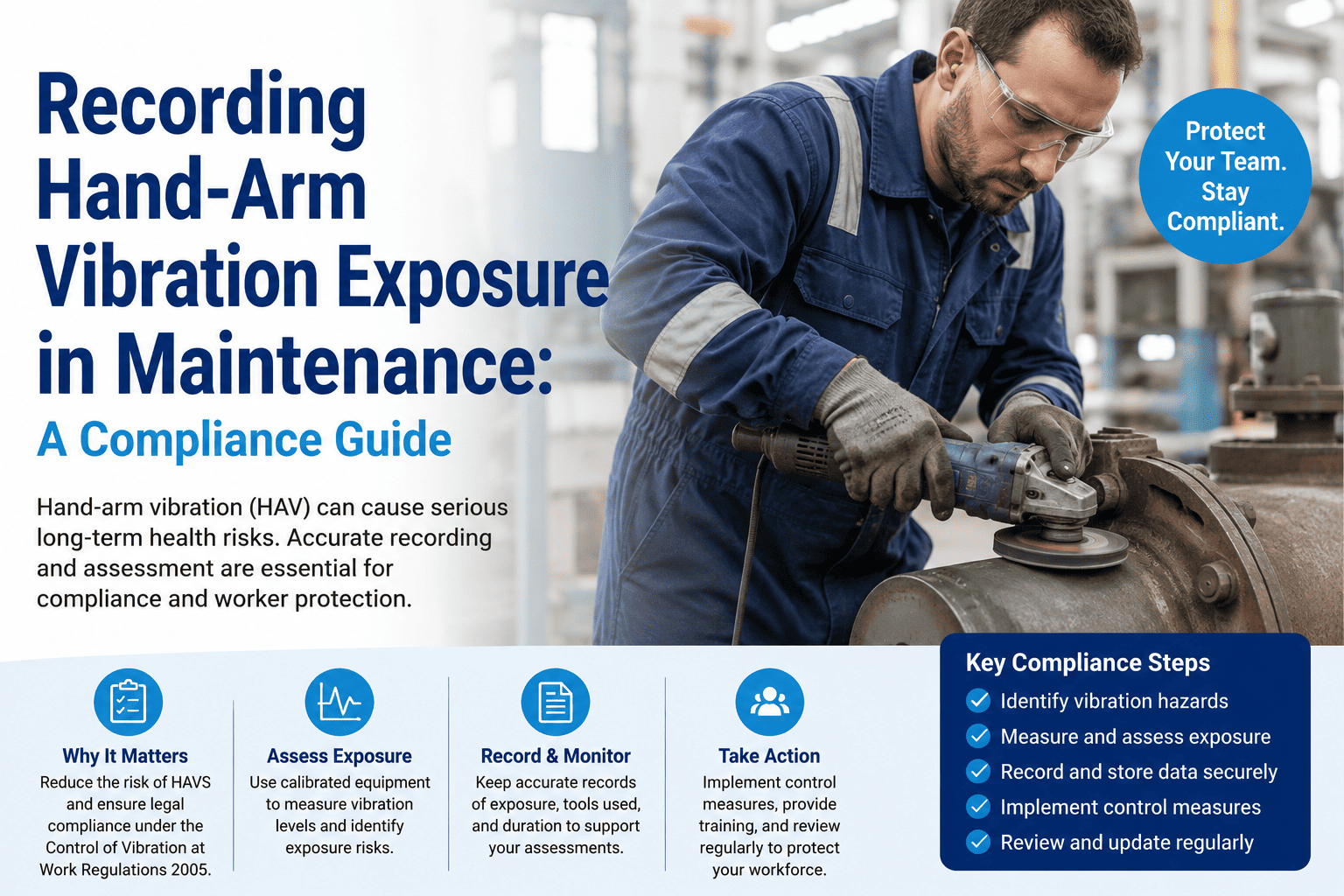
Hand-Arm Vibration Syndrome cannot be cured. Once the nerves and blood vessels in an engineer's fingers are damaged by years of grinders, breakers, and impact wrenches, the damage is permanent — and it often shows up only after the exposure that caused it is long forgotten. Vibration White Finger remains one of the most commonly prescribed industrial diseases in the UK, and the regulations exist precisely because the harm builds silently, tool session by tool session, until a worker can no longer feel a screw between their fingers. A CMMS like OxMaint turns exposure points, EAV thresholds, and surveillance triggers into a running record instead of a guess made at the end of the year.
Track Every Engineer's Vibration Exposure Automatically
Tool-by-tool exposure points, EAV and ELV thresholds, and health surveillance triggers — recorded against every work order instead of an annual spreadsheet guess.
The Two Numbers That Govern Everything
The Control of Vibration at Work Regulations 2005 set two daily thresholds for hand-arm vibration, both measured as an 8-hour energy-equivalent exposure, written as A(8). Confusing the two is where most maintenance programmes quietly go wrong — one is a trigger to act, the other is a hard ceiling.
EAV — 2.5 m/s² A(8)
Exposure Action Value, equal to 100 exposure points. Crossing it does not break the law, but it legally obliges you to start reducing exposure.
ELV — 5 m/s² A(8)
Exposure Limit Value, equal to 400 exposure points. This is a hard daily ceiling that must not be exceeded under normal working conditions.
HSE converts both thresholds into exposure points specifically so that partial exposure from several tools used across one shift can be added together: 100 points at the EAV, 400 points at the ELV. An engineer who uses three different vibrating tools in a day is not assessed against each tool separately — their combined daily total is what matters.
Calculating Daily Exposure Without Getting It Wrong
Get the Magnitude
Use HSE-published values rather than manufacturer figures alone — lab-tested manufacturer data typically understates real-world exposure by two to four times.
Record Trigger Time
Trigger time is the time the tool is actually vibrating in the engineer's hands, not the time they were near it or carrying it between jobs.
Energy-Sum, Don't Add
Combining exposure from multiple tools requires energy summation, not simple addition of A(8) values — a common and serious calculation error.
A worked example shows how quickly this adds up: an engineer using an angle grinder at 6.0 m/s² for two hours, then a chipping hammer at 30 m/s² for fifteen minutes, can reach a combined exposure of around 590 points — comfortably over the 400-point ELV — despite the second tool only being in use for a quarter of an hour. Book a demo to see how OxMaint runs this calculation automatically from logged work order time against each tool's recorded magnitude.
Health Surveillance: What Triggers Each Tier
Baseline Questionnaire
Completed before an engineer starts working with vibrating tools, establishing prior symptom history before any new exposure begins.
Annual Screening
A short annual questionnaire for anyone still exposed, used to catch early symptoms before they become irreversible.
Clinical Assessment
Triggered the moment a worker reports symptoms — a nurse or doctor assessment determines diagnosis and fitness for continued exposure.
The Records HSE Expects to See
| Record | What It Must Show | Retention |
|---|---|---|
| Vibration Risk Assessment | Tools used, magnitudes, trigger times, and exposed individuals | Reviewed regularly and after any change |
| Daily Exposure Log | A(8) or points total per engineer, per shift, across all tools used | Ongoing, individually attributable |
| Health Surveillance Record | Tier 1/2 questionnaire results and any Tier 3/4 referral outcomes | Long-term, often beyond employment |
| HAVS Diagnosis | Confirmed diagnosis reported under RIDDOR as a disease | Permanent |
A vibration risk assessment completed once and never revisited is not compliance — it is a snapshot of conditions that existed before tools were replaced, work patterns changed, or new engineers joined. Sign up free to start logging exposure points against every work order without relying on anyone remembering to fill in a spreadsheet at the end of the week.
Why HAVS Stays a Persistent UK Problem
How OxMaint Manages HAVS Compliance
Tool Vibration Register
Hold HSE-recommended magnitude values against every tool in your fleet, so calculations never rely on optimistic manufacturer figures.
Automatic Exposure Calculation
Convert logged trigger time per work order into exposure points automatically, energy-summed across every tool used that shift.
EAV and ELV Alerts
Flag any engineer approaching the 100-point action threshold or the 400-point limit before the shift ends, not after.
Surveillance Scheduling
Trigger Tier 1 and Tier 2 health surveillance automatically based on each engineer's recorded exposure history.
Stop Estimating HAVS Exposure — Start Recording It
Exposure points, EAV and ELV tracking, and health surveillance triggers — built into the maintenance workflow your engineers already use every day.
Frequently Asked Questions
What is the difference between the EAV and the ELV?
The EAV (2.5 m/s² A(8), or 100 points) is the level at which you must start taking action to reduce exposure. The ELV (5 m/s² A(8), or 400 points) is a legal ceiling that must not be exceeded under normal working conditions.
Can I use manufacturer vibration figures for my calculations?
You can use them as a starting point, but the regulations require you to consider actual working conditions. Manufacturer figures come from idealised lab tests and often understate real-world exposure by a factor of two to four.
How do I combine exposure from multiple tools in one shift?
Exposure from different tools must be energy-summed, not added directly. Adding A(8) values as simple numbers overstates or understates true combined exposure and is one of the most common calculation errors on site.
When does an engineer need health surveillance?
Tier 1 baseline screening should happen before vibration exposure begins, with Tier 2 annual screening for anyone still exposed. Any reported symptoms trigger a Tier 3 clinical assessment regardless of how recently the worker was screened.
Is HAVS reportable under RIDDOR?
Yes. A confirmed diagnosis of Hand-Arm Vibration Syndrome is a reportable occupational disease, separate from the daily exposure records that must also be maintained as evidence of ongoing compliance.