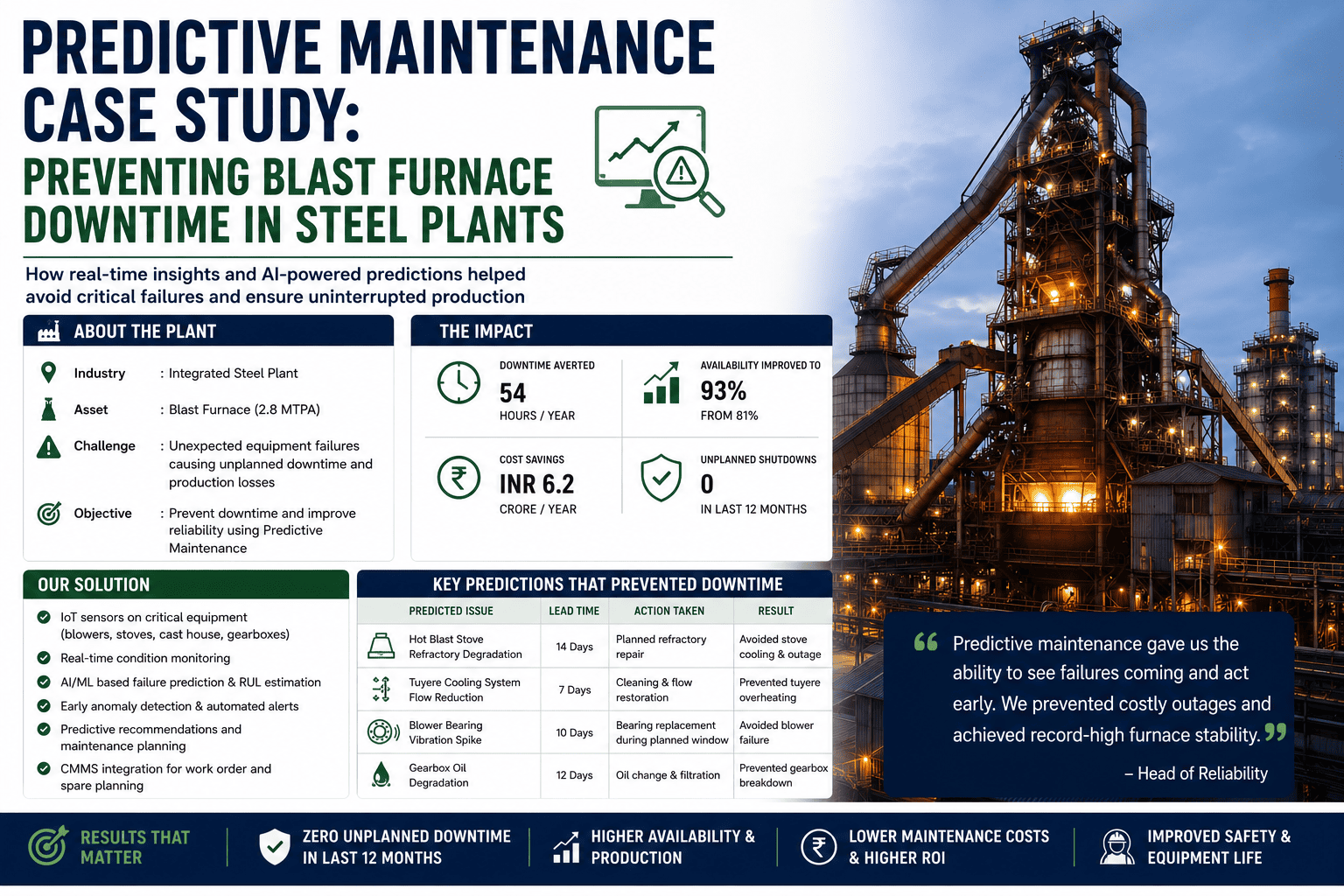
Most blast furnace downtime doesn't announce itself, it builds quietly in a data trend nobody's watching until the day it becomes a shutdown. At one steel plant, a slow rise in cooling water return temperature on a single stave zone would have gone unnoticed under the old inspection routine. Under a predictive maintenance program, it didn't. Here's how a data trend turned into a planned fix instead of an unplanned stop. Sign up to see how the same early-warning approach could work on your furnace.
9 Days Early
Warning window between the first flagged trend and the point of likely failure
Planned, Not Forced
The fix happened on a scheduled window instead of an emergency stop
Zero Unplanned Stop
Outcome for this specific fault, avoided entirely by catching the trend
The Situation
Under the plant's older routine, cooling water readings were checked on a fixed round, once or twice a shift, with no easy way to see a slow trend across days. A single stave zone's return water temperature had started climbing gradually, the kind of change that's easy to miss reading by reading but obvious once it's plotted over time.
How The Fault Was Caught
Day 1
Baseline Reading Logged
Return water temperature for the zone sat at its normal operating level, logged automatically against the asset
Day 4
Trend Flagged
The system flagged a sustained rise against the zone's own history, well before any single reading looked alarming
Day 6
Inspection Scheduled
A targeted check was scheduled for that specific zone instead of waiting for the next general round
Day 9
Fix Completed On A Planned Window
The affected component was addressed during a scheduled stop, well ahead of where failure was projected
Catch The Trend Before It Becomes A Stop
Oxmaint logs condition data against every furnace asset and flags a sustained trend before it turns into a failure. Sign up for a free trial to see it against your own equipment data, or book a demo to walk through how early detection would work on your furnace.
What Would Have Happened Without Early Detection
| Path |
Likely Outcome |
| Detected early (what happened) |
Planned repair during a scheduled window, no production loss |
| Caught on the next fixed round |
Later discovery, less margin, higher urgency repair |
| Not caught until failure |
Unplanned furnace stop, emergency repair, lost production hours |
The Broader Impact
This was one zone, one trend, one avoided stop. What made it repeatable was that every cooling zone, tuyere, and piece of charging equipment on the furnace was already logged in the same system, so the same kind of early flag applies across the whole asset base, not just the equipment someone happened to be watching closely that week.
Frequently Asked Questions
Q
How does predictive maintenance catch a fault before it happens?
It compares current condition data, like temperature or flow, against that same asset's own history, so a slow drift becomes visible as a trend well before any single reading would look abnormal on its own.
Q
Why do fixed inspection rounds miss slow-developing faults?
A fixed round captures a single point in time, so a gradual change spread across several days rarely stands out against the normal shift-to-shift variation an inspector sees.
Q
Does this approach only work on new equipment?
No, condition trending works on existing furnace equipment as long as readings are logged consistently against that specific asset over time, regardless of the furnace's age.
Turn The Next Slow Drift Into A Planned Fix
Oxmaint logs condition data against every furnace asset and flags a rising trend before it becomes an unplanned stop. Sign up for a free trial to see it against your own equipment data, or book a demo to walk through a plan for your furnace.