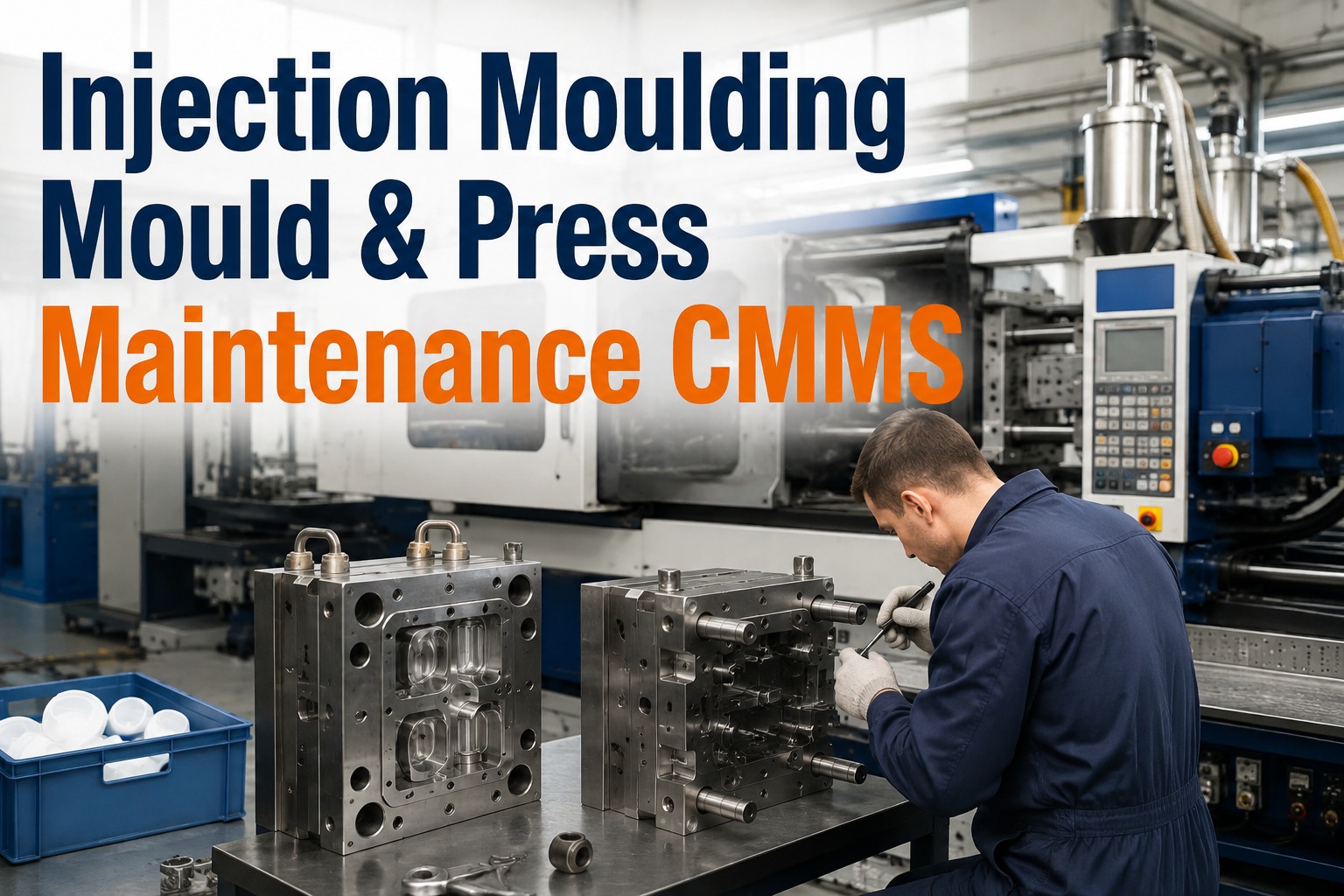
An injection moulding plant runs on a paradox: the more consistently the tools cycle, the more visibility you lose. Shot counts accumulate silently. Flash creeps onto parting lines. Cooling channels scale up degree by degree. Vents block, gate vestige changes, tie-bar preload drifts. By the time a defect makes the QA report, the mould has usually crossed a PM interval nobody was tracking. Oxmaint gives moulding plants a CMMS built around the industry's rhythm — shot-count mould PM, press subsystem PPM, tool history serialised per cavity. Book a demo to see moulding CMMS in action.
£380k+
typical annual downtime, scrap and emergency mould repair cost on a mid-sized 12-press moulding plant
±0.5%
shot-weight variation threshold that signals screw-barrel wear approaching OEM replacement clearance
33%
longer tool life typical from disciplined cycle-count PM — 400k shots vs 300k on the same mould class
The Cycle-Count Ladder — PM Triggered by Shots, Not Calendars
Injection moulds do not wear by time. They wear by cycles, by resin type, by pressure, by the number of times a slide advances or an ejector fires. Calendar-based PM either over-maintains moulds sitting idle in tool storage, or under-maintains tools running three shifts on abrasive glass-filled resin. Every serious moulding operation moves to a shot-count ladder, with PM tiers triggered by cumulative cycles against the specific tool's classification. Oxmaint runs this natively — every press cycle logged, every mould record accumulating shots, PM work orders raised automatically at each tier threshold.
Cycle-Count PM Ladder — Trigger Tiers
Thresholds shown are illustrative — actual intervals set by tool complexity, resin abrasiveness and cosmetic requirement
Tier 1 · Clean & Grease
Cavity surface cleaning · vent inspection · ejector greasing · slide lubrication · visual defect check on last-shot parts.
15-30 minutes at the press
Tier 2 · General Maintenance
Full parting-line inspection · vent depth restoration · cooling-channel scale check · O-ring policy replacement · dimensional check on last-shot parts.
2-6 hours in the toolroom
Tier 3 · Full Refurb
Complete disassembly · cavity/core wear measurement · shut-off restoration · gate vestige control · hot runner service · full pressure decay test.
1-3 days · toolroom + validation shots
Defect Diagnostics — Reading the Parts to Find the Fault
The unusual power of moulding maintenance is that the parts themselves diagnose the tool. Flash on the parting line points to worn shutoffs or insufficient clamp tonnage. Sink marks trace back to blocked cooling channels. Drag marks indicate cavity finish damage. Short shots signal check ring wear or heater band failure. Every defect pattern maps to a specific fault mode, and the response is a targeted PM task — not a full teardown. Oxmaint holds the defect-to-fault-to-task mapping so QA rejections become actionable maintenance intelligence within the same shift.
| Defect observed | Likely mould / press fault | Targeted PM response |
|---|
| Flash on parting line | Worn shutoffs, insufficient clamp, worn tie-bar preload | Shut-off restoration, clamp tonnage verification |
| Sink marks / voids | Blocked cooling channels, scale buildup, pack pressure | Cooling circuit descale, flow verification |
| Drag marks on surface | Damaged cavity finish, misaligned ejector pins | Cavity polish, ejector alignment check |
| Short shot / incomplete fill | Check ring wear, heater band failure, screw wear | Check ring replacement, heater band swap, screw wear measurement |
| Diesel burns / gas marks | Blocked vents, insufficient venting depth | Vent restoration, mould breather cleaning |
| Shot weight drift ±0.5%+ | Screw-barrel clearance exceeding 0.8-1.0% of diameter | Physical clearance measurement, screw/barrel service |
Making that mapping instant — from QA log to targeted maintenance work order — is what shortens response time from days to hours. Sign up free to configure defect-to-fault mapping for your specific tool set.
The Six Press Subsystems That Actually Drive Downtime
The press itself is not a single asset. It's six distinct subsystems, each with its own failure modes and PPM cadence. A CMMS that treats the press as one line item misses the fact that hydraulic seal failure, heater band burnout, thermocouple drift, screw and barrel wear, and toggle link lubrication failure are the five recurring causes behind the vast majority of unplanned press downtime — and each demands a different intervention. Oxmaint decomposes the press into servicing subsystems so PPM concentrates where failures actually happen.
Hydraulic system
Highest-frequency failure
Oil contamination, valve leakage, seal wear. Oil analysis, filter change intervals, cylinder inspection on tier schedule.
Screw & barrel
Shot-quality critical
Wear from abrasive resin, glass fill, chemical attack. Shot-weight monitoring, physical clearance checks against OEM tolerance.
Heaters & thermocouples
Process-consistency
Heater band burnout, thermocouple drift. Resistance checks, comparison against neighbouring zones, hot-runner service every 6-12 months.
Clamp unit & toggle
Cycle-integrity
Toggle linkage wear, tie-bar preload drift, platen parallelism. Torque verification, clamp force distribution across tie bars.
Ejector system
Quality-affecting
Ejector stroke, speed, position feedback within programmed tolerance. Sensor calibration, pin wear inspection.
Safety systems
PUWER critical
Safety gate interlocks, light curtains, e-stop response. Statutory testing regime, PUWER-aligned records, LOTO procedure verification.
See Cycle-Count PM and Defect Traceback Live
Walk through the mould register, cycle-count triggers, press subsystem PPM library, and defect-to-fault mapping — configured against your specific tools and presses. Thirty minutes with the Oxmaint team.
The Auxiliaries Nobody Tracks — Until They Fail
Moulding plants tend to focus PPM discipline on presses and tools, and neglect the auxiliaries — dryers, chillers, granulators, conveying systems, TCUs, mould-temperature controllers. Yet a failed material dryer can put out-of-spec parts into every mould running on that material line, and a chiller trip cascades across every press it feeds. Oxmaint treats auxiliaries as first-class assets with their own PPM libraries, sensor integration and criticality rankings — because a plant is only as reliable as the least-tracked equipment on it. Sign up free to add your auxiliary equipment alongside presses and moulds in the first setup session.
Expert Perspective — Why Cycle-Count PM Is the Industry Baseline
The moulding plants that consistently protect margin share one operational discipline: they've abandoned calendar-based mould PM. Cycle-count triggering isn't optional at scale — it's the only regime that scales with tool utilisation and doesn't over-service tools sitting idle or under-service tools running three shifts on abrasive resin. Combined with defect-driven diagnostics feeding maintenance response, and structured PPM across the press subsystems, cycle-count PM typically extends tool life by 25-35% and cuts unplanned downtime dramatically. It's not a new idea — it's just the discipline the leaders execute consistently.
Serialised cavity tracking
Every cavity in a multi-cavity tool tracked individually. Wear patterns often differ by position — cavity-level data surfaces which specific cavities need attention.
Spares-first policy
High-wear components (ejector pins, O-rings, heater bands) held in stock against every mould class. Worn parts replaced immediately rather than compromised.
Tool storage discipline
Moulds pulled from production get cleaned, treated with anti-corrosive and stored to spec. Idle-storage neglect is a leading source of return-to-service downtime.
Micro-stop capture
Sub-5-minute stops don't hit the major downtime report but destroy OEE. CMMS captures them, patterns emerge, root causes get permanently fixed.
Who Uses Oxmaint in Injection Moulding
The platform is used by the roles that live with moulding reliability outcomes: maintenance managers running PPM libraries across presses, moulds and auxiliaries, toolroom managers responsible for mould condition, refurbishment planning and tool life extension, production managers tracking OEE, scrap rate and cycle-time consistency against maintenance discipline, quality managers using defect traceback to prevent repeat quality escapes, and HSE managers keeping PUWER, LOLER (for overhead cranes lifting tools), PSSR (for pressure receivers in hydraulic systems) and DSEAR (for volatile purge compounds) compliance evidence current across UK moulding sites. Each role sees the same underlying data filtered to their view — backlog dashboard, tool-life projection, quality traceback view or audit evidence pack. Sign up free to configure roles for your moulding team.
Getting a Moulding Deployment Live
Rolling out a new CMMS on a running moulding plant isn't a "big bang" project — production continuity dominates every decision. Existing tool registers, cycle-count baselines, press asset lists and PM histories import from spreadsheets, MES exports and OEM manuals in the first weeks. PPM templates are configured per press class, per mould classification and per auxiliary type. Cycle-count integration is set up against your existing MES or press-controller data source. Most single-site deployments move from initial scoping to live PPM inside 45-75 days, with the first cycle-count triggered PM typically firing inside the first month of operation. Book a walkthrough to see live UK moulding deployments.
One CMMS for Presses, Moulds and Auxiliaries
Oxmaint gives moulding operators cycle-count triggered PM, press subsystem PPM, tool serialisation down to cavity level, defect traceback and complete maintenance history against every asset — in a single system built for the moulding rhythm.
Frequently Asked Questions
How does Oxmaint get cycle-count data from our presses?
Multiple options depending on your press estate. For plants with an existing MES (Wittmann, Engel e-connect, KraussMaffei netstal, Arburg Gestica), Oxmaint integrates directly for automatic cycle-count sync. For plants with press controllers that expose shot counts via OPC-UA or Modbus, direct integration pulls counts from each machine. For older presses without connectivity, cycle counts are captured through operator entry on the mobile app at end of shift — which is still a substantial improvement over spreadsheet tracking. The mix of methods is scoped during deployment based on your specific press fleet.
Can it track individual cavities in multi-cavity tools?
Yes. Every cavity in a multi-cavity tool can be tracked as a discrete asset within the parent mould record, with its own inspection history, defect log and PM history. This position-level granularity is what surfaces cavity-specific wear patterns — a leaking cavity 4 shows up in the data long before it produces scrap. For simpler moulds where tool-level tracking is sufficient, that granularity is available too, so the configuration matches the operational reality of the tool.
Does it handle statutory UK inspections on pressure and lifting equipment?
Yes. PSSR written schemes of examination for hydraulic pressure receivers and accumulators, LOLER 6-month thorough examinations for overhead cranes lifting moulds and swan-neck arms, PUWER work-equipment inspection regimes on all presses and safety systems, and DSEAR-relevant maintenance where volatile purge compounds are stored are all supported. Statutory intervals, competent-person sign-off, and audit-pack export for HSE or insurer inspection are built into the workflow. One system covers the everyday PPM programme and the UK regulatory discipline.
How does the CMMS handle tool storage and return-to-service?
Moulds pulled from production trigger a "tool pull" workflow — cleaning, anti-corrosion treatment, storage location logged and check-in date recorded. When the mould is scheduled back into production, a return-to-service checklist runs automatically, including inspection of storage condition, any deferred PM tasks that fell due during storage, and cycle-count baseline confirmation before the first shot. Idle-storage neglect is a common source of return-to-service downtime; the workflow closes that gap.
What integrations does Oxmaint support in moulding environments?
Standard integrations include MES platforms (Wittmann TEMI+, Engel e-factory, KraussMaffei APC), press controllers via OPC-UA and Modbus, ERP systems (SAP, Microsoft Dynamics) for parts and financials, and QA systems for direct defect-to-mould traceback. Auxiliary equipment (dryers, chillers, granulators, TCUs) integrates where the equipment exposes network data. RESTful APIs enable custom integrations with in-house systems. Integration scope is agreed during deployment so the plant runs against one authoritative maintenance record rather than a stack of disconnected tools.