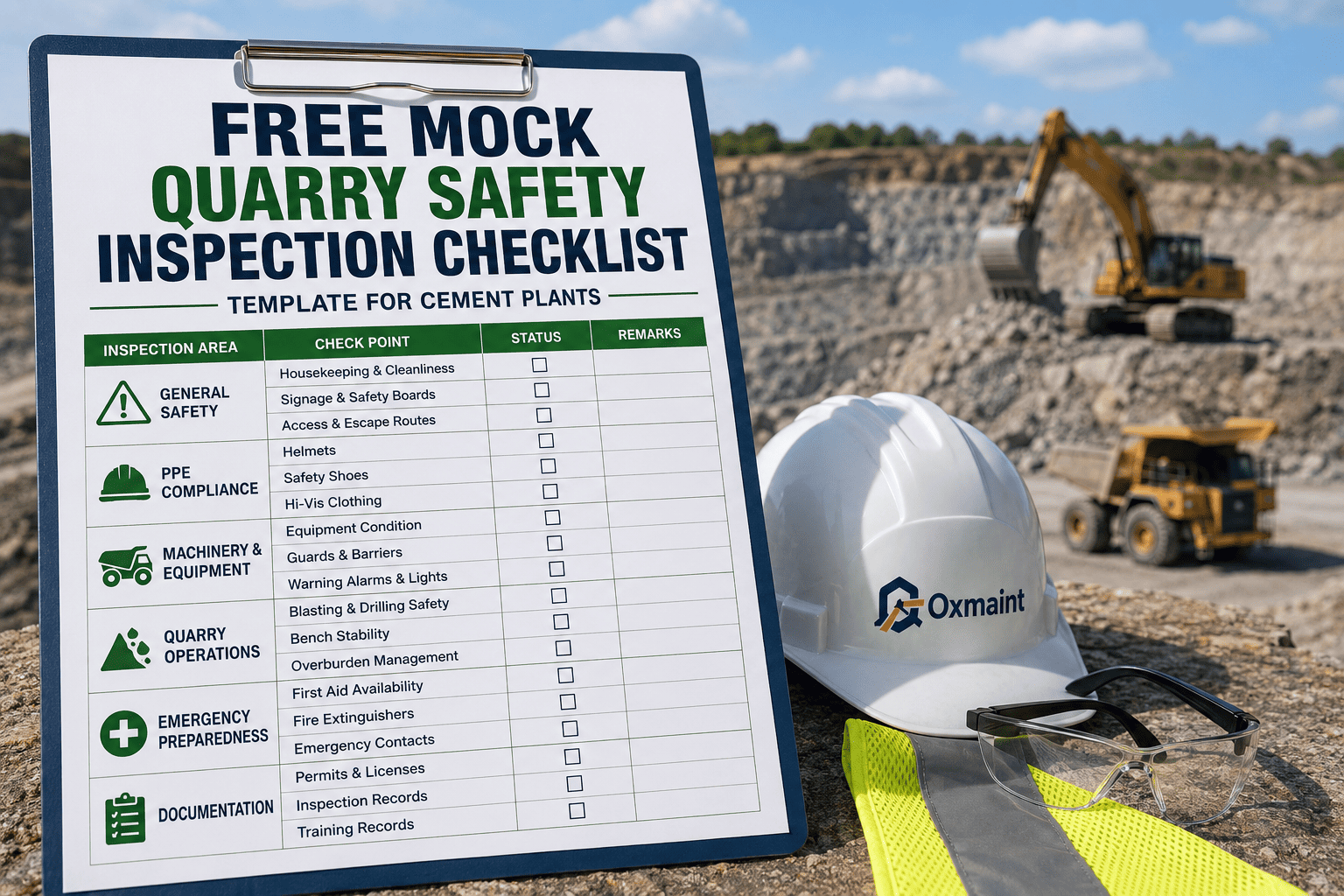
Most quarry safety inspections fail before the inspector ever reaches the pit — not because hazards go unnoticed, but because the checklist behind the inspection is incomplete, inconsistent, or lives on paper nobody can produce during an audit. A missed berm measurement, an undocumented corrective action, or a workplace examination that was never logged is exactly what regulators flag first. This guide breaks down what a defensible mock quarry safety inspection actually looks like, and gives you a ready-to-use checklist template built for cement plant quarries. Start your free trial on Oxmaint or book a live demo to see how cement plants are running audit-ready quarry inspections today.
41%
of quarry citations trace back to a workplace examination that was skipped or left undocumented
3.5x
more likely to fail a regulatory audit when corrective actions aren't tracked to closure
58%
of quarry teams cannot produce a full inspection record on request during a surprise visit
95%
audit-readiness achievable with a standardized, digitally logged inspection checklist
The 4 Gaps Breaking Quarry Safety Inspections Today
Before you can run a mock inspection worth trusting, you need to know where real quarry inspections quietly fall apart. These four gaps show up in cement plant quarries of every size, and every one of them is solvable with a proper checklist and a system behind it.
01
No Standardized Checklist
Inspectors work from memory or a checklist that changes shift to shift, so the same hazard gets checked one week and skipped the next.
02
Missing Workplace Examination Records
The competent person's daily or shift examination isn't logged consistently, leaving no proof the area was walked before work began.
03
Corrective Actions Never Closed Out
A hazard gets flagged, but there's no owner, no deadline, and no record that it was actually fixed before the next shift started.
04
No Audit Trail When It's Needed
When a regulator asks for the last six months of inspection records, the team is digging through binders instead of pulling a report.
Turn your quarry inspection into an audit-ready record
Oxmaint gives cement plant quarries a standardized checklist, corrective action tracking, and a full digital audit trail in one place.
How a Mock Quarry Safety Inspection Works: The Full Workflow
A mock inspection is only useful if it mirrors what a regulator would actually do. Run it as a structured pipeline, not a walkthrough, so every step produces a record you can hand over on request.
1
Pre-Inspection Preparation
Confirm the competent person assigned, pull the checklist for the specific area (pit face, haul road, crusher, stockpile), and review open items from the last inspection.
Competent person assigned
Area-specific checklist
Open item review
▼
2
Workplace Examination
Walk the working area before activity begins, checking ground conditions, highwalls, berms, and mobile equipment travel paths against the standard.
Ground and highwall check
Berm height verification
Equipment path review
▼
3
Hazard Identification and Evidence Capture
Every hazard found is logged with a photo, location, and severity rating in the moment, not reconstructed from memory back at the office.
Photo evidence
Severity rating
Location tagging
▼
4
Corrective Action Assignment
Each finding gets an owner and a deadline immediately, so nothing sits unresolved until the next scheduled inspection finds it again.
Owner assigned
Deadline set
Status tracked to closure
▼
✓
Audit-Ready Report Issued
A complete inspection record is generated automatically, ready to hand to a regulator or a corporate safety review the moment it's requested.
Digital inspection record
Full audit trail
Regulator-ready format
What a Compliant Quarry Inspection Actually Covers
A checklist is only as strong as what it forces you to look at. These four areas are where regulators focus first, and where a mock inspection earns its value.
G
Ground Control
Highwall stability, bench width, and berm height checked against the standard before any equipment operates near the edge.
M
Mobile Equipment
Haul roads, sightlines, backup alarms, and travel paths reviewed to confirm equipment can move through the area safely.
H
Hazard Documentation
Every hazard identified is logged with photo evidence and a severity rating the moment it's found, not after the shift ends.
C
Corrective Action Tracking
Findings are assigned an owner and deadline and tracked until closed, with a record proving the fix actually happened.
Run your next mock inspection the way a regulator would
From workplace examination to corrective action closure — Oxmaint keeps your quarry inspection audit-ready year-round.
Book a Demo
Quarry Inspection Readiness: The Checklist
Before you consider a quarry area cleared, these six items should be checked, logged, and signed off. If any box is open, the area isn't ready for a real audit.
Competent Person Assigned and Logged
A named, qualified individual is on record as having performed the workplace examination for this shift and area.
Workplace Examination Completed
Ground conditions, highwalls, berms, and travel paths have been walked and checked before work began in the area.
Hazards Documented With Evidence
Any hazard identified is logged with a photo, location, and severity rating at the time it was found.
Corrective Actions Assigned and Tracked
Every finding has a named owner, a deadline, and a status that's tracked through to closure.
Records Retained Per Regulation
Inspection records are stored digitally for the retention period required, and can be pulled up on request.
Next Inspection Scheduled
The next required examination is already on the calendar, so no area goes longer than allowed between checks.
Before vs. After: Running Inspections Without a System
Without a Standardized Checklist
Checklist varies by inspector — hazards get missed inconsistently
Workplace examinations logged on paper, if at all
Corrective actions flagged verbally and forgotten by next shift
No record ready when a regulator requests inspection history
Same hazard cited repeatedly across multiple audits
With Oxmaint Mock Inspection Workflow
One standardized checklist used across every shift and area
Workplace examination logged digitally with time and location
Corrective actions assigned, deadlined, and tracked to closure
Full audit-ready record available the moment it's requested
Recurring hazards surface early instead of at the next citation
Where Quarry Safety Inspections Go Wrong
| Inspection Problem |
Root Cause |
Fix |
| Citation for missed examination |
Workplace examination performed but never logged or dated |
Digital sign-off required at time of examination, timestamped automatically |
| Same hazard cited twice |
Corrective action was flagged but never assigned an owner or deadline |
Every finding routed to an owner with a due date and closure tracking |
| Berm or highwall violation |
Ground control checks done visually without measurement records |
Standardized checklist requires measurement entry, not a visual pass |
| Missing records during audit |
Inspection history stored on paper across multiple binders and shifts |
Centralized digital log searchable by date, area, or inspector |
| Inconsistent inspection frequency |
No system reminding teams when the next required check is due |
Scheduled inspection cycle with automatic reminders before each due date |
Key Metrics That Measure Quarry Inspection Performance
C
Checklist Completion Rate
Percentage of scheduled inspections completed on time and in full. Target for audit-ready quarries: 100%.
A
Corrective Action Closure Rate
Percentage of flagged hazards closed within their assigned deadline, not carried over shift after shift.
R
Repeat Finding Rate
How often the same hazard is cited across consecutive inspections — a falling rate signals the fix is actually working.
T
Time to Produce Records
How long it takes to pull a full inspection history on request. Digital logs bring this down from days to minutes.
95%
audit-readiness for quarries running a standardized, digitally logged inspection checklist
70%
drop in repeat citations once corrective actions are tracked to closure
Minutes
to produce a full inspection record on request, down from days of searching binders
How Oxmaint Powers Quarry Safety Inspections Across Cement Plants
Cement plant quarries running inspections on paper or scattered spreadsheets are one missed signature away from a citation. Oxmaint connects the mock inspection checklist, workplace examination log, corrective action tracking, and audit trail into one system built for quarry teams. Start for free and run your first audit-ready inspection today.
Standardized Digital Checklist
One checklist template used across every area and shift, so ground control, mobile equipment, and hazard checks are never skipped.
Workplace Examination Logging
Competent person sign-off is captured digitally with time and location, giving you proof the examination happened before work began.
Photo-Backed Hazard Records
Every hazard is logged with a photo, severity rating, and location at the moment it's found, right from the field.
Corrective Action Tracking
Findings are assigned an owner and deadline automatically, and stay open in the system until closure is confirmed.
Automated Inspection Scheduling
Required inspection cycles are scheduled with reminders, so no area goes past its due date between checks.
Full Digital Audit Trail
Every inspection, hazard, and corrective action is logged and searchable, ready to hand to a regulator on request.
Stop Preparing for Audits. Stay Ready for Them.
Oxmaint gives cement plant quarry teams a standardized checklist, digital workplace examination log, corrective action tracking, and full audit trail — so the next regulatory visit is just another day, not a scramble.
Frequently Asked Questions
What is a mock quarry safety inspection?
A mock inspection is a practice run of a regulatory-style safety inspection, using the same checklist, evidence standards, and record-keeping a real auditor would expect. It's used to find gaps in ground control, equipment paths, and hazard documentation before a real citation does.
What should be included in a quarry safety inspection checklist?
A complete checklist covers the competent person assignment, workplace examination of the working area, ground control checks like highwalls and berms, mobile equipment travel paths, hazard documentation with photo evidence, and corrective action tracking through to closure.
How often should a quarry safety inspection be performed?
Workplace examinations are typically required before work begins in an area each shift, with more detailed inspections on a daily or weekly cycle depending on the activity and area. Oxmaint schedules each cycle automatically so no area goes past its required check.
Can Oxmaint replace paper checklists for quarry inspections?
Yes. Oxmaint replaces paper checklists and spreadsheets with a digital inspection workflow that logs the workplace examination, captures hazard evidence, assigns corrective actions, and keeps a complete audit trail your team can produce instantly during a real inspection.