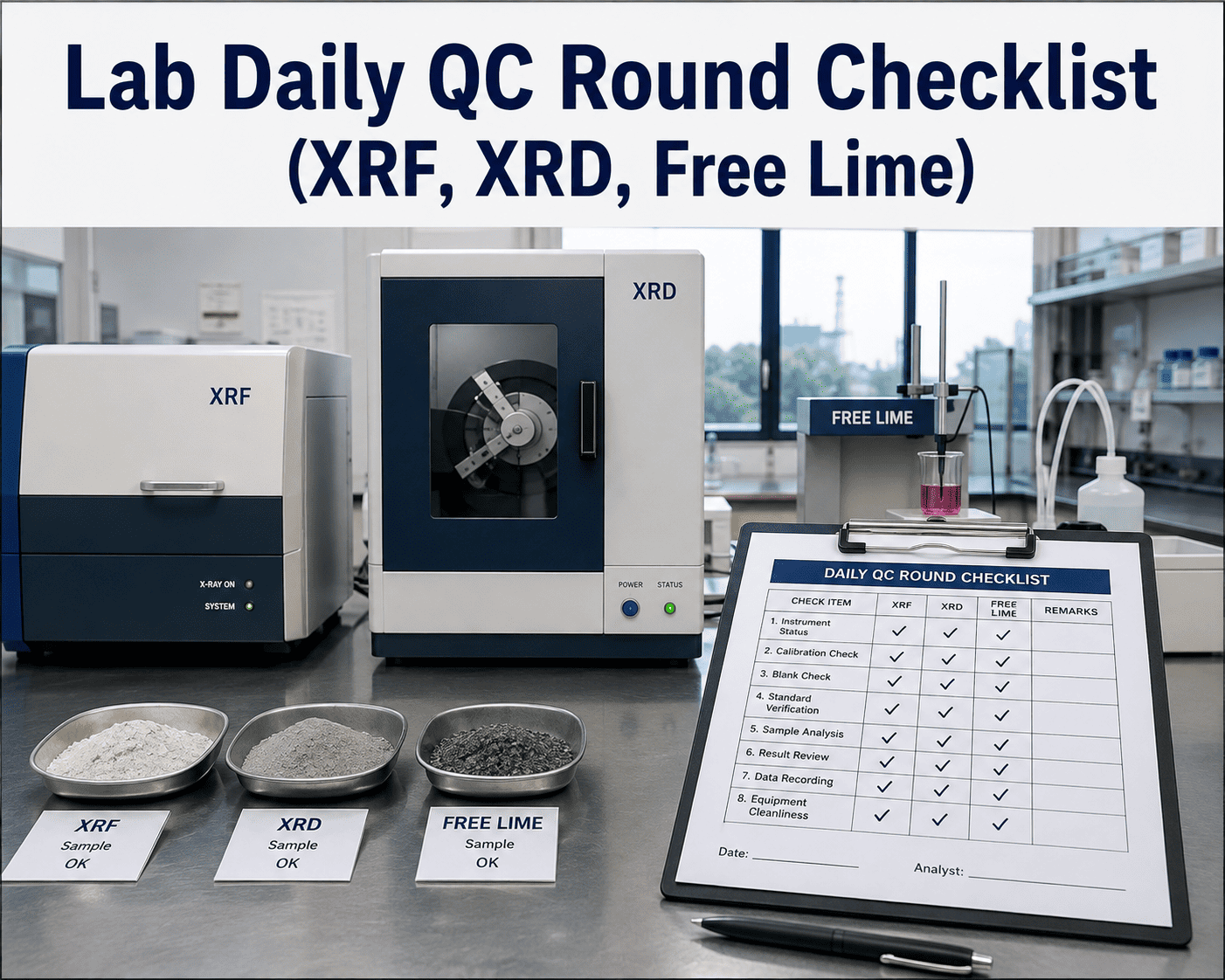
Somewhere between the kiln feed sample going into the XRF and the result appearing on a screen, the kiln keeps running. That gap is usually one to four hours, and in that window a plant can produce 200 to 800 tonnes of clinker before anyone knows whether the chemistry was actually on spec. The daily QC round is what keeps that blind spot as short as possible. Sign up to log every XRF, XRD, free lime, and Blaine result against its target and let out-of-spec readings trigger the next step automatically.
Why It Matters
Free lime has to be watched constantly, because it's the clearest signal of whether the kiln's burning zone is running at the right temperature for full reactivity. Run it too cold and free lime climbs, reactivity drops, and cement strength suffers. Catching that drift on the next round, instead of a shift later, is the difference between a small burner adjustment and a batch of off-spec clinker.
What Each Test Actually Tells You
XRF
Elemental composition of raw meal, clinker, and cement — the CaO, SiO2, Al2O3, and Fe2O3 levels that LSF, SM, and AM are calculated from.
XRD
Mineral phase quantification — confirms how much of the clinker is actually C3S, C2S, C3A, and C4AF, not just what elements are present.
Free Lime
Unreacted CaO left in the clinker — the fastest read on burning zone temperature and how completely the reaction actually finished.
Blaine
Specific surface area of ground cement — too coarse and strength suffers, too fine and the mill wastes energy over-grinding.
The Daily Round, Step By Step
Pull hourly kiln feed and shift-end clinker samples: collected on schedule so trend data stays continuous instead of showing gaps whenever a round gets skipped
Prepare the sample correctly for each instrument: fused disk or pressed pellet for XRF, ground powder for XRD, so a preparation shortcut doesn't undermine an otherwise good reading
Run free lime on every clinker sample: since it's the fastest available signal of kiln burning zone temperature and gets checked more frequently than a full XRF/XRD run
Check Blaine against the target band: confirming fineness is on spec before finished cement moves on, not after it's already loaded out
Log every result and flag deviations immediately: a high free lime or low Blaine reading routed to the shift operator right away, not discovered at the next handover
From Lab Result To Corrective Action, Automatically
When free lime rises above target or Blaine falls below spec, Oxmaint doesn't just log the number — it can trigger a corrective work order for the relevant equipment, from a kiln thermocouple check to a classifier inspection. Sign up for a free trial to connect your lab data, or book a demo to see it configured for your plant.
Why Frequency Isn't The Same For Every Test
Not every test runs on the same clock, and that's by design rather than a shortcut. Free lime is quick enough to check on nearly every clinker sample because it needs to catch kiln temperature drift in near real time. A full XRF-based Bogue mineralogy calculation, by contrast, typically runs once or twice per shift, because it needs a properly fused or pressed sample and calibrated equipment that isn't practical to run continuously. Blaine and XRD sit somewhere in between, tied more to production batches than to the clock. Matching test frequency to what each result is actually protecting against is what keeps the lab round useful instead of just busy.
Typical Round Frequency By Test
| Test |
Typical Frequency |
Sample Point |
| Free Lime |
Every clinker sample, near-continuous |
Clinker discharge |
| XRF |
Once or twice per shift |
Kiln feed and clinker |
| XRD |
Daily, or when phase drift is suspected |
Clinker composite |
| Blaine |
Per grinding batch |
Finish mill outlet |
Frequently Asked Questions
Q
Why does free lime get checked so much more often than XRD?
Free lime is a fast, simple test that directly reflects kiln burning zone temperature, so it needs to be checked near-continuously to catch temperature drift early. XRD requires more sample preparation and instrument time, so it's reserved for confirming mineral phase composition on a daily or as-needed basis.
Q
What's the difference between what XRF and XRD each tell you?
XRF measures elemental composition — how much calcium, silica, alumina, and iron are present. XRD measures mineral phase composition — how much of the clinker actually formed into C3S, C2S, C3A, and C4AF. The same elemental result can correspond to different phase outcomes, which is why both tests matter together.
Q
What happens to production while a sample is being tested?
The kiln keeps running during the one to four hour window between sampling and a result coming back, which is why the daily round schedule matters as much as the tests themselves — the shorter and more consistent the interval between samples, the less clinker gets produced with unknown quality.
Every Round Logged, Every Deviation Caught Early
Oxmaint keeps your XRF, XRD, free lime, and Blaine results tied to sample, time, and target band, flags out-of-spec readings the moment they're logged, and links straight through to a corrective work order when equipment is the cause. Sign up for a free trial to run it on your own lab round, or book a demo to see it configured for your plant.