A pump rarely fails without warning — it tells you first through a bearing that runs a little warmer than usual, a seal that weeps a bit more each shift, or a vibration reading that has quietly doubled since the last inspection. FMCG plants that catch these signals early turn a scheduled seal change into routine maintenance; plants that miss them turn the same seal into an unplanned shutdown, sometimes a full CIP cycle restarted from the beginning. Centrifugal and positive displacement pumps fail differently, wear differently, and need genuinely different maintenance attention — treating every pump on the line the same way is one of the most common reliability mistakes a plant can make. This guide breaks down how to maintain both pump types across a UK FMCG plant, the early warning signs worth tracking before a failure, and what a genuinely predictive reliability programme looks like in practice on the floor. If your pump maintenance still starts after the leak is already visible, start a free trial with OxMaint AI to see how a predictive record catches the signal instead of the failure.
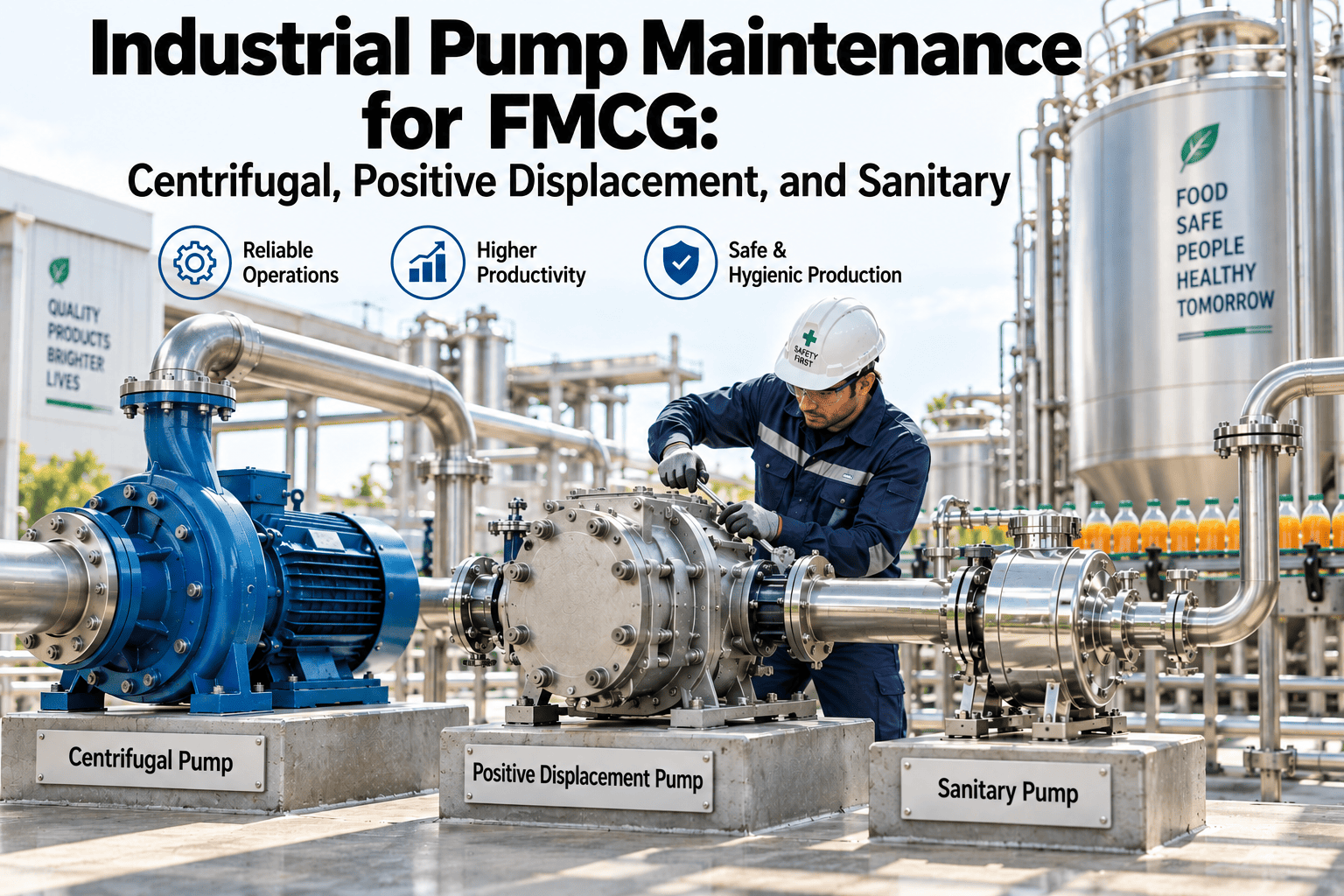
Industrial Pump Maintenance for FMCG: Centrifugal, Positive Displacement, and Sanitary
How UK FMCG plants keep centrifugal, positive displacement, and sanitary pumps running reliably — and catch a failing seal or bearing weeks before it becomes a shutdown on the line.
Centrifugal or Positive Displacement — Maintaining the Right Pump for the Job
Centrifugal and positive displacement pumps move fluid through entirely different mechanisms, and that difference shapes everything about how each one should be maintained. A centrifugal pump spins an impeller to create velocity; a positive displacement pump traps and forces a fixed volume of fluid with every rotation or stroke. Applying a centrifugal maintenance plan to a positive displacement doser — or the reverse — means checking the wrong things at the wrong intervals, and often missing the one check that would have caught the actual failure mode developing on that specific pump.
| Attribute | Centrifugal Pump | Positive Displacement Pump |
|---|---|---|
| Best Suited Fluid | Low-viscosity, consistent liquids such as water or thin ingredient blends | High-viscosity, shear-sensitive, or particulate-containing products like purees and sauces |
| Flow Under Pressure | Flow rate drops as discharge pressure rises | Flow rate stays consistent regardless of discharge pressure |
| Typical FMCG Use | Water transfer, CIP supply, low-viscosity ingredient movement | Dosing, metering, dairy, chocolate, and other shear-sensitive product transfer |
| Seal Wear Pattern | Faster wear at higher operating speeds | Slower wear — lower operating speed typically extends seal life |
| Maintenance Focus | Bearing temperature, vibration, and pump-motor alignment | Seal or diaphragm condition, internal clearance wear, and valve function |
This is not a small distinction dressed up as an important one — a technician trained to chase alignment and vibration on a centrifugal pump can walk straight past a worn diaphragm on a positive displacement unit, simply because nothing on their checklist told them to look for it.
The Five Warning Signs Before a Pump Actually Fails
Almost no pump fails out of nowhere — it moves through a sequence of escalating signals first, and the plants that catch it earliest in that sequence are the ones that schedule the repair instead of reacting to it. Below is roughly how that sequence tends to unfold, from the earliest and easiest signal to spot through to the one that means stop the pump right now, before it runs another cycle.
A slow, sustained rise above baseline usually points to lubrication loss, contamination, or a load the bearing was not specified to carry — and it is one of the easiest signals to log on a routine round.
Slight seeping from a mechanical seal is often acceptable, but a rising drop-per-minute count means the seal faces have lost tolerance and degradation from that point tends to accelerate quickly.
A reading roughly twice the pump's normal baseline is a widely used rule of thumb for imbalance, misalignment, or bearing wear serious enough to warrant immediate investigation rather than waiting for the next scheduled check.
A pump running measurably below its rated curve at a known flow rate is often losing internal clearance or fighting a suction problem, both of which get more expensive to fix the longer they run unaddressed.
Audible mechanical distress at this stage usually means bearing or impeller damage already in progress — the pump should be stopped and inspected rather than left running until the end of the shift.
A Pump Maintenance Cadence That Actually Catches Problems Early
Every one of the five warning signs above is visible well before it becomes a failure, provided someone is actually looking at the right interval. The cadence below spreads that responsibility across the shift, the week, and the quarter, so no single check carries the entire burden of catching a developing fault.
Visual check for leaks, unusual noise, and perceptible vibration at every pump on shift.
Lubricant level and condition checked, motor power draw recorded against baseline.
Portable vibration measurement taken and seal leakage drop-rate logged and compared.
Pump-motor alignment checked, anchor bolts and foundation inspected for movement.
Internal inspection of impeller, wear rings, and seal, plus full laser alignment.
OxMaint logs vibration, bearing temperature, and seal leakage against baseline every time a technician checks a pump — flagging drift automatically instead of waiting for the annual inspection to notice it.
Sanitary Pumps Have Their Own Rules
A pump in direct food contact has to satisfy hygienic design and cleanability requirements on top of everything a standard industrial pump needs, and skipping this layer of maintenance turns a mechanical issue into a food safety one. Most FMCG plants build their sanitary pump programme around three specific requirements that a standard PM checklist does not automatically cover.
Polished stainless steel product-contact surfaces and crevice-free design need periodic inspection for scoring, pitting, or gasket wear that can trap product and harbour bacteria between cleaning cycles.
A pump rated for clean-in-place and sterilise-in-place cycles still needs its seals and elastomers checked for thermal and chemical degradation, since repeated CIP exposure is what typically shortens their working life.
Gaskets and seal elastomers rated for one product can swell, crack, or degrade with another — a material substitution during a repair needs the same compatibility check as the original specification.
What a Reliability Dashboard Should Actually Show
A pump maintenance programme built on individual work orders tells you what happened. A reliability programme built on trend data tells you what is about to happen — and the difference between the two usually comes down to whether the four metrics below are actually visible in one place.
Pumps ranked by repair frequency and cost, surfacing the handful of assets consuming a disproportionate share of the maintenance budget quarter after quarter.
Every logged vibration reading trended against each pump's own baseline, with an alert the moment a reading crosses the threshold that historically preceded a failure.
Mean time between failures broken out by centrifugal, positive displacement, and sanitary pumps, showing which category is genuinely driving downtime rather than assuming it is spread evenly.
Replacement part spend tracked over time per pump, making it obvious when a repeated seal or bearing failure is cheaper to solve with a root-cause fix than another reactive swap.
How OxMaint Builds Pump Reliability Automatically
None of this requires a separate reliability engineering project bolted on top of maintenance. Built correctly, the trend data comes from the same readings a technician was already taking on their normal route.
Vibration, bearing temperature, and seal leakage readings are logged against each individual pump's own history, not a generic plant-wide average that hides which asset is actually drifting.
Centrifugal, positive displacement, and sanitary pumps each get a checklist built around their own failure modes, so a technician is never checking bearing alignment on a diaphragm pump that has none.
A vibration or temperature reading that crosses its threshold generates a corrective work order immediately, instead of waiting for the trend to be spotted during a manual monthly review.
Bad actor rankings, MTBF, and spend trends sit on one dashboard covering every pump on site, so reliability decisions are based on the whole fleet rather than whichever pump failed most recently.
Industrial Pump Maintenance — What FMCG Plants Ask Most
What's the biggest difference between maintaining a centrifugal and a positive displacement pump? +
How often should vibration readings actually be taken on a production pump? +
Does a sanitary pump really need a different maintenance plan than a standard industrial pump? +
What does "bad actor" mean in pump reliability, and why does it matter? +
Can pump reliability tracking realistically be done without dedicated vibration analysts on staff? +
OxMaint builds a pump-type-specific PM plan, logs every vibration and seal reading against its own baseline, and flags drift automatically — so the next pump failure on your line shows up as a scheduled repair instead of an unplanned stop with product still in the line.