The golden thread is the duty most accountable persons underestimate, because it is not a document you produce once and file. Under section 88 of the Building Safety Act 2022 and the Higher-Risk Buildings (Keeping and Provision of Information etc.) (England) Regulations 2024, prescribed information about a higher-risk building must be held electronically, kept accurate and current, and handed over intact whenever responsibility for the building changes. In occupation, most of that information is generated by maintenance activity, which is precisely where paper certificates and shared drives stop being defensible. Oxmaint keeps the safety-critical asset record and the evidence of every check in one live system, and you can see it in your own building at app.oxmaint.ai.
Building Safety Act 2022 / Higher-risk buildings / Accountable persons
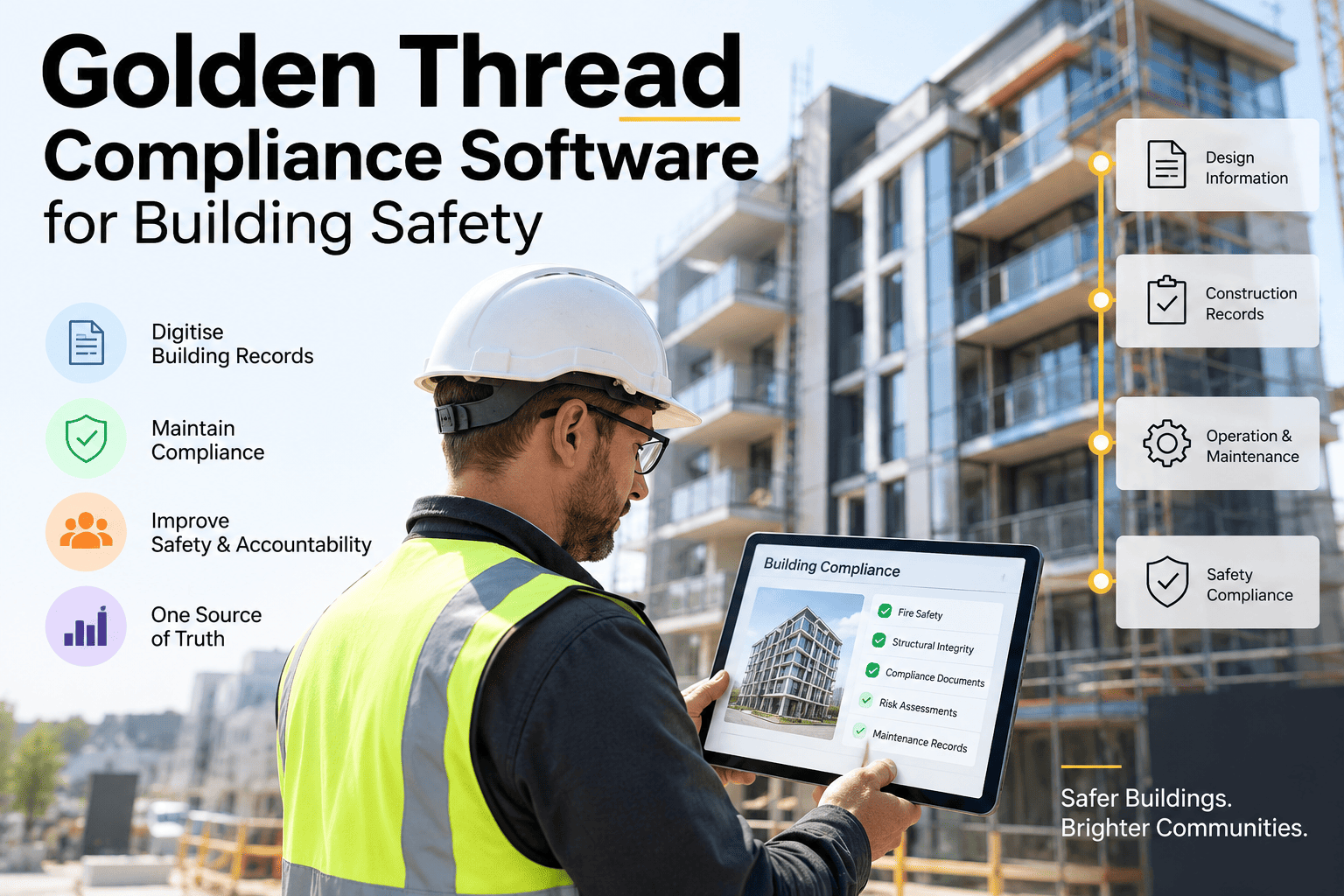
Golden Thread Compliance Software for Building Safety
Hold design, construction and occupation information as one live digital record, tie every safety-critical asset to the checks that keep it working, and produce evidence for the Building Safety Regulator without reassembling it from filing cabinets and inboxes.
Layer 1
Design and construction information
Drawings, specifications, fire strategy, structural design, materials and products, and the evidence of building regulations compliance carried through the gateways
Layer 2
Occupation information
Safety case report, fire risk assessments, the safety-critical asset register, planned and reactive maintenance records, inspections, tests and mandatory occurrence reports
Layer 3
Change control and handover
A versioned record of what changed, when, why and on whose authority, transferable in full when the accountable person or the managing agent changes
The legal foundation underneath the phrase
Golden thread is shorthand, not a statute in itself. The duty is assembled from an Act and a set of regulations, and knowing which instrument does what makes the compliance conversation far more concrete.
Building Safety Act 2022, section 88
Places the duty on accountable persons to keep prescribed information and documents about a higher-risk building in electronic form, and to give that information to others who need it.
SI 2024/41, Keeping and Provision of Information
Prescribes, in its schedules, exactly which information and documents make up the golden thread in occupation, and how it must be provided to residents, incoming accountable persons and the regulator.
SI 2023/907, Management of Safety Risks
Sets the standards the information must be kept to, covering accuracy, currency, security and accessibility, and links the record to the wider duty to assess and manage building safety risks.
Building (Higher-Risk Buildings Procedures) Regulations 2023
Governs the design and construction phase, including what must be submitted at gateway two and what golden thread information must accompany a gateway three completion application.
Registration Regulations 2023
Requires occupied higher-risk buildings to be registered with the Building Safety Regulator and identifies who the accountable and principal accountable persons are for each part of the building.
Fire Safety Order and Fire Safety (England) Regulations 2022
Continue to apply in parallel, generating the fire door checks, firefighting equipment checks and premises information that feed directly into the occupation-phase record.
A building is in scope when all three conditions are met
Condition one
At least 18 metres in height, or at least seven storeys
and
Condition two
Contains at least two residential units
and
Condition three
Located in England, in occupation or being built
Buildings that fall outside these thresholds have no statutory golden thread duty, but the underlying expectation has spread regardless. Insurers, lenders, freeholders and warranty providers increasingly ask mid-rise and social housing landlords for the same standard of digital building information, which is why many portfolios now apply the approach well below the 18 metre line.
What the record has to contain during occupation
Design and construction information is largely inherited. Occupation information is created every week by the people maintaining the building, and it is the half that decays fastest if there is no system holding it.
Inherited from design and construction
As-built drawings and structural design information
Fire strategy and compartmentation details
External wall system construction and materials
Product and material specifications with performance data
Commissioning results for fire and life safety systems
Operation and maintenance manuals for installed plant
Generated during occupation
Safety case report and the evidence supporting it
Current fire risk assessment and remedial actions
Safety-critical asset register and its condition history
Planned maintenance, inspection and test records
Reactive repairs, defects and their closure evidence
Mandatory occurrence reports and resident engagement records
Six standards the information has to meet
The regulator's guidance is less concerned with which platform holds the record than with whether the record behaves properly. These are the tests any golden thread solution has to pass.
Accurate
Reflects the building as it actually is today, including alterations, replacements and repairs made since handover.
Up to date
Updated as changes happen rather than in a periodic catch-up exercise that leaves the record trailing reality.
Digital
Held electronically as the primary record, not as scans of paper produced retrospectively to satisfy a request.
Secure
Protected against loss, tampering and unauthorised access, with clear control over who can change what.
Accessible
Available to the people entitled to it, including residents, the regulator and incoming accountable persons.
Usable
Structured so a person can find a specific answer quickly, rather than dumped as thousands of unsorted files.
Usable is where most portfolios fail
A cloud folder containing every certificate the building has ever received technically satisfies digital and arguably satisfies secure. It fails usable and it usually fails accurate, because nothing in a folder tells you that the smoke control damper test due last month never happened. A golden thread has to be able to answer questions, not merely store answers.
Expectation against reality in most occupied blocks
The gap between the duty and the day-to-day position is rarely about willingness. It is about where information lands when a job finishes and whether anything connects that job to the asset it was performed on.
Safety-critical assets and the records they generate
The occupation golden thread is substantially a maintenance record. Mapping each safety-critical asset to the routine activity it requires shows exactly which day-to-day workflows the record depends on.
Every row is a work order waiting to happen
Read the table as a maintenance programme rather than a compliance list and the software requirement becomes obvious. You need an asset register, recurring schedules, mobile completion, defect tracking and reporting. A maintenance management platform already does all five, and the golden thread becomes an output of running the building properly rather than a separate administrative project.
Four levels of golden thread maturity
Most accountable persons recognise their building somewhere on this ladder. The step that matters is the one from stored information to connected information, because that is where the record starts answering questions on its own.
Level one
Scattered
Information sits with contractors, in personal inboxes and in site files. Nobody can say with confidence what exists until somebody asks for it and a search begins.
Level two
Stored
Documents are collected into a shared drive with a folder structure. Retrieval is possible but slow, currency is unverified and nothing flags a check that was never completed.
Level three
Structured
Assets are registered individually and records attach to the asset rather than to a date. The building can be interrogated asset by asset and gaps become visible instead of assumed.
Level four
Live
Schedules, completions, defects and changes update the record continuously. Evidence exists because the building is being maintained, and a regulator request is a report rather than a project.
How Oxmaint holds the occupation half of the golden thread
Oxmaint is not a document repository pretending to be a building safety system. It is maintenance management software, and the golden thread duties in occupation are maintenance duties with a statutory audience.
Safety-critical asset register
Every door set, damper, riser, alarm panel, lift and lighting circuit held as an identified asset with location, specification, documents and complete history attached to it rather than to a folder.
Preventive maintenance scheduling
Statutory and manufacturer frequencies set once per asset class, with due, upcoming and overdue states visible per building so a missed cycle surfaces before it becomes a gap in the record.
Mobile inspections and checklists
Standard forms completed on site by in-house teams and contractors, with photographs, readings and outcomes captured at the point of work and timestamped automatically.
Work orders and corrective maintenance
Defects raised from a failed check carry a priority, an owner and a target date, and remain open in reporting until the fix is completed and verified rather than verbally confirmed.
Compliance records and audit trail
Each action is attributed to a person and a time and cannot quietly disappear, which is what turns a set of maintenance records into evidence somebody outside the organisation can rely on.
Dashboards and reporting
Building-level and portfolio-level views of completion, outstanding defects and overdue statutory checks, exportable when the regulator, an insurer or an incoming duty holder asks.
Condition-based workflows
Where monitoring data exists on plant such as lifts, pumps or ventilation, condition triggers maintenance earlier, which strengthens the safety case as well as reducing unplanned failure.
Inventory and spares
Critical spares tracked against the assets that use them, so a safety-critical defect is not left open for weeks while a replacement part is sourced from scratch.
Building the record without stopping the building
Accountable persons rarely have the luxury of pausing operations to build a golden thread. The workable route is to start with the assets carrying the highest safety consequence and widen coverage from there.
Phase one
Establish the safety-critical asset register
Survey what is actually installed, building by building, and register each item with a stable reference. Almost every portfolio finds assets nobody was maintaining and maintained items nobody had registered.
Phase two
Attach the inherited documents
Link existing drawings, manuals, commissioning results and certificates to the assets they describe, so the design information and the maintenance history live against the same record.
Phase three
Switch on statutory schedules
Apply the required frequencies to each asset class and bring contractor-delivered activity into the same schedule so the building has one maintenance calendar rather than several.
Phase four
Close the defect loop
Route every failure into a tracked corrective job with verification on completion, which is the single biggest difference between a record that looks complete and one that genuinely is.
Phase five
Report and rehearse
Run the extract you would give the regulator on a routine basis. Rehearsing the request is how gaps are found while there is still time to close them quietly.
Golden thread software questions from accountable persons
What building safety, asset and facilities teams most often want clarified before committing to a system.
Is Oxmaint a complete golden thread solution on its own?+
It covers the occupation half comprehensively: the safety-critical asset register, schedules, inspections, defects and evidence. Design and construction documents can be attached to the assets they relate to so both sides sit together.
Who does the duty actually fall on?+
Accountable persons hold it, with the principal accountable person responsible overall. Where a building has more than one accountable person, each keeps the information relating to their part of the building.
Can contractors update the record directly?+
Yes. Contractors complete the same mobile checklists against the same assets, so third-party activity builds the record as it happens instead of arriving later as a certificate to be filed.
Schedule a demo to see the contractor workflow.
What happens when a building changes hands?+
Because the history sits against assets rather than in individual inboxes, the complete record for the building can be exported and handed to the incoming duty holder rather than partially reconstructed.
Is this useful below the 18 metre threshold?+
Many landlords apply the same approach to mid-rise stock because insurers, lenders and residents expect it.
Start a free trial and set it up on a single building first.
Give every safety-critical asset in your higher-risk buildings a live record that updates itself as the building is maintained, so the golden thread is something you keep rather than something you rebuild.