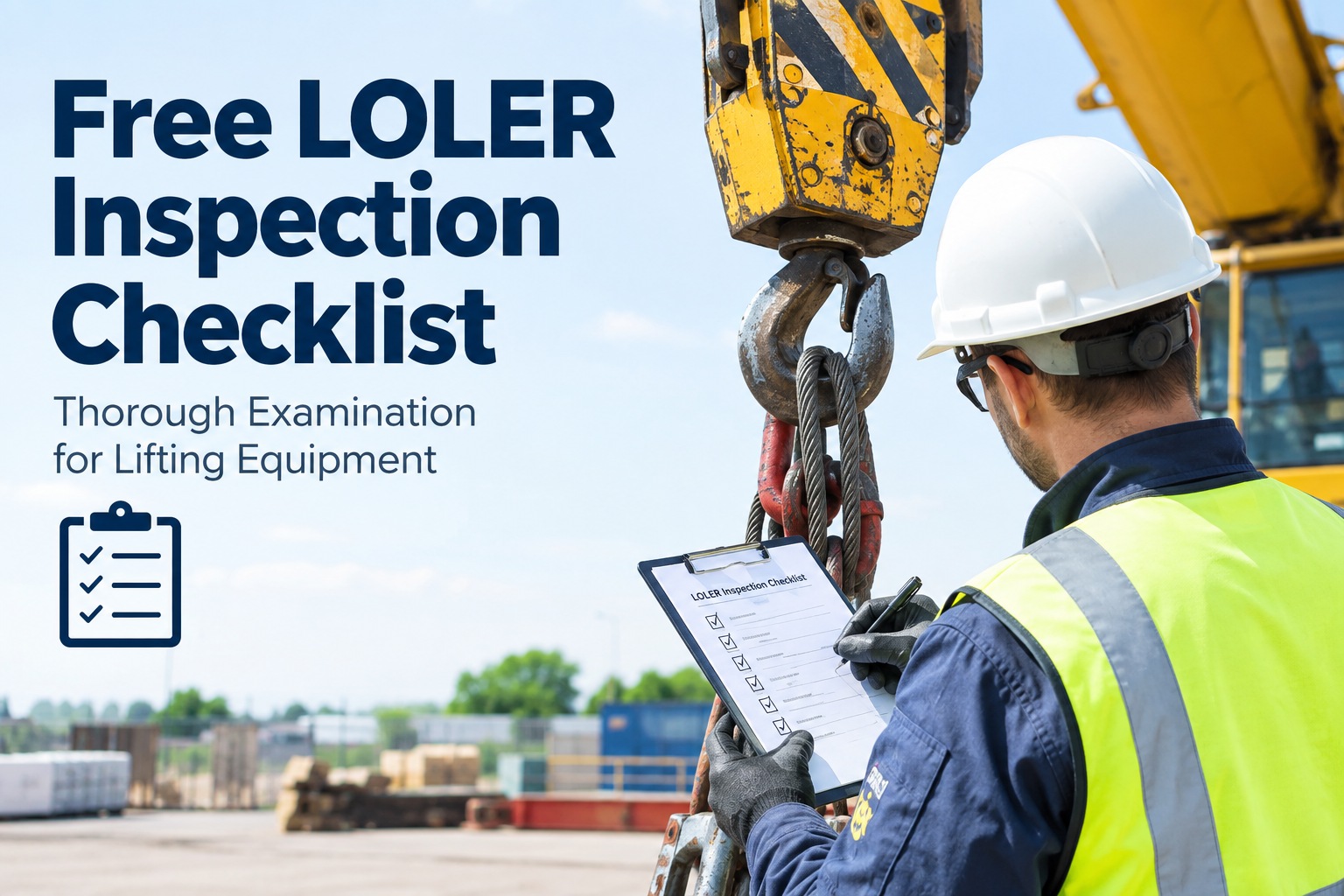
LOLER doesn't ask for a checklist — it asks for a Report of Thorough Examination containing eleven specific items, signed by a competent person. Most compliance failures don't happen because someone skipped a step; they happen because the steps ran in the wrong order, or because a sling got forgotten while the crane above it stayed perfectly compliant. This page follows the actual examination journey from first use to renewal, so nothing quietly falls through the sequence. Sign up free to digitise this checklist and keep every examination record in one accessible place.
Free LOLER Inspection Checklist
PDF and Excel-ready, mapped to Schedule 1 of LOLER 1998.
The Examination Journey, Start to Finish
LOLER compliance isn't one event — it's a sequence that starts before equipment is ever used and repeats on a clock that never really stops. Most checklist templates online skip straight to "what to check" and miss the sequence around it, which is exactly where compliance quietly breaks.
Follow the five stages below in order, and the checklist itself becomes the easy part.
1
Before First Use
Every new item of lifting equipment needs a thorough examination before it enters service — unless it arrives with a declaration of conformity less than 12 months old and wasn't assembled on site.
2
Installed or Assembled
Where safety depends on how equipment was installed — a crane runway, a fixed hoist — a further examination is required once it's in place, before it's relied on.
3
The Recurring Examination
This is the one most checklists focus on — but it only works if the interval and the checklist itself are right. Both are broken out below.
4
After Something Happens
Damage, a major modification, or a long period out of use each reset the clock — a fresh examination is due regardless of when the last one happened.
5
Report, Record, Repeat
A signed Report of Thorough Examination is filed, the next due date is set from today's date, and the cycle continues.
Why the Wrong Interval Is So Easy to Apply
Teams rarely apply the wrong interval on purpose — it usually happens because a spreadsheet register treats "lifting equipment" as one category instead of two. Once accessories and load-only equipment share a column, the 12-month default creeps onto items that actually need 6. Sign up free and split your register by interval type to see the gap immediately.
Stage 3, Zoomed In: Getting the Interval Right
The recurring examination is where most registers actually live — and where the wrong interval quietly slips in. Regulation 9 sets two defaults, and a written examination scheme is the only legitimate way to vary them.
People & Accessories
Any equipment used to lift people, plus every lifting accessory — slings, chains, shackles, eyebolts — regardless of what they're attached to.
Loads Only
Cranes, hoists, forklifts and other equipment that only lifts loads, not people — provided no written scheme says otherwise.
A sling is lifting equipment in its own right, not "part of" the crane it hangs from. Give it its own 6-month interval and its own traceable record — this exact gap is the most common finding in HSE lifting-related notices.
What Only a Thorough Examination Can Do
Not every check discharges Regulation 9. A year of diligent daily checks doesn't substitute for one missed statutory examination — the law is specific about which layer of checking counts.
Pre-Use Check — operator, every use
Doesn't count
Inspection — between examinations, per risk assessment
Doesn't count
Thorough Examination — competent person, at interval
Satisfies Reg 9
See LOLER Compliance Tracked Automatically
Watch how OxMaint schedules thorough examinations, flags overdue equipment and keeps every report accessible in one place.
When the Examination Finds Something
What happens after the checklist is completed depends entirely on what it found — and getting this wrong is its own compliance failure, separate from the examination itself. Sign up free and link every defect to a work order automatically.
Immediate Risk
Equipment stops working now. Duty holder and enforcing authority notified, verbally and in writing.
→
Defect, Not Imminent
Stays in service. Remedial deadline set and recorded on the report itself.
→
Clear
Pass recorded. Next due date calculated from today, not the old deadline.
Expert Perspective: Where LOLER Compliance Actually Breaks
Book a free demo to see how accessories get tracked separately from the equipment they're used with.
The most common finding isn't a missed crane examination — it's the accessories cupboard. A sling, shackle or eyebolt is lifting equipment in its own right under LOLER, with its own 6-month interval and its own traceable record. Registers built from spreadsheets routinely show a pristine crane history sitting next to accessories with no markings anyone can trace to a report.
Track Accessories Separately
Every sling and shackle needs its own identification and interval, not a line item under the crane.
Reset From Completion Date
The next interval runs from today's examination, not the previous due date, or intervals silently drift.
Competent Person Must Be Independent
Your own maintenance engineer cannot examine equipment they service themselves.
A Note on the Current LOLER Review
HSE ran a Call for Evidence reviewing LOLER 1998 through late 2025, with outcomes expected during 2026. The intervals and stages described here reflect the regulations as they currently stand — check current HSE guidance periodically rather than treating any single page as a permanent reference. Book a free demo to see how OxMaint keeps intervals current as requirements evolve.
Frequently Asked Questions
Is there such a thing as a "LOLER certificate"?
Not legally. The statutory document is a Report of Thorough Examination containing the items specified in Schedule 1 of LOLER 1998. Many inspection companies issue documents titled "LOLER certificate" as a commercial format, which is fine provided the content matches Schedule 1 — check the content, not just the title.
Do lifting slings really need examining every 6 months?
Yes. Slings, along with other lifting accessories such as chains, shackles and eyebolts, fall under the 6-month interval regardless of what they're attached to. Applying the 12-month interval used for cranes or hoists to accessories is a common and non-compliant mistake.
Can pre-use checks replace a thorough examination?
No. Pre-use checks by an operator and periodic inspections are useful safety practices, but only a thorough examination by a competent person, recorded in a Report of Thorough Examination, satisfies LOLER Regulation 9. A year of diligent pre-use checklists does not substitute for a missed statutory examination.
Who counts as a "competent person" under LOLER?
A competent person has the practical and theoretical knowledge and experience to detect defects and assess their significance, and must be sufficiently independent and impartial to give an objective assessment. This typically rules out your own maintenance engineer examining equipment they routinely service.
What happens if a thorough examination finds a defect?
Where a defect involves an existing or imminent risk of serious injury, the equipment must be taken out of service immediately until remedied. The competent person notifies the duty holder verbally and in writing, and in many cases sends a copy of the report to the relevant enforcing authority.
Keep Every LOLER Record in One Place
Schedule examinations, track accessories separately and keep every Report of Thorough Examination accessible. See it with your own equipment in a free 30-minute walkthrough.