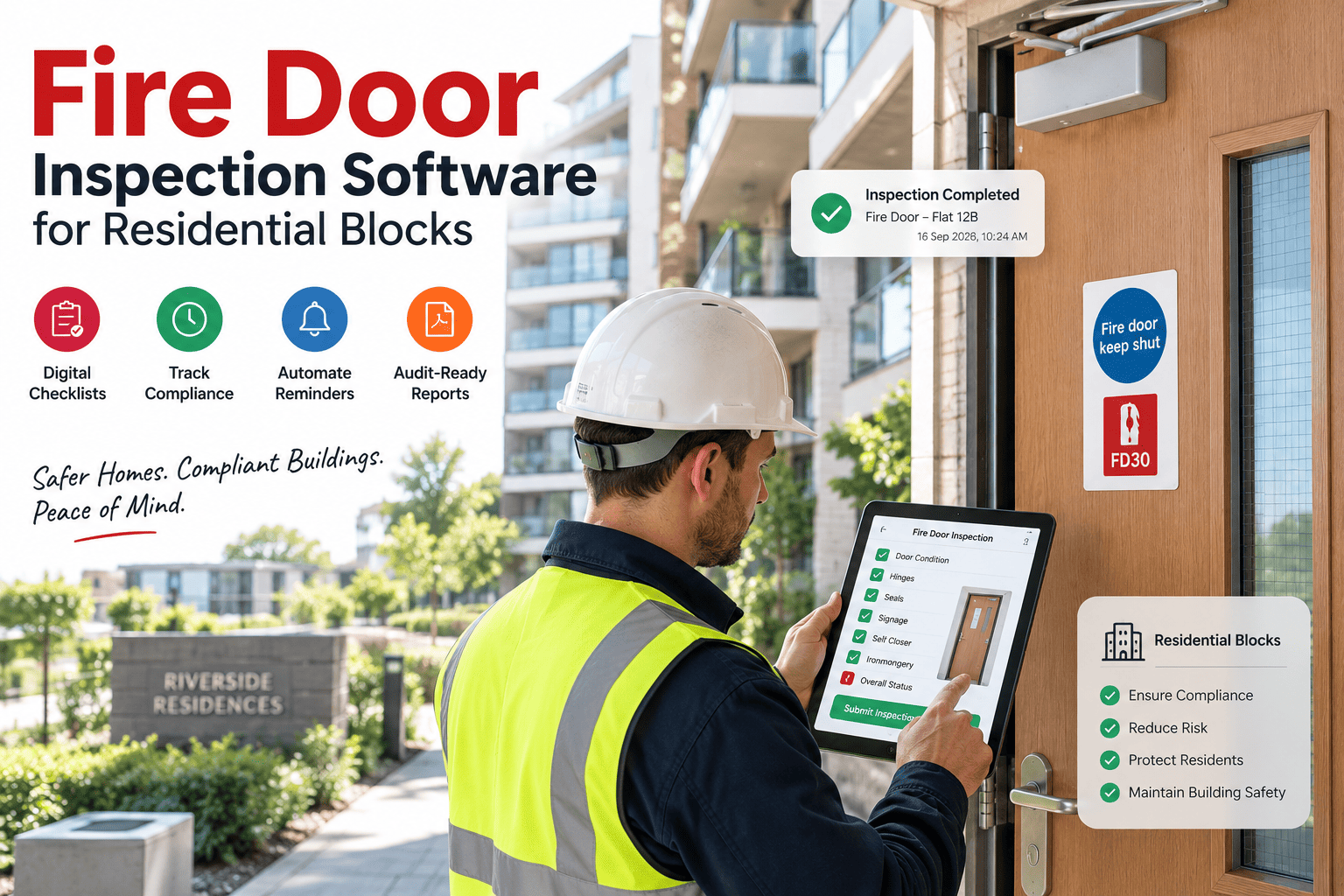
Fire door inspection is one of the few maintenance duties in a residential block where the paperwork carries almost as much weight as the physical check itself. A responsible person can inspect every communal door on schedule, correct every defect found, and still fail an audit because the evidence sits in a paper folder, a phone camera roll and three separate email threads. Regulation 10 of the Fire Safety (England) Regulations 2022 did not just introduce a checking frequency — it introduced an expectation that the record is retrievable, dated, attributable and complete. Most blocks discover the gap only when an enforcement officer, an insurer or a leaseholder asks to see the last twelve months of checks. The practical answer is to capture the inspection and the evidence in the same action, on the door, at the moment of the check, which is exactly how OxMaint structures fire door inspections inside its maintenance management platform.
Every Door Checked. Every Check Evidenced.
OxMaint turns quarterly communal and annual flat-entrance fire door inspections into scheduled, photo-evidenced records with a timestamped audit trail your golden thread can actually stand on.
Why Fire Door Inspection Became a Records Problem, Not a Checking Problem
Almost every block manager we speak to is already doing fire door checks. Somebody walks the stairwells, looks at the doors, notes what is wrong, and raises a repair. The physical discipline is rarely the weak point. The weak point is what survives the walk: a tick-sheet that says "all doors OK" with no door-level identification, no photograph, no inspector name, and no way to prove that the door on the third-floor lobby was actually opened, released and observed rather than glanced at from the far end of the corridor.
That matters because a fire door record has to answer four separate questions under scrutiny, and a tick-sheet answers only one. Which specific door was inspected? When exactly? By whom, and with what competence? And what condition was it in at that moment — demonstrably, not by assertion? A folder of photocopied checklists cannot answer any of those with confidence eighteen months later, particularly when the original inspector has left the contractor.
The second structural problem is that fire doors do not degrade on a schedule. They degrade because a resident props one open with a fire extinguisher every morning, because a delivery trolley clips the same leaf twice a week, because a closer is adjusted by a well-meaning caretaker to stop a slam complaint. The defect appears between inspections, and if your record system only captures the inspection, you have no way of spotting that one door on one landing produces four times as many defects as any other door in the building. You keep repairing it and never ask why.
- Door identity recorded as a description, not a unique asset
- Evidence is a photo on a personal phone, if at all
- Defect and repair live in two unconnected systems
- Inspector competence not attached to the record
- Producing twelve months of history takes days
- Every door is a numbered asset with its own history
- Photo evidence attaches to the specific check point
- Defect auto-raises a linked work order with a due date
- Inspector identity and training stamped on the record
- Twelve months of history exports in under a minute
What the Inspection Regime Actually Asks For
The regulatory picture for residential blocks in England is more specific than many managing agents realise, and the distinction between the two duties is where most compliance gaps open up. Communal fire doors in buildings above eleven metres require checks at least every three months. Flat entrance doors that open onto communal areas in the same buildings require a best-endeavours annual check. The phrase "best endeavours" is not a get-out — it is a duty to try, repeatedly, and to record the attempts. A door you could not access is only defensible if you can show three logged attempts, a letter, and a follow-up date.
Below eleven metres, the statutory checking frequency does not bite in the same way, but the general fire precautions duty under the Fire Safety Order still applies, and the risk assessment will almost always specify a checking regime. Blocks that treat the eleven-metre line as permission to stop checking tend to find that their insurer and their fire risk assessor disagree. A sensible policy is to run the same inspection structure everywhere and vary only the frequency.
| Door Type | Frequency | Scope Of Check | Evidence To Capture |
|---|---|---|---|
| Communal fire door, building over 11m | Quarterly | Full condition check, closer, seals, gaps, glazing, signage | Photo per defect, pass or fail per check point |
| Flat entrance door, building over 11m | Annual, best endeavours | External condition check, closer operation, seals, gaps | Photo, plus logged access attempts if refused |
| Communal fire door, building under 11m | As specified by fire risk assessment | Full condition check to same standard | Photo per defect, inspector signature |
| Riser and cupboard fire doors | Quarterly with communal round | Latching, self-closing where fitted, intumescent seals | Photo of any damage or missing seal |
| Fire door after repair or replacement | On completion | Verification against original specification | Certificate, installer detail, photo of label |
| Fire door reported as damaged | Within defined response window | Targeted defect assessment | Before and after photos, repair record |
The Eight Check Points That Decide Pass or Fail
A fire door inspection is not a judgement call. It is a sequence of observable conditions, each of which either meets a standard or does not. Structuring the inspection as discrete check points rather than an overall impression is what makes the record defensible and what makes two different inspectors produce comparable results on the same door.
Certification And Labelling
The door should carry evidence of its fire rating, typically a label or plug on the top or hinge edge. Record the rating and its location so future inspections do not repeat the search.
Gaps Around The Leaf
Consistent gaps around the top and sides, typically no more than about 3mm, and a threshold gap within specification. Uneven gaps usually indicate a dropped or worn hinge.
Intumescent And Smoke Seals
Seals must be continuous, undamaged, correctly seated in the groove and not painted over. Missing sections are among the most common defects found on older communal doors.
Hinges And Fixings
Usually three hinges, correctly rated, with all screws present, tight and of the right type. A single missing screw is a recordable defect, not a cosmetic issue.
Self-Closing Device
Release the door from a range of open angles and confirm it closes fully onto the latch every time, without sticking on the carpet or stalling in the final few degrees.
Leaf And Frame Condition
Check for impact damage, delamination, holes from removed ironmongery, and any unauthorised alteration such as a cut-out for a cat flap or a retro-fitted letter plate.
Glazing And Beading
Vision panels must be intact, correctly bedded and held by the original beading. Cracked panels and replaced beading are both failures until proven compliant.
Signage And Obstruction
Correct signage on both faces where required, and no wedges, props, bins or stored items preventing the door from closing. Photograph obstructions before removing them.
Building a Golden-Thread-Ready Audit Trail
The golden thread concept asks for building safety information that is accurate, current, accessible to those who need it, and maintained over the life of the building. Applied to fire doors, that translates into something quite concrete: an unbroken chain running from the original door specification, through every inspection, every defect, every repair and every replacement, to the door's condition today.
Most blocks have fragments of that chain. The specification sits with the developer or in an O&M manual. The inspections sit with the managing agent. The repairs sit with whichever contractor did the work. The replacements sit in a project file. Nobody holds the full sequence for a single door, which means nobody can answer the one question that actually matters after an incident: what did we know about this door, when did we know it, and what did we do about it?
The fix is to make the door the record, not the inspection. When each door is an asset with a persistent identity, every subsequent event attaches to it automatically. The inspection from two years ago, the closer replacement last spring, the resident report in July and the photo taken this morning all sit on one timeline. Producing an audit response stops being a research project and becomes an export.
We had eleven blocks and about nine hundred doors between them. The inspections were being done, but when our insurer asked for twelve months of evidence on one specific block, it took two people the better part of a week to assemble it, and we still had gaps. Moving to door-level records with photos attached meant the same request last quarter took one export and about four minutes.
Stop Rebuilding Your Audit Trail From Scratch
OxMaint keeps every fire door inspection, defect, repair and photograph attached to the door itself, so twelve months of evidence is an export, not an excavation.
The Flat Entrance Door Access Problem
Communal doors are straightforward to inspect because nobody has to let you in. Flat entrance doors are the opposite, and they are where most residential blocks accumulate their compliance risk. A best-endeavours duty sounds forgiving until you try to evidence it, at which point it becomes a records discipline in its own right.
The defensible approach is to treat every attempted access as a logged event with a date, a method and an outcome. A first visit with no answer is an attempt. A card through the door is an attempt. A letter is an attempt. A phone call to a listed number is an attempt. An agreed appointment that the resident does not keep is an attempt. Six logged attempts across four months, each timestamped, is a genuinely strong position. A note in a spreadsheet saying "no access" is not.
It also helps to be honest about why residents refuse. Most refusals are not obstruction, they are inconvenience — a two-hour inspection window in the middle of a working day, a contractor who does not identify themselves clearly, or a resident who has heard nothing about why the check matters. Blocks that batch flat entrance door inspections alongside an annual gas safety visit or a communal round, give a proper notice period and offer evening slots consistently reach access rates well above those that simply post a generic letter.
Attempt One
Written notice with a fourteen-day lead time, explaining the legal basis, the duration and what the inspector will and will not need to touch.
Attempt Two
Scheduled visit during the notified window. Log the outcome on site, including a photograph of the card left if there is no answer.
Attempt Three
Direct contact by phone or email offering an alternative slot, including at least one outside standard working hours.
Escalation
Formal letter referencing the lease and the statutory duty, with the full attempt log attached and a final proposed date.
How OxMaint Handles Fire Door Inspections
OxMaint is a maintenance management platform, and fire door inspection fits naturally inside it because a fire door is simply an asset with a statutory inspection cycle, a defect history and a repair record. Rather than bolting on a separate compliance tool, the inspection, the defect and the resulting work order all live in the same system your team already uses for everything else in the building.
Door-Level Asset Register
Every communal and flat entrance door is registered with its location, rating, leaf type, ironmongery and installation history, so records attach to the door rather than to a round.
Scheduled Inspection Cycles
Quarterly and annual cycles generate automatically per door type and building height, with overdue checks escalating before they become a reportable gap.
Mobile Check Point Forms
Inspectors work through structured check points on a phone or tablet, recording pass, fail or not applicable, with photographs attached directly to the failing point.
Automatic Defect Work Orders
A failed check point raises a linked work order immediately, with severity, owner and due date, so the defect never depends on somebody remembering to type it up later.
Access Attempt Logging
Refused or unavailable flat entrance doors record each attempt with date, method and outcome, building the best-endeavours evidence trail as a by-product of normal work.
Audit-Ready Export
Produce a complete inspection, defect and repair history for one door, one block or the whole portfolio, with photographs and timestamps, in a single export.
Getting a Portfolio Onto a Structured Regime
The most common reason a fire door programme stalls is that the team tries to build a perfect asset register before doing a single inspection. Six months later the register is still incomplete and no checks have been recorded in the new system. A better sequence front-loads the inspection and lets the register build itself from the work.
Start with one block, ideally the one with the highest risk profile or the most upcoming scrutiny. Register the communal doors only, with the minimum viable detail — location, type and rating. Run one full quarterly round in the new system and see what the data tells you. You will almost certainly find that the door count differs from what the drawings said, that several doors have no visible certification evidence, and that a handful of closers have been adjusted out of specification.
Fix the process problems that round exposes before scaling. Then add the flat entrance doors for that block, then the next block. Portfolios that move this way are typically running their whole estate on a consistent regime within a quarter, with a defect backlog that is visible and shrinking rather than unknown and growing.
Frequently Asked Questions
How often must communal fire doors be inspected in a residential block?
In buildings above eleven metres, communal fire doors require checks at least quarterly. Below that height, the frequency is set by the fire risk assessment, though most managers apply the same quarterly cycle for consistency. OxMaint schedules both cycles automatically per door.
What counts as best endeavours for flat entrance doors?
A logged, repeated and varied set of access attempts — written notice, a scheduled visit, direct contact and a formal escalation — each with a date and outcome. A single unanswered letter will not satisfy an assessor reviewing your records.
Do I need photographic evidence for every fire door check?
Photographs are not universally mandated, but they are the single most effective way to make a record defensible. At minimum, capture an image for every failed check point and every completed repair, attached to that specific door.
Who is competent to carry out a fire door inspection?
The person must have the training, knowledge and experience appropriate to the complexity of the check. Routine visual condition checks can be done in-house with proper training; certification disputes and remedial specification usually need a specialist.
Can fire door records be kept alongside general maintenance records?
Yes, and they generally should be. Keeping inspections, defects and repairs in one system removes the reconciliation gap between compliance and maintenance. Book a demo to see a full door history in one view.
Make Your Next Fire Door Round the Last One You Have to Chase
Register your doors, schedule the cycles, capture the evidence on site and export a complete audit trail whenever it is asked for. OxMaint handles the structure so your team can focus on the doors.