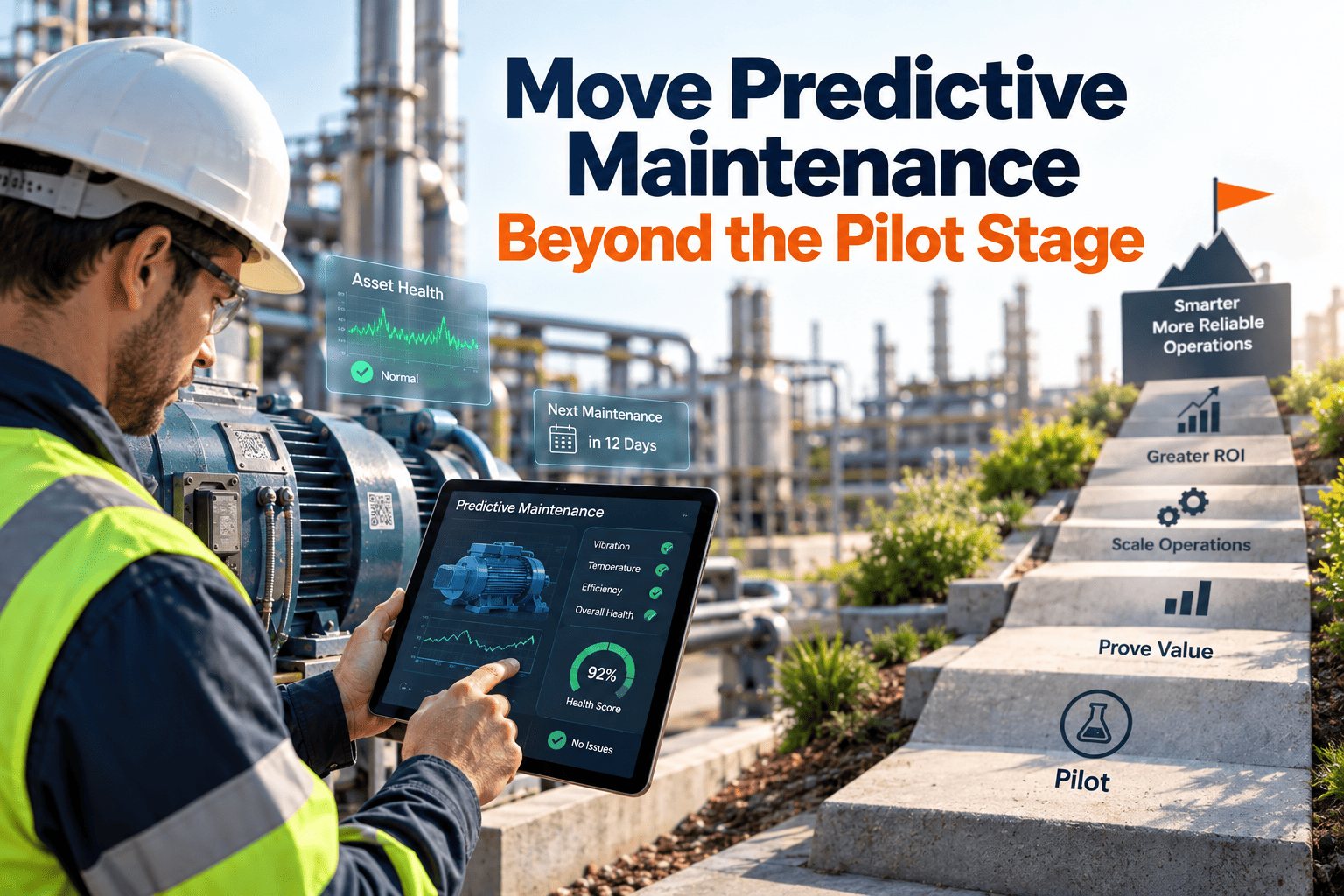
Every millisecond of latency between a plant sensor and the decision it triggers costs something — bandwidth, cybersecurity exposure, or on a fast-moving line, a scrap batch. Industrial edge analytics moves the AI to where the data lives: on the plant floor, air-gapped from the internet if needed, with sub-50ms decision loops no cloud architecture can match. For UK operators wrestling with OT security, data residency and intermittent site connectivity, the edge isn't a niche experiment — it's the default. Book a demo to see edge analytics running against live plant data.
◆ EDGE AI · ON-PREMISES ANALYTICS · OT SECURITY
Some decisions are too fast, too sensitive or too remote for the cloud. That's exactly where industrial edge analytics earns its keep.
Every sensor stream, every anomaly, every inference — processed on the plant floor and only the answers travel further.
DECISION LATENCY · CLOUD vs EDGE
Sensor
→
Gateway
→
Internet
→
Cloud
→
Return
300-800 ms
Sensor
→
Edge Node
→
Return
< 50 ms
15×
Faster decision loop · Edge vs cloud round-trip
0
Raw sensor data leaves site · Air-gap possible
90%
Reduction in outbound WAN bandwidth typical
Why Edge — The Four Forces Driving It Into UK Operations
Edge analytics is not a technology sale — it's a response to four operational realities that the cloud-first architecture of the 2010s never fully solved. UK operators are pushing analytics to the edge because those realities have become material to how plants run, not because of any hype cycle. Sign up free to explore edge-ready condition monitoring on your assets.
01
LATENCY
Sub-50 ms decisions
Vibration anomaly detection, vision inspection, process safety interlocks — none of these tolerate 300-800 ms cloud round-trips. Edge inference brings the model to the data.
02
DATA SOVEREIGNTY
UK data stays UK
Defence, pharma, food and CNI operators need raw operational data — production rates, formulations, control setpoints — to remain within the site. Edge keeps it there by design.
03
BANDWIDTH
Send answers, not data
A single high-frequency vibration sensor generates gigabytes per day. Sending the raw stream to cloud is economically nonsensical when edge inference sends only the alerts.
04
RESILIENCE
Operates through outages
Remote sites and rural UK manufacturing routinely lose connectivity for hours. Edge analytics keeps operating and queues results for sync when the link returns.
The Edge Stack — What Actually Runs on the Plant Floor
An industrial edge deployment isn't a single black box. It's a stack of four layers, each with a specific job, connected upward through controlled interfaces rather than open internet exposure. Getting the layer split right is what separates a real edge deployment from a repackaged cloud one running on a small server. Sign up free to explore the edge stack architecture.
EDGE ANALYTICS ARCHITECTURE
Four Layers · Bottom-Up · Locally Sovereign
LAYER 4
CMMS & DECISIONS
Anomaly becomes work order · Priority routing · Technician assignment · Audit trail · Only outcomes sync to central platform
Only decisions leave the edge
LAYER 3
AI INFERENCE ENGINE
Trained models run locally · Vibration classification · Vision defect detection · Multivariate anomaly detection · Sub-50ms response
GPU or NPU accelerated
LAYER 2
DATA NORMALISATION
Time-series database · Multi-protocol ingestion · Contextualisation to asset · Quality flagging · Feature extraction for models
MQTT · OPC UA · Modbus
LAYER 1
DATA INGESTION
Sensor buses · PLC tag reads · Vision camera streams · Legacy protocol translation · Buffered against network loss
The plant-floor interface
Cloud vs Edge — The Honest Decision Matrix
Edge is not a religion, and it isn't the answer for every workload. Model training belongs in the cloud where compute is elastic. Fleet-wide trend analysis benefits from aggregation. But real-time inference, sensitive operational data, latency-critical safety, and disconnected sites — those all belong at the edge. A properly designed maintenance platform uses both, and knows which decision belongs where.
DEPLOYMENT DECISION MATRIX
Workload → Best Location → Why
Real-time anomaly detection
✕
✓
Latency budget under 100 ms
Vision defect inspection
✕
✓
Line speed & bandwidth
Sensitive process data
✕
✓
Data residency & sovereignty
CMMS & work orders
✓
✓
Hybrid — either works
Model training
✓
✕
Elastic GPU compute
Fleet-wide analytics
✓
✕
Cross-site aggregation
◆ EDGE ANALYTICS DEMO
See On-Premises AI Running Against Live Plant Data
Edge inference on vibration, thermal and vision streams, air-gapped deployment for sovereign workloads, hybrid sync to central CMMS, work-order generation from local anomaly detection — all in 30 minutes.
Where Edge Analytics Actually Pays — Four UK Use Cases
The abstract case for edge analytics is easy. The concrete case is what makes it worth deploying. These are the four workloads where UK operators are getting measurable return on edge inference within the first year of deployment, most within the first quarter of operation. Sign up free to prototype the first one on your critical assets.
01 · ROTATING EQUIPMENT
High-Frequency Vibration Inference
Continuous vibration sampling at 20-50 kHz produces gigabytes/day per sensor. Edge inference detects bearing defect signatures, GMF sidebands and cavitation events locally, sending only the classified alerts.
Outcome · WAN bandwidth cut 95% · Real-time alerting
02 · VISION QUALITY
Line-Speed Defect Detection
Vision inspection at 200+ units/minute demands local inference — round-tripping images to cloud is architecturally impossible. Edge-deployed CNN models classify defects, drive reject actuators and log evidence locally.
Outcome · Line-speed decisions · Reject accuracy > 99%
03 · PROCESS ANOMALY
Multivariate Deviation Detection
Chemical, food and pharma processes read dozens of correlated variables continuously. Edge-deployed multivariate models catch drift patterns invisible to single-variable alarms, before quality escapes occur.
Outcome · Earlier deviation catch · Batch protection
04 · REMOTE SITES
Disconnected Operation
Rural manufacturing, distribution centres and remote infrastructure sites lose connectivity routinely. Edge analytics keeps monitoring, alerting and generating work orders locally, syncing on reconnection.
Outcome · Zero data loss · Continuous operation
Expert Perspective — Why the Edge Argument Is Really About Trust
"
Every serious industrial AI conversation in the UK right now comes back to the same three questions: where does the data physically live, who has technical ability to access it, and what happens when the internet drops out. Cloud-only architectures answer those questions poorly for defence primes, regulated pharma manufacturers, CNI operators and any site running processes they consider commercially sensitive — which turns out to be most of them. Edge analytics answers them cleanly: the data lives on your rack, in your building, on your VLAN, and it operates whether the WAN link is up or not. What we've watched happen over the last two years is that the burden of proof has reversed. Two years ago a plant engineer had to justify why analytics should be edge-based. Now they have to justify why they shouldn't. The economic and regulatory tide has moved decisively toward local inference for anything that touches real operational data, with cloud reserved for the workloads it's genuinely best at — model training and portfolio-wide trending. A CMMS platform that natively supports both, with clear separation, is what plant operators are actually procuring in 2026.
— Industrial AI & OT Architecture Practice
01
Local-first architecture
Inference and work-order generation happen on-premises. Central sync is optional and controlled per data category.
02
Air-gap capable
Full deployment mode with no outbound WAN traffic. Ideal for defence, CNI and regulated sovereign workloads.
03
Human-in-the-loop
Edge inference generates recommended actions. Engineers approve and execute — model never actions unsupervised.
04
Hybrid by design
Model training and fleet trending in cloud. Real-time and sensitive workloads on the edge. Clear layer boundary.
Who Uses Oxmaint for Edge Analytics in the UK
The platform is used by the UK roles that own OT data and reliability decisions day-to-day: reliability engineers running continuous condition monitoring across critical rotating equipment, plant IT/OT architects designing hybrid analytics deployments, defence and aerospace primes with sovereign data requirements, pharmaceutical and food manufacturers running GxP or BRCGS environments where process data cannot leave site, CNI operators in water, energy and transport under NIS Regulations 2018 obligations, remote infrastructure operators (offshore, rural manufacturing, distribution) with intermittent connectivity, and QSHE directors requiring auditable evidence chains that keep sensitive operational data locally sovereign.
Getting Edge Analytics Live in 30-60 Days
Deployment starts with the workload split — which analyses need to be local, which can sit in cloud, and where the boundary sits. Edge node sizing per site (typical UK deployment: a mid-range rack server or industrial edge appliance with GPU/NPU acceleration for vision or high-frequency vibration workloads). Sensor and PLC integration with local time-series database. Model deployment to edge inference engine — pre-trained for the workload class or fine-tuned on customer historical data. CMMS layer configuration for local work-order generation from anomaly detection. Optional sync boundary configuration if central platform integration is required. Air-gap mode configures for fully sovereign deployments. Most sites see edge stack running against critical assets within 30-60 days; sovereign-mode deployments align to customer security accreditation timelines and can extend accordingly. Book a walkthrough to scope your site's edge deployment.
◆ THE INTELLIGENCE STAYS ON YOUR RACK
Edge AI. On-Premises. Sovereign. Real-Time.
Oxmaint gives UK operators industrial edge analytics that runs on your plant floor — local inference, air-gap capable, sub-50ms decisions, and only the outcomes travel further. Model training in cloud, real-time and sensitive workloads on the edge.
Frequently Asked Questions
What is industrial edge analytics software?
Industrial edge analytics software runs AI models, anomaly detection and analytics workloads on servers or appliances physically located at the plant, rather than in the cloud. Sensor and machine data is ingested locally, processed through models running on the edge hardware (typically GPU or NPU accelerated), and only the classified outcomes — alerts, anomalies, work orders — sync to central platforms if at all. The pattern is designed for latency-critical workloads (real-time control, vision inspection), sensitive data (defence, pharma, CNI), high-bandwidth streams (high-frequency vibration, video), and remote sites with intermittent connectivity. Oxmaint's edge deployment integrates with its central CMMS via controlled sync boundaries so operators get the benefits of both architectures.
Does it support fully air-gapped deployment?
Yes. Air-gap deployment mode operates with no outbound WAN connectivity — the edge stack ingests plant sensor data, runs inference, generates work orders and holds all history locally, with no data leaving the site. This is standard configuration for defence primes, some pharmaceutical manufacturers with sovereign data requirements, CNI operators under NIS Regulations 2018, and any site running commercially sensitive processes. Model updates and version upgrades in air-gapped mode are delivered via controlled physical media transfer with cryptographic verification, following the site's approved change-control process rather than automatic pull from the internet.
What hardware is typically required?
Edge hardware sizing scales with workload. A typical UK site with condition monitoring on 20-100 rotating assets runs on a mid-range rack server (16-32 cores, 64-128 GB RAM, GPU or NPU accelerator for inference). Vision inspection workloads (line-speed defect detection) typically need dedicated GPU acceleration per line. Large multi-line manufacturing plants may deploy multiple edge nodes with a local aggregation server. For smaller sites or remote infrastructure, industrial edge appliances (fanless, DIN-rail or rack-mount) handle the workload in a compact footprint. Hardware is customer-owned and located on the plant OT network. Oxmaint publishes reference architectures and sizing guidance per workload class as part of pre-deployment scoping.
How does it integrate with existing PLCs and SCADA?
Edge nodes ingest data through the protocols already present on plant OT networks — OPC UA (both classic and OPC UA over TSN), Modbus TCP and RTU, MQTT, EtherNet/IP, Profinet, and vendor-specific PLC drivers for legacy Siemens, Rockwell, Mitsubishi and Schneider hardware. Historian integration (OSI PI, AVEVA, Wonderware) is supported where existing time-series data warrants ingestion. No PLC programming changes are required — the edge node reads existing tags with appropriate access rights. Where sensors are being newly deployed alongside the edge stack (typical for high-frequency vibration or vision) the edge node terminates the sensor bus directly. Integration architecture is scoped as part of pre-deployment consultation.
How does edge fit with cloud-based CMMS?
Edge and cloud are complementary rather than exclusive. In hybrid deployments (which cover the majority of UK sites without full air-gap requirements), the edge handles real-time inference and generates work orders locally against site-critical assets, then syncs anomaly outcomes, work-order status and equipment history to the central Oxmaint cloud platform on a controlled cadence — typically minutes rather than milliseconds. This gives central reliability teams portfolio-wide visibility and fleet trending, while keeping latency-critical decisions and sensitive raw data local. Model training and updates flow the other direction: fleet-wide model improvements developed in cloud push down to edge nodes through controlled deployment channels. Sites can adjust the sync boundary per data category based on their sensitivity and compliance requirements.