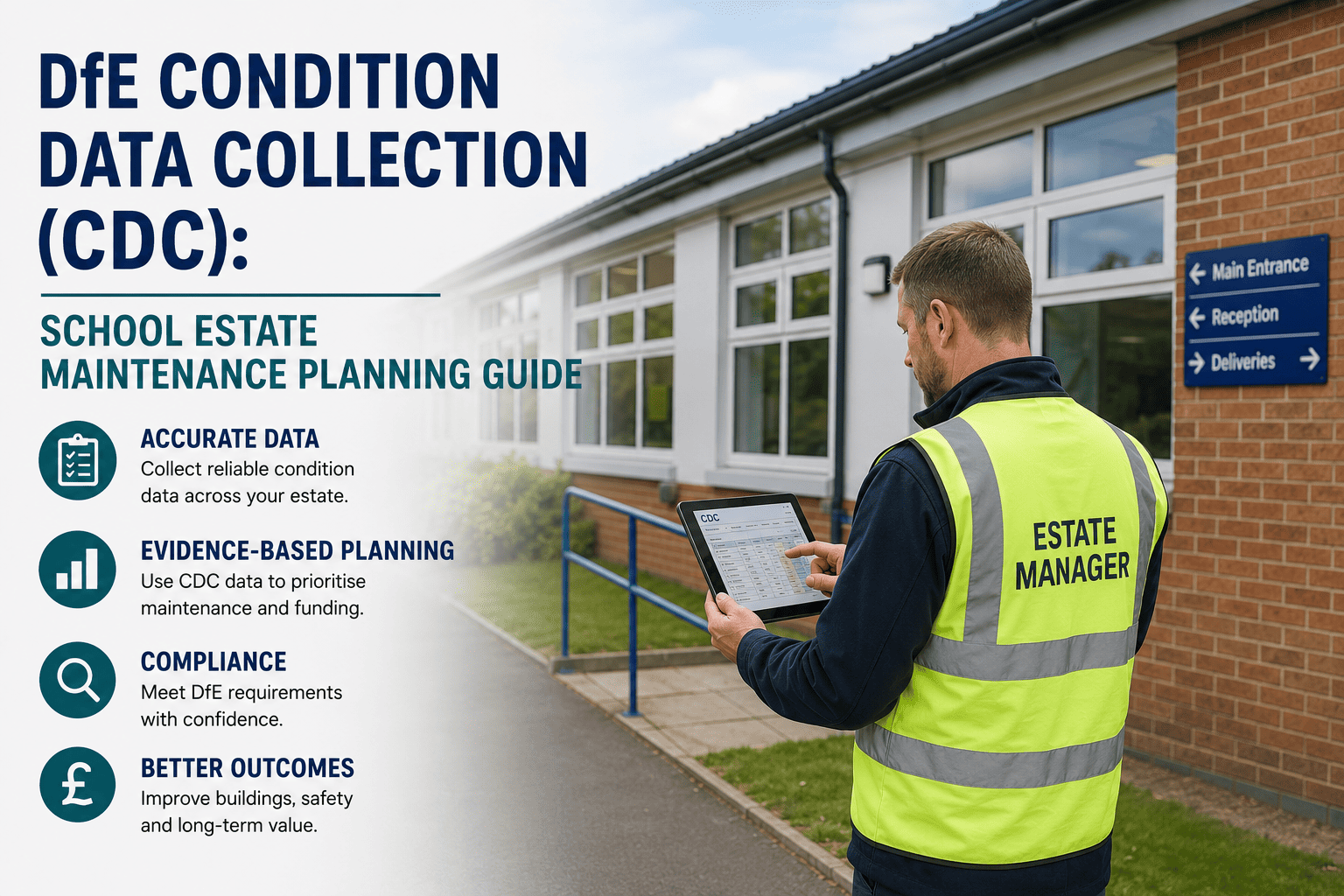
Every trust in England is now living with the results of Condition Data Collection 2. Surveyors visited every government-funded school between 2021 and 2026, scored each building, and that score now flows directly into how much School Condition Allocation or Condition Improvement Fund money a trust receives. The trouble is CDC2 is a snapshot, taken once every few years, by surveyors who don't test your boilers or look behind your ceiling tiles. What happens between visits is entirely down to the trust. A CMMS like OxMaint keeps that gap covered with your own live condition and maintenance record.
Keep Your Estate Data Current Between CDC Cycles
Log condition, remaining life and compliance records for every building and asset, ready whenever the next CDC visit or funding bid comes around.
What CDC2 Actually Scores
A CDC2 visit is a high level, visual-only inspection carried out by an accredited surveyor. Nothing is dismantled, no plant is switched on, and no roof void is opened. What comes out the other end is a condition grade and a priority rating for each building element, which together decide how urgently work is needed.
| Rating Type | Scale | What It Means |
|---|---|---|
| Condition grade | A to D | A is good condition, D is bad and needs urgent attention |
| Priority rating | 1 to 4 | 1 means immediate replacement or remedial action, 4 means over five years away |
| Survey cycle | Roughly every two years | Timing depends on the tranche your trust is allocated to |
How CDC Data Turns Into Funding
School Condition Allocation
Larger trusts with over 3,000 pupils and more than five academies receive a formulaic annual allocation.
Condition Improvement Fund
Smaller trusts, sixth form colleges and voluntary aided schools bid into this pot instead of SCA.
Condition Bands
CDC2 introduced fifteen bands from A to O, weighting funding toward the greatest relative need.
Rebuilding Programmes
The most severe CDC findings have previously fed directly into national school rebuilding decisions.
What CDC2 Doesn't Tell You
The DfE is clear about the limits of its own data, and trusts relying on it alone for day-to-day decisions are working with a partial picture. On its own, CDC2 data is not suitable for local asset management, since it is non-invasive, non-structural, does not report on asbestos, does not cover fire or intruder alarm function, and includes no cost information. That gap is exactly where a trust's own maintenance records need to sit.
Building a Trust-Wide Plan Between Survey Cycles
Log Your Own Condition Data
Record condition against every building and asset yourself, not just at the point CDC surveyors visit.
Track Remaining Life
Flag components approaching end of life so nothing is a surprise when the next tranche is due.
Keep Compliance Current
Store fire, asbestos, gas and legionella records alongside condition data, all in one place.
Prepare Before the Next Visit
Review the estate ahead of your next tranche so nothing has quietly drifted between surveys.
Trust Estate Data Maturity
CDC Report and Nothing Else
The last CDC report sits in a folder and nobody has updated the picture since the surveyor left site.
Site-Level Tracking
Individual schools keep their own condition notes, but the trust has no combined view across sites.
Live Trust-Wide Record
Condition, remaining life and compliance data stay current across every school, ready for any bid or visit.
Why Trusts Can't Just Wait for the Next Tranche
CDC2 concluded its final tranche in 2025, and its scores are already reshaping School Condition Allocation for most trusts, sometimes reducing funding sharply for those who expected otherwise. With a longer-term estates strategy under discussion and no confirmed date for a CDC3, the trusts best placed to defend their funding position are the ones already holding their own up-to-date condition and maintenance evidence, not just the DfE's last snapshot. Sign up free to start your own trust-wide record, or book a demo to see how condition and compliance data can sit together in one system.
Don't Wait for the Next CDC Visit
Build a live, trust-wide condition and maintenance record that stands up to funding scrutiny at any point in the cycle.
Frequently Asked Questions
Is Condition Data Collection compulsory for schools?
CDC is not a statutory programme, but schools are strongly encouraged to take part since the data directly supports the DfE's capital allocation decisions.
How often does a school get surveyed under CDC2?
Each school is intended to be surveyed on a rolling cycle, typically around every two years, with the exact timing set by the tranche it falls into.
What's the difference between SCA and CIF funding?
School Condition Allocation is a formulaic annual allocation for larger trusts, while the Condition Improvement Fund is a bid-based pot for smaller trusts, sixth form colleges and voluntary aided schools.
Can a trust rely on CDC2 data alone for maintenance planning?
No, CDC2 is non-invasive and excludes structural detail, hazardous materials, plant testing and cost information, so trusts need their own condition and maintenance records alongside it.
What happens after CDC2 finishes in 2026?
No further national survey has been confirmed, so trusts are advised to keep commissioning their own condition and structural surveys to stay current between any future DfE programmes.