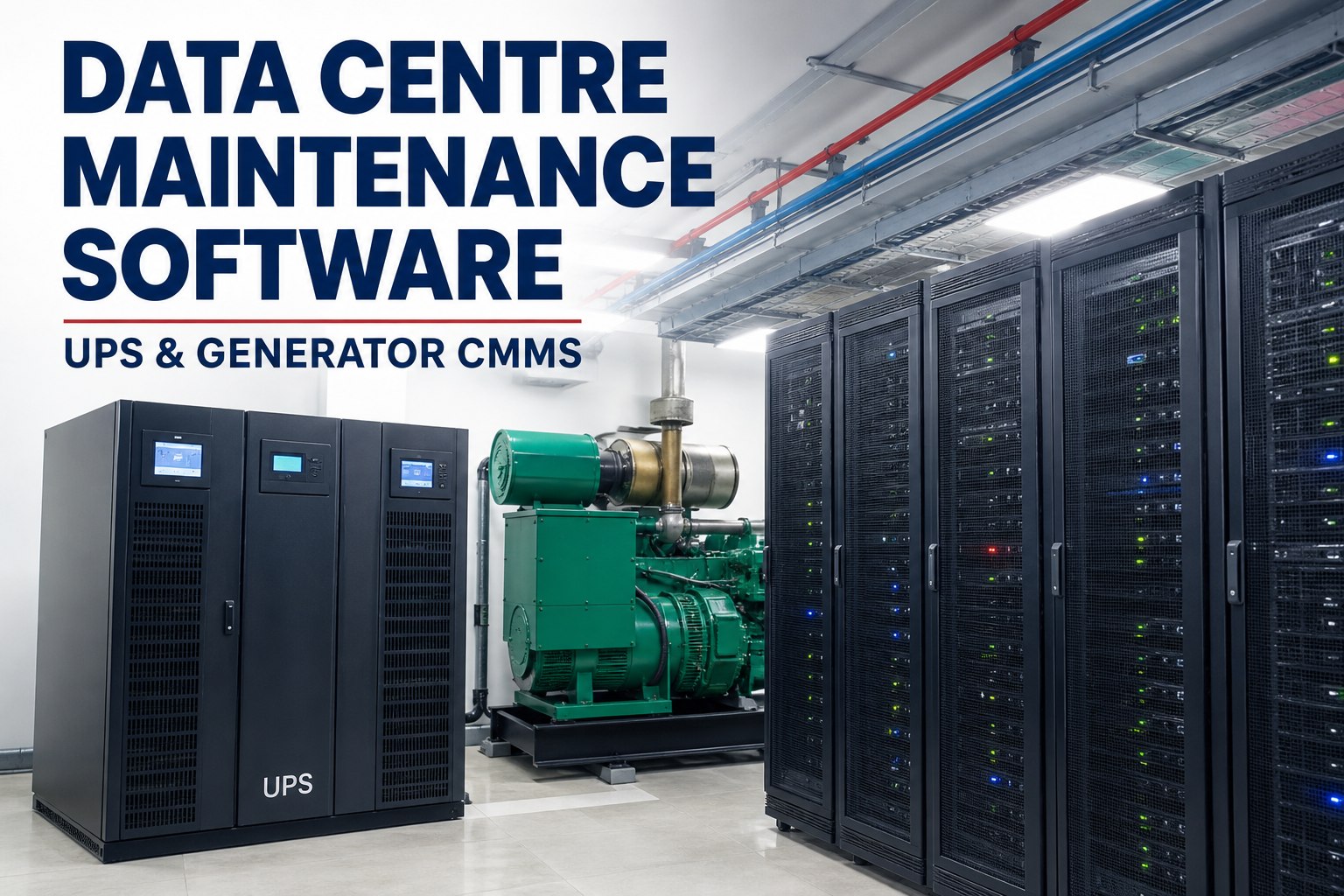
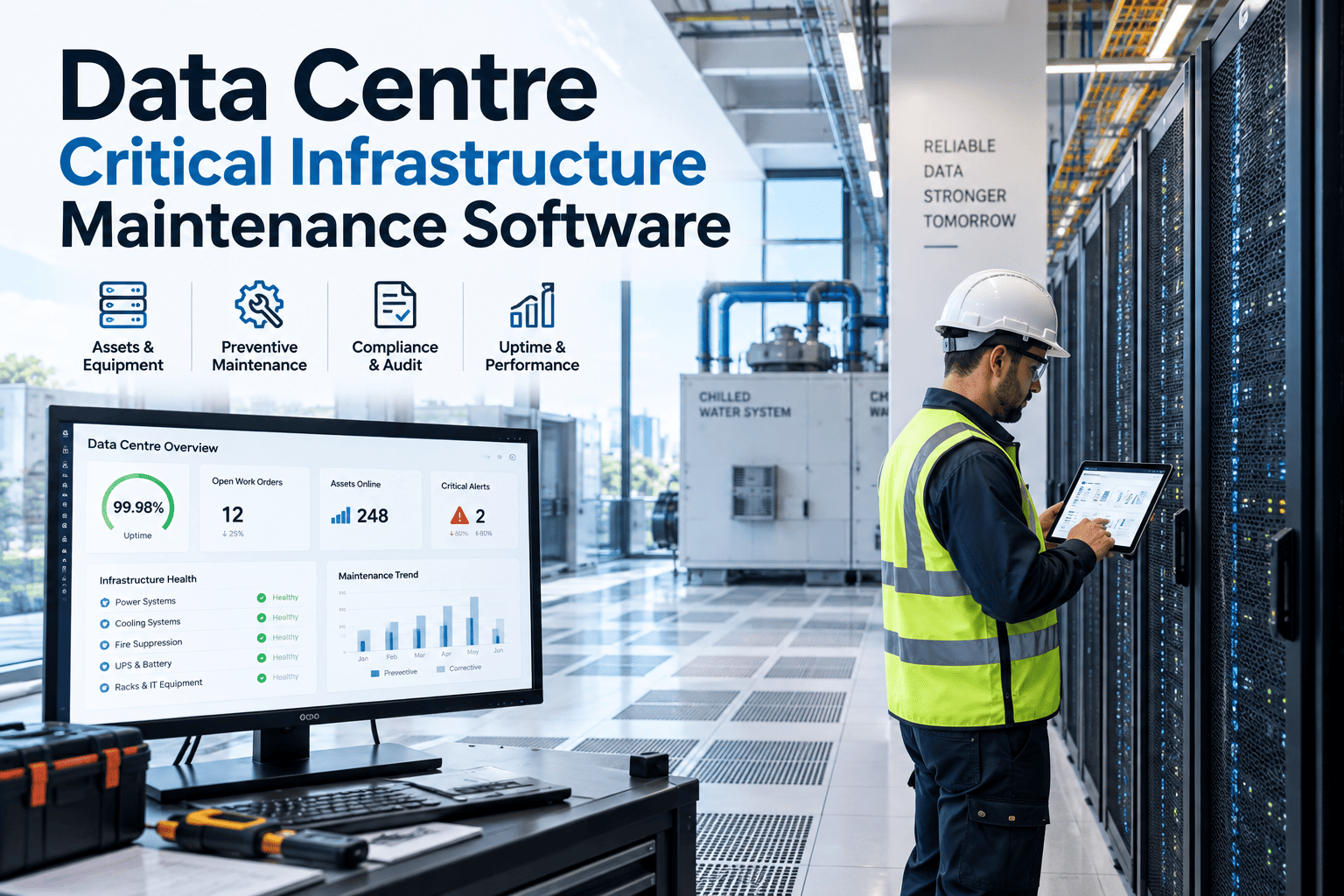
A data centre isn't a building with servers in it — it's a life-support system for compute. Every kilowatt drawn on the IT floor has to be delivered redundantly through UPS and switchgear, cooled continuously by chillers and CRAHs, and backed by generators that start within 10 seconds of a grid trip. When any system fails during maintenance with no redundancy behind it, the site's uptime rating drops. DCs that hold SLAs run MOP-driven maintenance with concurrent maintainability in every procedure. Book a demo to see critical maintenance workflows live.
◆ UPTIME INSTITUTE · N+1 · 2N · MOP · CONCURRENT MAINTAINABLE
Redundancy on paper isn't redundancy in practice. Every maintenance window is a live test of whether N+1 actually holds.
Every UPS module, every generator, every chiller, every CRAH, every ATS — under one critical-facility maintenance platform.
UPTIME INSTITUTE TIER STANDARD · MAINTENANCE IMPLICATIONS
TIER I
Basic Capacity
99.671%
28.8 hrs/yr
Full shutdown for maintenance · No redundancy
TIER II
Redundant Capacity
99.741%
22.0 hrs/yr
Partial redundancy · Distribution single path
TIER III
Concurrently Maintainable
99.982%
1.6 hrs/yr
N+1 · Any component maintainable without downtime
TIER IV
Fault Tolerant
99.995%
26.3 min/yr
2N · Fully redundant · Compartmentalised
10s
Generator start-to-load requirement post grid trip
$9k
Average cost per minute of DC outage (Uptime Institute)
42%
Of outages traced to human error during maintenance
The Critical System Tree — What Every DC Must Track
Data centre maintenance isn't a single asset class — it's a stack of interdependent critical systems where each layer supports the compute floor. Losing any layer degrades the tier rating and, in the worst case, drops load. Structured tracking of every critical asset, its redundancy pair, and its maintenance state is what turns a paper tier design into a delivered SLA. Sign up free to structure your critical asset tree with redundancy pairing.
CRITICAL FACILITY STACK
System → Component → Redundancy Pair
01 · UTILITY & SWITCHGEAR
Grid supply · Transformers · HV switchgear · Ring main units · Metering
Dual-feed from separate substations · Automatic failover on grid loss
02 · BACKUP GENERATION
Standby generators · Fuel storage tanks · Automatic transfer switches · Load banks
N+1 or 2N gen sets · 10-second start · 72-hour fuel autonomy
03 · UPS & BATTERY
UPS modules · Battery banks (VRLA or Li-ion) · Static switches · Bypass switchgear
N+1 UPS · Battery bridging until generator load acceptance · Full-load discharge test annually
04 · POWER DISTRIBUTION
PDUs · RPPs · Busway · Rack PDUs · Metering · Branch circuit monitoring
A/B feed to every rack · Dual-corded servers · Independent breaker groups
05 · COOLING PLANT
Chillers · Cooling towers · Pumps · Heat exchangers · Free-cooling economisers
N+1 chillers · Redundant pumping loops · Free-cooling for low ambient · Water treatment
06 · WHITE-SPACE COOLING
CRAH · CRAC · In-row cooling · Hot-aisle containment · Rear-door heat exchangers
N+1 units per zone · Fan redundancy · Temperature and humidity monitoring
07 · LIFE SAFETY & SECURITY
Fire detection · Gas suppression (FM-200, Novec, Inergen) · Access control · CCTV · Leak detection
Cross-zoned detection · Independent gas suppression per hall · L8 water treatment where wet cooling
The MOP · SOP · EOP Chain — Why Procedures Prevent Outages
Uptime Institute research consistently identifies that 42 percent of DC outages trace to human error during maintenance activity. The industry response is the procedure trilogy — Method of Procedure (MOP) for every planned work item, Standard Operating Procedure (SOP) for every routine, and Emergency Operating Procedure (EOP) for every failure scenario. Every one must be version-controlled, tested and executed step-by-step with sign-off. Book a demo to see MOP-driven maintenance in action.
MOP
Method of Procedure
Every planned maintenance activity has its own MOP · Step-by-step actions with sign-off at each critical step · Risk assessment attached · Rollback procedure defined
Example: UPS module bypass and battery replacement · 47-step procedure with 4 hold points
SOP
Standard Operating Procedure
Every routine day-to-day operational activity has its own SOP · Repeatable across shifts · Version controlled · Referenced from work orders · No individual improvisation
Example: Weekly generator run test · Monthly UPS battery capacity check · Quarterly CRAH filter change
EOP
Emergency Operating Procedure
Every foreseeable failure scenario has its own EOP · Pre-rehearsed response · No decision-making under panic · Clear escalation chain
Example: UPS bypass failure during battery change · Generator fail-to-start on grid trip · Chiller loss with rising floor temperature
The Maintenance Risk Matrix — Which Jobs Go When
Not every maintenance job carries the same risk of dropping load. A CRAH filter change is a nuisance if botched; a UPS bypass is a potential outage if mishandled. Structured risk classification decides when work happens, who signs it off, and whether the change advisory board reviews it — because doing everything by the same process either over-controls trivial work or under-controls critical work. Sign up free to structure your risk-classified maintenance workflow.
LOW RISK
Routine Non-Critical
Air filter changes · Non-critical lighting · Cosmetic work · Office HVAC
Standard work order · Shift lead approval
MEDIUM RISK
Redundant Critical Asset
CRAH filter change · Non-live UPS module maintenance · Chiller isolation for cleaning
MOP required · Engineering manager approval
HIGH RISK
Live-Bypass or Single-Point Work
UPS bypass switching · Generator load transfer · ATS testing under load · Battery bank change
MOP + CAB approval + on-site engineering escalation ready
CRITICAL
Single Path of Failure
HV switchgear work · Main incomer transformer maintenance · Cooling plant isolation · Fire suppression discharge test
MOP + CAB + customer notification + rollback rehearsed
◆ DATA CENTRE MAINTENANCE DEMO
See the Full Critical Facility Workflow in 30 Minutes
Critical asset tree with redundancy pairing, MOP/SOP/EOP procedure library, risk-classified work order workflow, concurrent maintainability verification, real-time DCIM integration and audit-ready evidence for Uptime Institute recertification.
The Outage Cost Curve — Why Prevention Justifies Everything
Uptime Institute reporting shows the cost of DC outages has climbed year-on-year as compute density and customer criticality have grown. The curve below shows the escalation from a 5-minute glitch to an hour-plus outage — non-linear because SLA credit clauses, reputational cost and enterprise customer contract penalties kick in at specific duration thresholds. Understanding the shape is what justifies the maintenance discipline that prevents ever reaching the upper end.
< 5 MIN
Glitch · Within Availability Envelope
Absorbed by session state · No customer notification · Root cause investigation · Post-mortem internal
Ops absorbed
5-30 MIN
Notable Event · SLA Warning Zone
Customer notifications triggered · Approaching monthly SLA credit thresholds · Post-incident review with customer facing
$50k - $500k
30-60 MIN
SLA Breach · Enterprise Customer Impact
SLA credit clauses triggered · Enterprise customer contract penalties · Media attention likely · Executive engagement required
$500k - $5M
> 1 HOUR
Major Incident · Reputational Damage
Major customer contracts at risk · Public post-mortem obligation · Uptime Institute tier certification review · Regulator engagement (financial services, healthcare customers)
$5M - $50M+
Expert Perspective — Why Data Centre Maintenance Rewards Ruthless Discipline
"
Every data centre operations director carries the same knowledge in the back of their mind. The Uptime Institute has been tracking the root causes of DC outages for over two decades, and the same statistic keeps recurring: roughly four in ten outages trace to human error during maintenance activity. Not equipment failure, not design flaw, not power grid instability — human error during a maintenance window. The engineer opened the wrong breaker. The technician bypassed the wrong UPS. The contractor didn't follow the MOP. The shift lead approved a job that hadn't been through change advisory board. The pattern isn't incompetence; the people running data centres are typically among the most disciplined engineering professionals in any industry. The pattern is that maintenance procedures held in binders, spreadsheets, tribal knowledge and individual expertise don't scale to the number of interventions that a modern data centre requires. Structural procedure discipline — MOP for every planned job, SOP for every routine, EOP for every failure, all version-controlled and enforceable through the work order system — is the only intervention that consistently moves the human error rate. That's the whole engineering leadership thesis in critical facilities, and it lives or dies on the quality of the CMMS platform holding it together.
— UK Data Centre & Critical Facility Engineering Practice
01
Redundancy-paired assets
Every critical asset holds its redundancy pair explicitly · Concurrent maintainability verified before every work order.
02
MOP-driven work orders
Every planned maintenance activity has a version-controlled MOP · Step-by-step sign-off with hold points · Rollback rehearsed.
03
Risk-classified approval
Low / Medium / High / Critical risk tiers with matching approval chains · CAB engagement for High and Critical.
04
DCIM integration
Real-time PUE, temperature and load data ingests · Work orders link to affected racks and containment zones.
Who Uses Oxmaint for UK Data Centre Maintenance
The platform is used by the UK roles that operate mission-critical facilities: data centre operations directors running colocation and hyperscale sites, critical facility engineering managers overseeing multi-tenant DCs and enterprise private DCs, chief engineers responsible for concurrent maintainability compliance, facilities managers at financial services and telecom sites where Uptime Institute certification is contractual, healthcare and pharmaceutical enterprise DCs supporting clinical systems, government and defence facility engineers under MoD critical infrastructure requirements, and specialist DC maintenance service providers supporting multiple customer sites under separate MOP libraries and SLA obligations.
Getting Data Centre Maintenance Live in 60-90 Days
Deployment starts with the critical asset tree — every UPS, generator, chiller, CRAH, ATS, PDU imported with criticality tag, redundancy pair and Uptime Institute tier position. MOP library imports from existing procedures with version control activated. SOP catalogue configures for weekly, monthly and quarterly routines. EOP scenarios structure for foreseeable failure modes. Risk classification workflow deploys with matching approval chains from shift lead through engineering manager to CAB. Mobile execution app deploys for step-by-step MOP walkthrough with sign-off at hold points. DCIM integration configures where existing DCIM platforms (Sunbird, Nlyte, Schneider EcoStruxure, Vertiv Trellis) are in place. Most UK DCs go live within 60-90 days with full critical asset visibility and MOP-driven work orders from cycle one. Sign up free to scope your DC deployment.
◆ EVERY MOP. EVERY REDUNDANCY. EVERY WINDOW HELD.
One DC. One Platform. Concurrent Maintainability Delivered.
Oxmaint gives UK data centre operators the complete critical facility platform — redundancy-paired asset tree, MOP/SOP/EOP procedure library, risk-classified work orders, DCIM integration and audit-ready evidence for Uptime Institute tier certification.
Frequently Asked Questions
What is data centre maintenance software?
Data centre maintenance software is a CMMS configured for the specific criticality profile of mission-critical facilities under Uptime Institute Tier standards. It holds every UPS, generator, chiller, CRAH, ATS, PDU and life-safety asset with explicit criticality tagging and redundancy pair identification. It manages a version-controlled MOP (Method of Procedure) library for every planned maintenance activity, SOP (Standard Operating Procedure) library for every routine, and EOP (Emergency Operating Procedure) library for every foreseeable failure. It applies risk-classified work order approval chains — from shift lead approval on low-risk routines through change advisory board and customer notification on critical single-path work. Integration with DCIM platforms provides real-time PUE, temperature and load context. The output is verifiable concurrent maintainability — the ability to demonstrate that every maintenance intervention was performed without compromising the tier design.
How does the platform handle MOP-driven maintenance?
Every planned maintenance activity that touches a critical asset carries a Method of Procedure — a step-by-step document with risk assessment, tool list, spares list, hold points where sign-off is required before proceeding, and defined rollback procedure if the intervention needs to be aborted. Oxmaint holds MOPs under version control with author, reviewer and approver identity, expiry date for periodic review, and change history. Work orders link to the current approved version of the applicable MOP — technicians cannot execute against an outdated procedure. Mobile execution walks the technician through step-by-step with digital sign-off at each hold point, timestamp and identity capture. If a step cannot be completed as documented, the technician invokes the rollback procedure rather than improvising. The audit trail supports both Uptime Institute recertification and post-incident investigation should anything ever go wrong.
Can it integrate with our DCIM platform?
Yes. The major DCIM platforms — Sunbird dcTrack, Nlyte, Schneider EcoStruxure IT, Vertiv Trellis and others — expose real-time environmental data (temperature, humidity, PUE, power draw, cooling load) via API. Oxmaint ingests this data per rack, per row and per hall, holds it against the maintenance schedule for the affected assets, and triggers condition-based work orders when thresholds are crossed. Work orders on any critical asset auto-link to the affected racks and containment zones so the operations team sees which customers or workloads are potentially affected. When a UPS goes into bypass for scheduled maintenance, the DCIM view immediately reflects the reduced redundancy state, giving operations and customer-facing teams the context they need without manual synchronisation between systems.
Does it support Uptime Institute tier certification evidence?
Yes. Uptime Institute Tier certification (Design and Constructed Facility) and the operational Management & Operations (M&O) Stamp both require demonstrable maintenance discipline. Oxmaint holds evidence of concurrent maintainability across the asset base — every work order tagged with the affected asset, its redundancy pair, and the pair's state at the time of the intervention. MOP version control demonstrates procedure discipline. SOP execution records demonstrate consistent routine operations. Risk-classified approval chains evidence the change control expected at each risk tier. Load-bank test records evidence the generator autonomy and UPS discharge capability required. Fire suppression and life-safety records evidence the resilience of the compartmentalisation design. The audit trail supports both initial certification and periodic recertification. Duty of concurrent maintainability compliance rests with the operator; the platform provides the evidence infrastructure.
How long does deployment typically take for a UK data centre?
A single UK data centre typically goes live within 60-90 days. The sequence: weeks 1-3 critical asset tree configuration with every UPS, generator, chiller, CRAH, ATS, PDU and life-safety asset imported with criticality tag, redundancy pair and Uptime Institute tier position; weeks 3-5 MOP library import from existing procedures with version control activation; weeks 5-6 SOP catalogue for weekly, monthly and quarterly routines; weeks 6-7 EOP scenarios for foreseeable failure modes; weeks 7-9 risk classification workflow with matching approval chains and mobile execution app deployment; weeks 9-12 DCIM integration where existing DCIM is in place, historical maintenance record migration, and operations team training. Multi-site DC operators (colocation portfolios, hyperscale groups, enterprise DC estates) typically complete within a quarter with per-site templating. Sites without existing MOP documentation typically extend to four months for the procedure authoring work, which is genuinely the critical path rather than platform configuration.