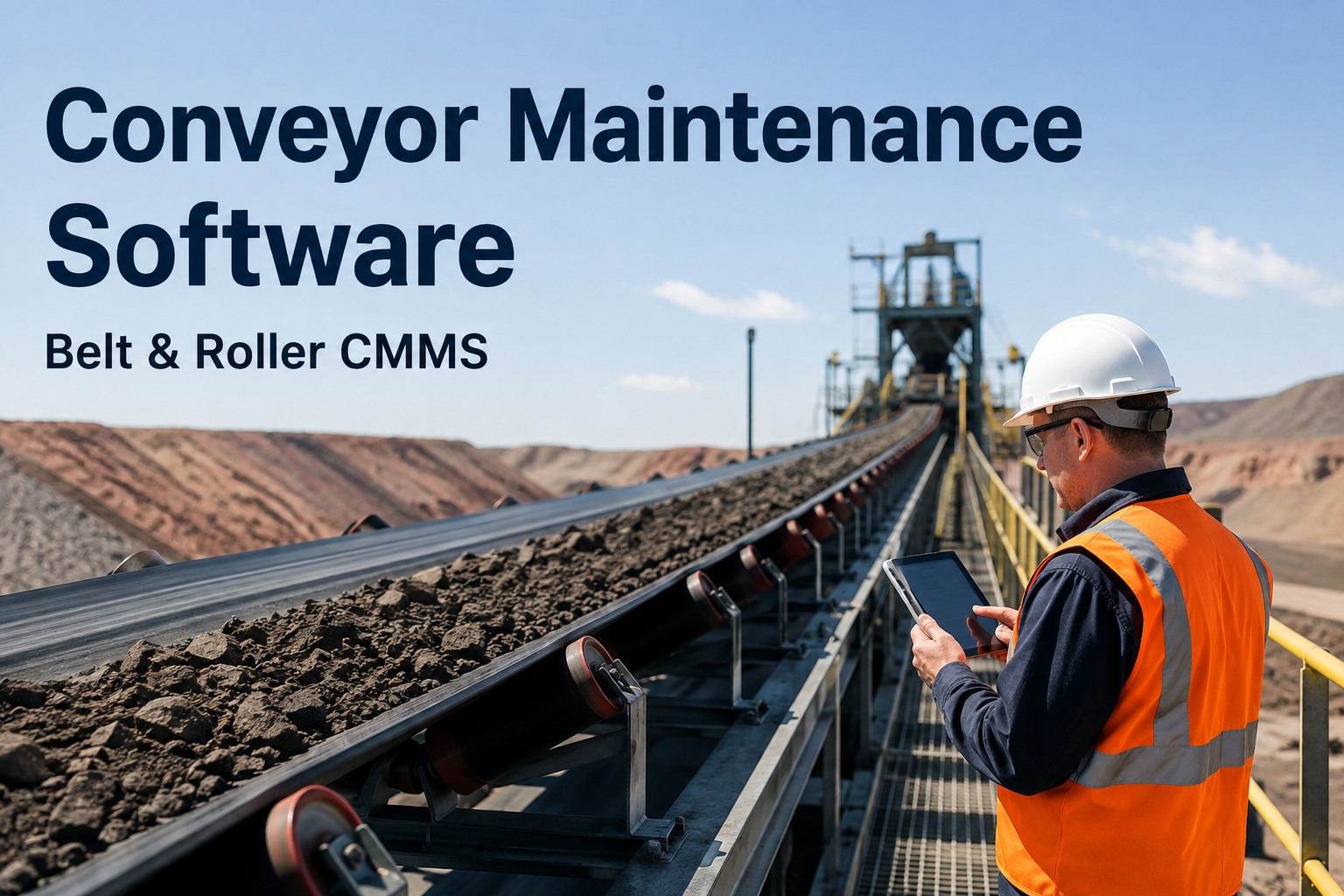
Conveyor Maintenance Software | Belt & Roller CMMS
By Riley Quinn on August 26, 2026
A stopped conveyor is a stopped process. Not delayed — stopped. Whether it's a mine, quarry, port, distribution centre or grain terminal, the conveyor is often the single-point-of-failure asset whose downtime halts every downstream operation instantly. Yet conveyors are treated as maintenance afterthoughts across most UK operations — checked when the belt tracks off or the drive trips, rather than managed as the critical continuous-flow assets they are. Structured conveyor maintenance is the difference between predictable availability and Sunday-night phone calls from the shift supervisor. Book a demo to see conveyor reliability workflows in action.
A conveyor doesn't fail gracefully. It stops the whole plant — and everything downstream stops with it.
Every belt metre, every idler, every splice, every drive — held under one condition-driven maintenance system.
TYPICAL LONG-HAUL CONVEYOR · WEAR POINT MAP
£40k
Typical belt replacement · 1,000mm × 500m
72hrs
Unplanned belt-change downtime window
£12k/hr
Bulk-materials handler downtime cost
The Conveyor System — What Actually Needs Managing
A conveyor isn't a belt. It's a system with a drive at one end, a tail at the other, and hundreds of moving components between them — each with its own inspection cadence, failure mode, and downtime consequence when it fails. The map below is what a properly configured CMMS holds against a working conveyor asset.
Failure · Safety trip · Material spillage · Compliance
Safety device test monthly · Structure annual
The Roller Failure Story — Where 60% of Conveyor Problems Start
Field studies across mining, aggregates and bulk handling repeatedly show the same pattern: idlers and rollers cause the majority of conveyor incidents. Not because rollers are complex — because there are so many of them, they run in punishing conditions, and their individual failure signatures are easy to miss until they cascade into belt damage or fire ignition. Understanding roller failure modes is what turns route-based inspection from a chore into a reliability programme. Sign up free to run structured idler inspection routes across every conveyor.
IDLER FAILURE MODES
Ranked by Incident Contribution
01
Seized bearing → belt burn
Idler stops rotating; friction generates temperatures above rubber cover ignition point. Cause of most conveyor fire incidents in bulk handling.
Seal failure allowing fines, water or slurry into bearing. Kills bearing life in weeks rather than years. Common at impact stations and dirty transfers.
Detection · Seal inspection · Grease consistency · Bearing temperature trend
14%
Combined, these four failure modes drive nearly 90% of idler-related conveyor incidents. Route-based inspection catches them in the early stages when replacement is planned; missing them turns them into unplanned shutdowns, belt fires or catastrophic belt failure.
The Splice Cycle — Where Belt Reliability Really Lives
Every conveyor belt has at least one splice, and every splice is a stress concentrator. Vulcanised splices are typically the belt's weakest point mechanically — designed to hold 90-95% of the parent belt strength when new, and to degrade with age. A structured splice inspection cycle catches propagating damage weeks before failure and lets replacement happen on planned downtime rather than during an emergency.
SPLICE INSPECTION CYCLE
4-Stage Structured Cadence
WEEKLY
Visual Splice Walk
Splice condition observed at running speed · edge lifting · surface cracking · abnormal noise at splice pass-through
Conveyor reliability performance varies dramatically by industry, and the pattern is instructive. Sites running structured route-based inspection, thermographic monitoring, and disciplined splice tracking achieve MTBF numbers that reactive-maintenance operations consider impossible. The chart below is what published operational data suggests across UK conveyor-heavy industries. Sign up free to lift your conveyor MTBF into the benchmark zone.
CONVEYOR MTBF · UK SECTOR BENCHMARKS
Hours Between Unplanned Stoppages
Aggregates & quarry
450 hrs
Mining operations
720 hrs
Bulk port terminal
850 hrs
Distribution / DC
1,150 hrs
Best-in-class programme
1,300+ hrs
Environmental severity drives most of the sector spread — bulk quarry conveyors run in dust, water, weather and impact loading; distribution centre belts run indoors in clean conditions. The reliability gap between average and best-in-class within each sector is where structured maintenance delivers.
Expert Perspective — Why Conveyor Reliability Is a Structural Discipline
"
Conveyor reliability is one of the most rewarding maintenance disciplines to invest in, and one of the most consistently under-invested in UK operations. The reason is that conveyor components — hundreds of idlers, dozens of scrapers, kilometres of belt, hundreds of bolts, dozens of safety devices — are cheap individually and add up to something material only when they're managed as a population. Route-based inspection is where the value lives. A thermographic scan of an entire conveyor takes 20 minutes and identifies the seized idlers that are hours away from starting a belt fire. A weekly splice walk catches propagating damage weeks before failure. A monthly idler rotation check identifies the components heading toward failure while replacement can still be planned. What a CMMS does is turn each of these observations from a note in someone's head into a tracked work item — which is exactly what separates the sites achieving 1,300-hour MTBF from those stuck at 450.
— Conveyor Reliability & Bulk Handling Practice
01
Conveyor hierarchies
Every conveyor held as parent with drive, belt, idlers, structure as tracked sub-assets with individual PPM cycles.
02
Route-based inspection
Idler and structure walks scheduled as routes on mobile. Findings route directly to work orders.
03
Splice cycle discipline
Weekly walk, quarterly stopped inspection, annual NDT. Splice age and condition tracked per belt.
04
Downtime with root-cause
Every unplanned stop logged with cause code. Chronic failure patterns become visible for engineering action.
Who Uses Oxmaint for Conveyor Systems in the UK
The platform is used by the UK roles that keep continuous-flow handling running day-to-day: quarry and aggregates engineers running long-haul conveyors across pit-to-plant operations, mining engineering managers overseeing shaft and surface conveyor systems, port and terminal engineers with bulk-handling infrastructure, distribution and fulfilment centre reliability teams running high-density conveyor networks, food and beverage engineers on packaging and material-flow conveyors, grain and agricultural terminal engineers with bucket elevators and belt conveyors, and reliability directors driving MTBF improvement across multi-site conveyor populations. Sign up free to configure conveyor maintenance for your operation.
Getting Conveyor Maintenance Live in 30-45 Days
Deployment starts with the conveyor asset register — every system with parent conveyor and hierarchical sub-assets (drives, belts with splice records, idler populations, safety devices, structure). PPM cycles configure per sub-asset with type-appropriate cadence. Route-based inspection templates deploy on mobile for weekly and monthly walks. Thermographic scan integration for prioritised conveyors. Splice cycle tracking with age and condition per belt. Downtime capture with root-cause coding structural to every unplanned stop. LOLER for lifting sub-components where applicable. Most industrial and bulk-handling sites see conveyor register, route inspection and PPM cycles live within 30-45 days; multi-site portfolios inside a quarter. Book a walkthrough to see UK conveyor deployments.
◆ FROM SUNDAY-NIGHT CALLS TO PREDICTABLE UPTIME
Every Belt. Every Idler. Every Splice.
Oxmaint gives UK conveyor operators the full reliability cycle in one platform — asset hierarchies, route-based inspection, thermographic integration, splice cycle discipline and downtime root-cause tracking.
Conveyor maintenance software is a CMMS configured for continuous-flow material handling — belt conveyors, bucket elevators, drag chains and roller conveyors used across mining, aggregates, ports, distribution centres, food processing and bulk handling. It holds each conveyor as a parent asset with sub-asset hierarchies (drive, belt with splice register, idler population, safety devices, structural frame), runs route-based inspection templates for idler walks and thermographic scans, tracks splice age and condition per belt, manages safety-device testing (pull-cords, drift switches, emergency stops), captures unplanned downtime with root-cause coding, and produces MTBF and availability reporting per conveyor.
How does the platform handle idler and roller inspection?
Idler inspection deploys as mobile route-based walks — the technician walks a defined route on the conveyor with a mobile checklist covering carry idlers, return rollers, impact stations and training idlers. Observations (non-rotating, damaged shell, misaligned frame, seal failure, abnormal noise) capture directly at each idler location with photograph and route to work orders. Thermographic scans similarly deploy as routes with camera integration where available, catching seized idlers by temperature signature before they become fire risks. Idler populations track per conveyor with failure history per position, so chronic problem locations become visible for engineering investigation and permanent design fixes.
Does it manage splice inspection cycles?
Yes. Every splice on every belt registers as an individual tracked item with install date, splice type (vulcanised or mechanical), install technician, and expected life. Weekly visual splice walks, quarterly detailed belt-stopped inspections, and annual X-ray or magnetic NDT (for steel-cord belts) all schedule against each splice. Inspection findings — edge lifting, cover cracking, cover-to-carcass adhesion loss, propagating damage — capture with photograph and severity rating. Splice replacement decisions can be made against structured age/condition data rather than emergency circumstances, and belt-lifecycle planning becomes possible when splice condition is a first-class managed data point rather than a note in the head engineer's head.
Can it integrate thermographic and vibration monitoring?
Yes. Thermographic scan integration is particularly valuable for conveyor systems — every seized or degrading idler bearing reads clearly on thermal imaging, and scan sessions across a whole conveyor take minutes but identify the components hours-to-days away from failure. Scan data attaches to specific idler locations against the asset record. Vibration integrates on drive assemblies (motor, gearbox, coupling), catching bearing defects and misalignment weeks in advance. Both feed into the CMMS work order engine — a thermal exceedance at a specific idler auto-generates a tracked replacement work order with priority, parts and target closure, rather than sitting in the thermographer's report as a note nobody actions.
How long does deployment typically take on a UK conveyor operation?
A single site with 5-30 conveyors typically goes live within 30-45 days — conveyor asset register import with parent-child hierarchies (drive, belt with splice register, idler population by location, safety devices, structure), PPM cycle configuration per sub-asset class, route-based inspection template deployment on mobile for weekly idler and structure walks, splice tracking with age and condition per belt, safety-device testing calendars, and downtime root-cause coding structure. Multi-site portfolio deployments (quarry groups, port-terminal chains, distribution networks) complete within a quarter. Thermographic scan or condition-monitoring integration typically follows in phase two once the core inspection workflow is bedded in.