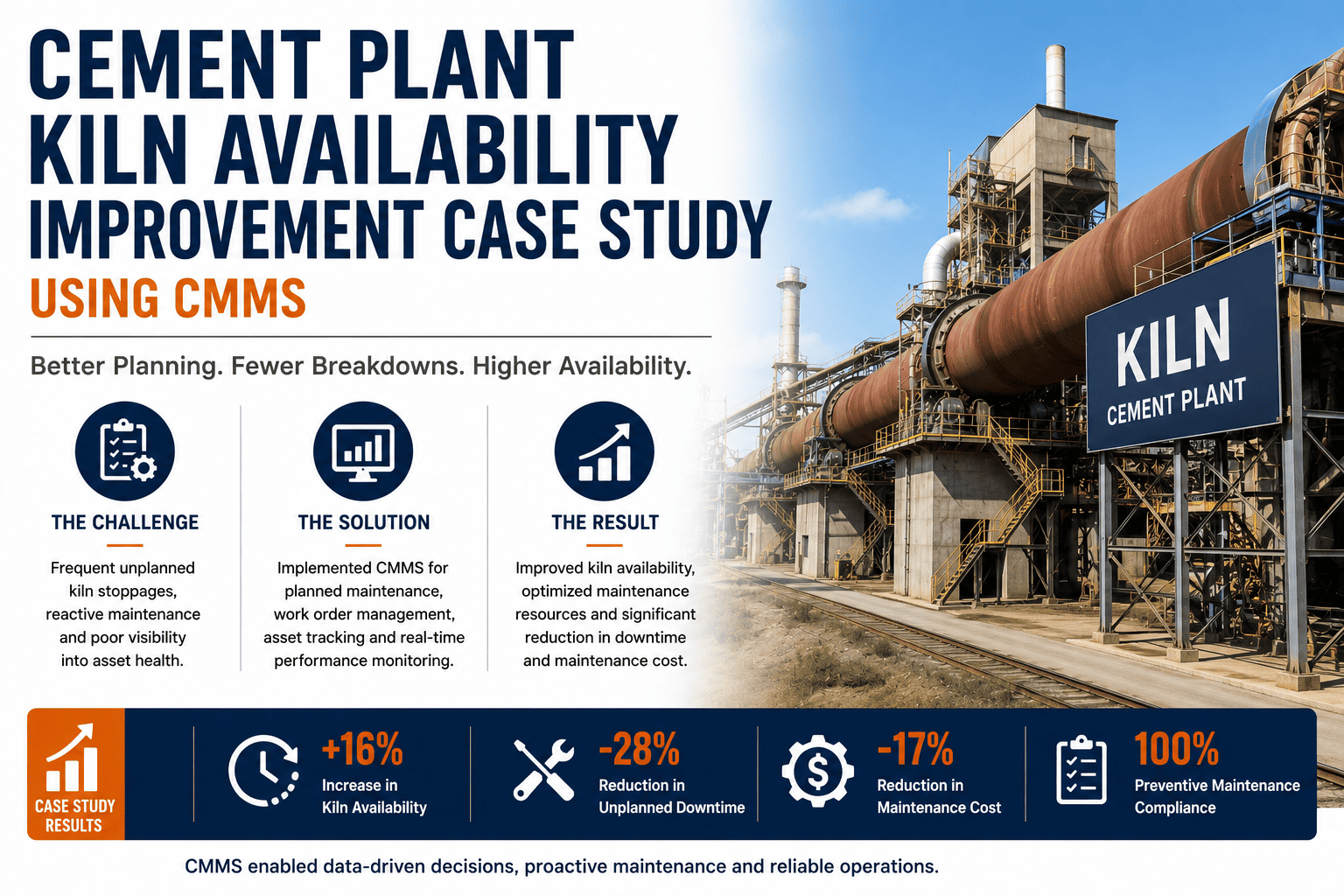
A rotary kiln that isn't turning is a cement plant that isn't producing, and one plant had settled into an availability ceiling of 82% because kiln shell issues, tyre wear, and girth gear problems kept surfacing as unplanned stops instead of planned work. Moving to condition-based maintenance on the kiln's critical rotating components pushed availability to 94% within a year. Here's how that shift worked. Sign up to see how the same approach could apply to your kiln.
82% → 94%
Rotary kiln availability improvement over the program
55% Fewer Stops
Reduction in unplanned kiln stops after condition monitoring began
40+ Kiln Days
Extra production days gained per year from the availability increase
12 Months
Timeframe from starting condition monitoring to the new baseline
The Challenge
The kiln team was skilled at reacting fast to a tyre running hot or a girth gear starting to whine, but every one of those events was still a surprise, found only once it had already forced a stop. Kiln shell ovality, tyre clearance, and gear mesh all drift slowly, and a slow drift caught only on a walkdown is a drift caught too late.
The Approach
1
Kiln Shell Ovality & Alignment Monitoring
Shell ovality and axis alignment were tracked continuously instead of measured only during planned outages
2
Tyre & Support Roller Condition Tracking
Tyre temperature and roller clearance were logged per support station to catch uneven wear early
3
Girth Gear & Pinion Wear Monitoring
Gear mesh and lubrication condition were checked against a fixed schedule instead of waiting for audible noise
4
Preventive Scheduling Through A CMMS
Inspections and refractory checks were scheduled off real condition data instead of a fixed calendar
Bring The Same Approach To Your Kiln
Oxmaint brings shell, tyre, and girth gear condition data together in one CMMS built for heavy process plants. Sign up for a free trial to explore it with your own kiln data, or book a demo to walk through a plan for your plant.
The Results
| Metric |
Before |
After |
| Kiln availability |
82% |
94% |
| Unplanned stops |
Frequent, discovered during production |
Sharply reduced, most caught in advance |
| Tyre and roller wear |
Found uneven only during scheduled outages |
Tracked continuously per support station |
| Maintenance approach |
Fixed calendar, reactive repairs |
Condition-based, scheduled by wear data |
Why It Worked
The gain came from watching the kiln's rotating equipment as continuously as the process itself. Once shell ovality, tyre clearance, and gear condition were all logged against their own history, the team could act on a slow drift weeks before it would have forced an unplanned stop.
Frequently Asked Questions
Q
What causes unplanned kiln downtime in cement plants?
Common causes include tyre overheating, uneven support roller wear, girth gear misalignment, and refractory failures, most of which develop gradually before causing a sudden stop.
Q
How does a CMMS improve rotary kiln availability?
A CMMS logs condition data like shell ovality and tyre temperature against each asset's own history, letting maintenance be scheduled off real wear trends instead of a fixed calendar that misses gradual drift.
Q
Can predictive maintenance extend refractory life in a kiln?
Yes, tracking shell temperature and ovality trends helps catch conditions that accelerate refractory wear, allowing corrective action before the lining is affected.
Turn Reactive Kiln Maintenance Into Extra Production Days
Oxmaint brings shell, tyre, and girth gear condition data together in one CMMS built for heavy process plants. Sign up for a free trial to explore it with your own kiln data, or book a demo to walk through a plan for your plant.