A raw mill hopper, a dust collector, a kiln inlet housing, a clinker silo — each one is a confined space, and each one has killed workers who went in without testing the air first. Atmospheric hazards inside cement plant vessels don't announce themselves; low oxygen and trapped carbon monoxide are invisible until someone collapses. Sign up to run every confined space entry against a permit that won't clear a worker until atmospheric testing, attendant assignment, and rescue plan are all logged.
Why It Matters
Confined space fatalities are disproportionately high in industries that run silos, kilns, and enclosed vessels, and OSHA 1910.146 exists specifically because entrants and would-be rescuers keep dying in the same predictable ways. A plant relying on a verbal "should be fine" instead of a tested, permit-required confined space program is one bad atmosphere away from a multi-fatality incident.
Which Cement Plant Spaces Actually Qualify
Silos and Hoppers
Clinker, raw meal, and cement silos trap dust that can engulf a worker and displace breathable oxygen without warning.
Kiln and Preheater Interiors
Residual heat, limited entry points, and combustion by-products make kiln shells and cyclone stages permit-required by default.
Dust Collectors and Tunnels
Baghouses, ductwork, and underground conveyor tunnels combine restricted exits with the risk of oxygen-deficient atmospheres.
The Pre-Entry Checklist
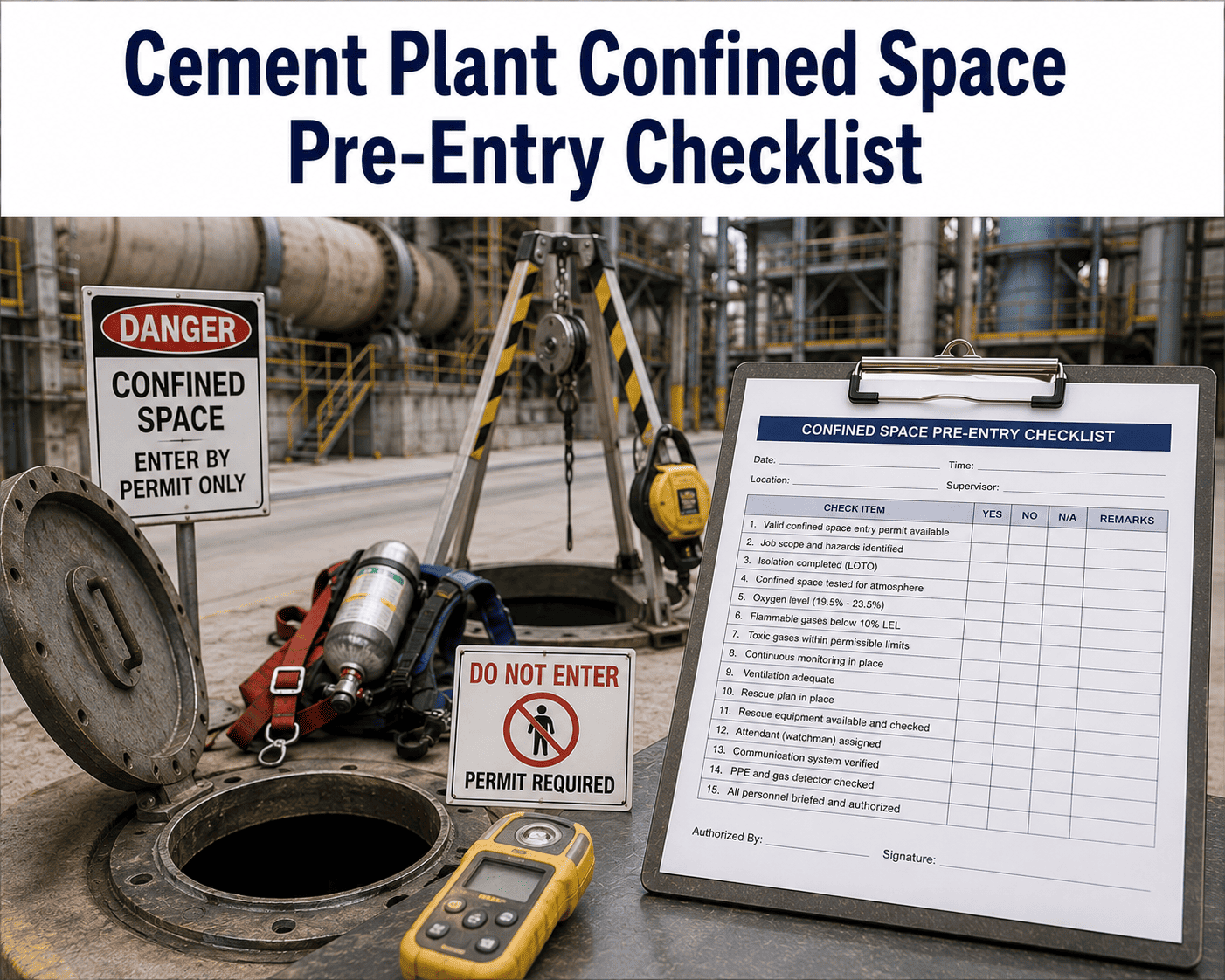
Confirm the permit matches the space: hazards specific to that silo, kiln section, or tunnel identified in writing, not a blanket confined space form
Isolate and lock out feed lines and mechanical hazards: augers, agitators, and material feeds blocked before anyone crosses the entry point
Test the atmosphere before entry, and continuously after: oxygen, flammability, and toxic gas readings logged with a calibrated meter, not assumed from a prior shift
Assign a dedicated attendant: stationed outside the space for the full duration, in direct communication with every entrant
Stage rescue and retrieval equipment: harness, tripod, and winch positioned at the entry point before the first entrant goes in
Get entry supervisor sign-off: permit authorized and time-stamped before the first entrant crosses the boundary
Every Entry Logged, Every Reading Time-Stamped
Oxmaint ties every confined space permit to atmospheric test results, attendant assignment, and rescue equipment checks, and won't authorize entry until every field is complete. Sign up for a free trial to run it on your own silo or kiln entry, or book a demo to see it configured for your plant.
Atmospheric Testing Order And Limits
The sequence of testing matters as much as the numbers. Oxygen is checked first because both flammability and toxicity readings depend on an accurate oxygen level, then flammable gas, then toxic gas. A cement plant vessel that reads safe on oxygen but skips the flammability check on a fuel-fired kiln section is still an unverified space.
| Test |
Acceptable Range |
Order |
| Oxygen |
19.5% to 23.5% |
Tested first |
| Flammable Gas |
Below 10% of lower explosive limit |
Tested second |
| Toxic Gas (CO, H2S) |
Below permissible exposure limit |
Tested third |
| Continuous Monitoring |
Same limits, checked throughout entry |
Ongoing |
Frequently Asked Questions
Q
What makes a cement plant space "permit-required" under 1910.146?
A space becomes permit-required when it has limited entry or exit, isn't designed for continuous occupancy, and contains or could contain a hazard such as an engulfment risk, a hazardous atmosphere, or an internal configuration that could trap an entrant, which describes most cement plant silos and kiln sections.
Q
Can the attendant also act as the rescuer?
The attendant's primary duty is monitoring entrants and conditions from outside the space and summoning rescue services, not entering the space themselves, since leaving that post removes the one person tracking every entrant's status.
Q
How long should confined space permit records be kept?
Completed permits are generally retained for at least a year, and longer where an incident, near-miss, or regulatory inspection is tied to that entry, giving the plant a documented history of every atmospheric reading and sign-off.
Turn Confined Space Entry Into A Verified Process
Oxmaint brings atmospheric testing, attendant assignment, rescue readiness, and supervisor sign-off into one auditable permit — no entry authorized until every check clears. Sign up for a free trial to run it on your own confined space entry, or book a demo to see it configured for your plant.