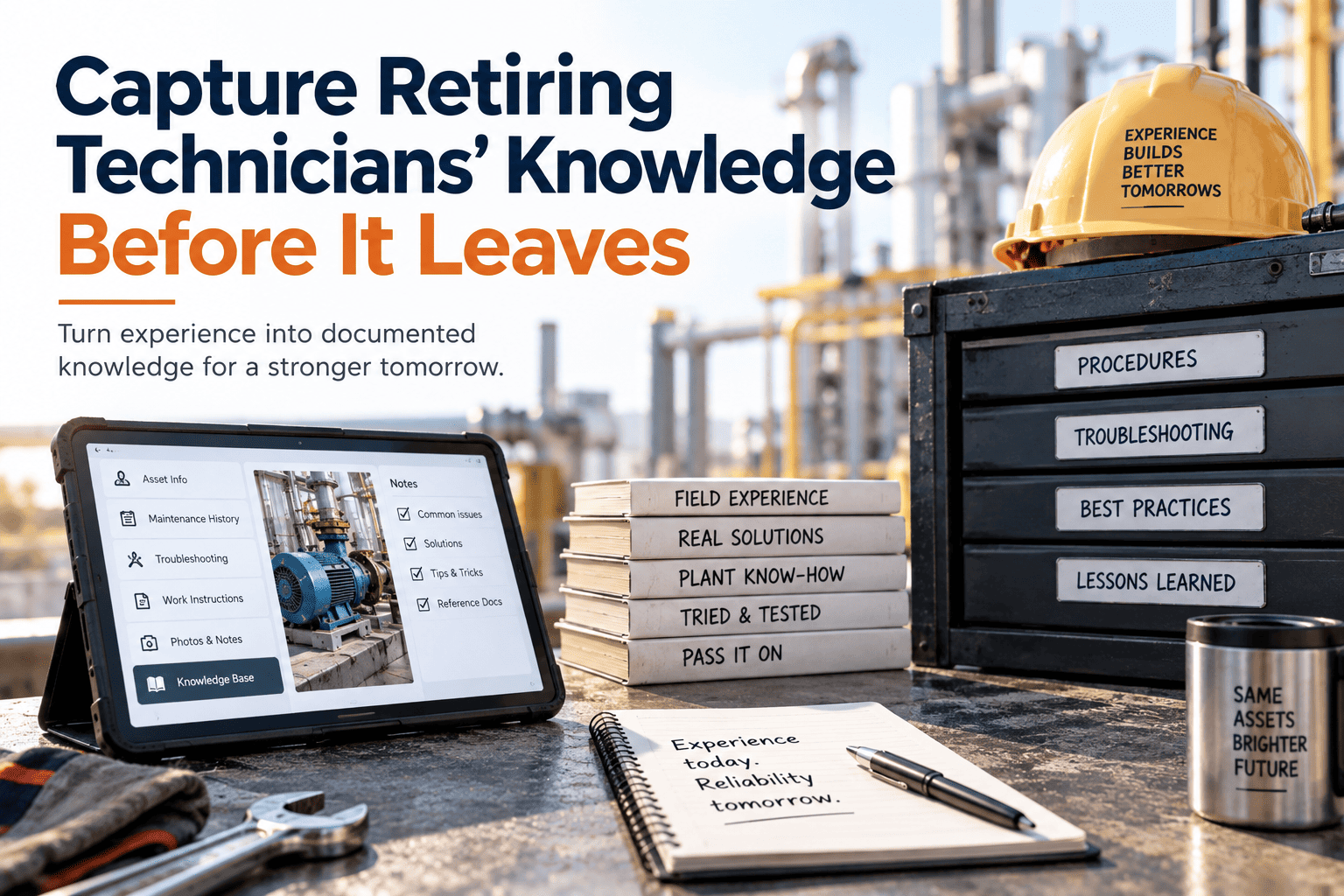
The maintenance technician who has fixed the same chiller for twenty years knows things no manual will ever say — which valve sticks in cold weather, which noise means order the part now, which shortcut saves an hour on a Friday shutdown. None of that lives in your CMMS today, and once that technician retires, it walks out the door with them. Manufacturing, healthcare and facility teams across every sector are watching their most experienced engineers reach retirement age at the same time junior hires are harder to find and slower to season. Knowledge capture software turns tribal expertise into structured digital job plans and asset histories before it disappears, so the next technician on the ticket starts with decades of context instead of a blank work order. This page covers why the skills gap is accelerating, what gets lost first, and how a connected system preserves it — start a free trial to see your own veteran technicians' knowledge captured against real assets.
Your most valuable asset record isn't written down anywhere
A veteran technician's judgment about how a specific machine actually behaves — not how the manual says it should behave — is built from thousands of hours nobody logged. When that person retires, the replacement inherits the equipment but not the experience, and the gap shows up as longer repair times, repeated mistakes and avoidable downtime for months afterward. OxMaint captures that expertise as structured job plans and asset notes while the knowledge is still in the building.
The knowledge that disappears fastest after a retirement
Not all expertise is equally at risk. Some knowledge lives in documented procedures that survive a departure just fine. The knowledge that vanishes overnight is the kind that was never written down because it felt too obvious to the person who knew it.
Failure pattern recognition
The specific sound, smell or vibration that means a particular asset is about to fail rarely gets written into a maintenance manual anywhere.
Workarounds for known quirks
Every aging machine has a known issue with an informal fix that keeps it running, and that fix is rarely documented outside one person's memory.
Vendor and parts relationships
Which supplier actually stocks the obscure part fast, and which one always causes delays, is knowledge that lives in a technician's contact list, not a system.
Undocumented modifications
Field fixes and equipment modifications made years ago often never made it back into the official asset record at all.
Why exit interviews alone don't preserve expertise
Most organizations' only formal knowledge transfer step is a final conversation in the last week of employment, which is far too little, far too late to capture decades of pattern recognition.
| Capture Method | Timing | Depth of Detail | Searchable Later? |
|---|---|---|---|
| Exit interview | Final week only | Shallow — high-level recall | No — buried in notes |
| Informal shadowing | Ad hoc, if scheduled | Moderate — depends on overlap | No — undocumented |
| Written SOP updates | Occasional, low priority | Moderate — formal steps only | Partial — static documents |
| OxMaint job plan capture | Continuous, during real work | Deep — tied to actual assets | Yes — linked to every asset |
See your veteran technician's knowledge captured live
Book a 30-minute walkthrough and we will show how a technician's notes on a real asset turn into a searchable job plan the whole team can use.
Turning tribal knowledge into a living asset record
OxMaint captures expertise as part of the normal maintenance workflow, so a veteran technician does not need to stop and write a separate knowledge document — the insight gets attached to the exact asset it belongs to as the work happens.
Guided job plan capture
Experienced technicians record step-by-step procedures and known quirks directly against the asset, turning memory into a reusable template.
Voice and photo notes on the job
Technicians can log a quick note or photo in the field describing a symptom or fix without breaking from the work itself.
Searchable asset history
Every past repair, workaround and part swap is searchable against the asset, so a new hire finds it in seconds instead of guessing.
Mentorship task pairing
Work orders can be assigned jointly to a veteran and a newer technician, with the veteran's notes captured automatically during the shared task.
Four steps to capture expertise before it walks out the door
Knowledge capture works best as an ongoing habit rather than a rushed project in a retiring technician's final month, so starting early with your most experienced staff pays off the most.
Identify at-risk expertise
List the technicians closest to retirement and the specific assets or trades where their knowledge is hardest to replace.
Build job plans together
Sit with the veteran technician while they walk through a real repair and capture the steps and quirks directly into the system.
Pair on live work orders
Assign upcoming tickets jointly so newer staff absorb context while the senior technician is still available to explain it.
Review and refine
Revisit captured job plans after they've been used a few times and refine them based on what newer technicians found unclear.
Don't let decades of expertise leave with the retirement party
Join the facility and manufacturing teams using OxMaint to turn their most experienced technicians' knowledge into a permanent, searchable asset record.
Knowledge capture software — frequently asked questions
What does knowledge capture actually mean in maintenance?
It means turning an experienced technician's undocumented judgment about specific assets into structured, searchable job plans and notes. Start a free trial to try it on a real asset.
Does this slow down a technician's actual work?
No, capture happens through quick notes, photos and guided job plan fields built into the same workflow the technician already uses to close a ticket.
How early should we start before someone retires?
As early as possible — knowledge capture works best as an ongoing habit across a technician's career, not a rushed project in their final weeks.
Can new hires actually find this information later?
Yes, every captured note and job plan is linked directly to the asset it describes, so it surfaces automatically the next time work is logged against it.
Is this only useful for large manufacturing sites?
No, any facility with long-tenured technicians and aging equipment benefits, from hospitals to commercial portfolios. Book a demo to see it fit your operation.
Preserve the expertise your equipment depends on
See how OxMaint turns decades of hands-on technician knowledge into a permanent part of your asset record, before it retires with the person who built it.
Free 14-day trial · No credit card