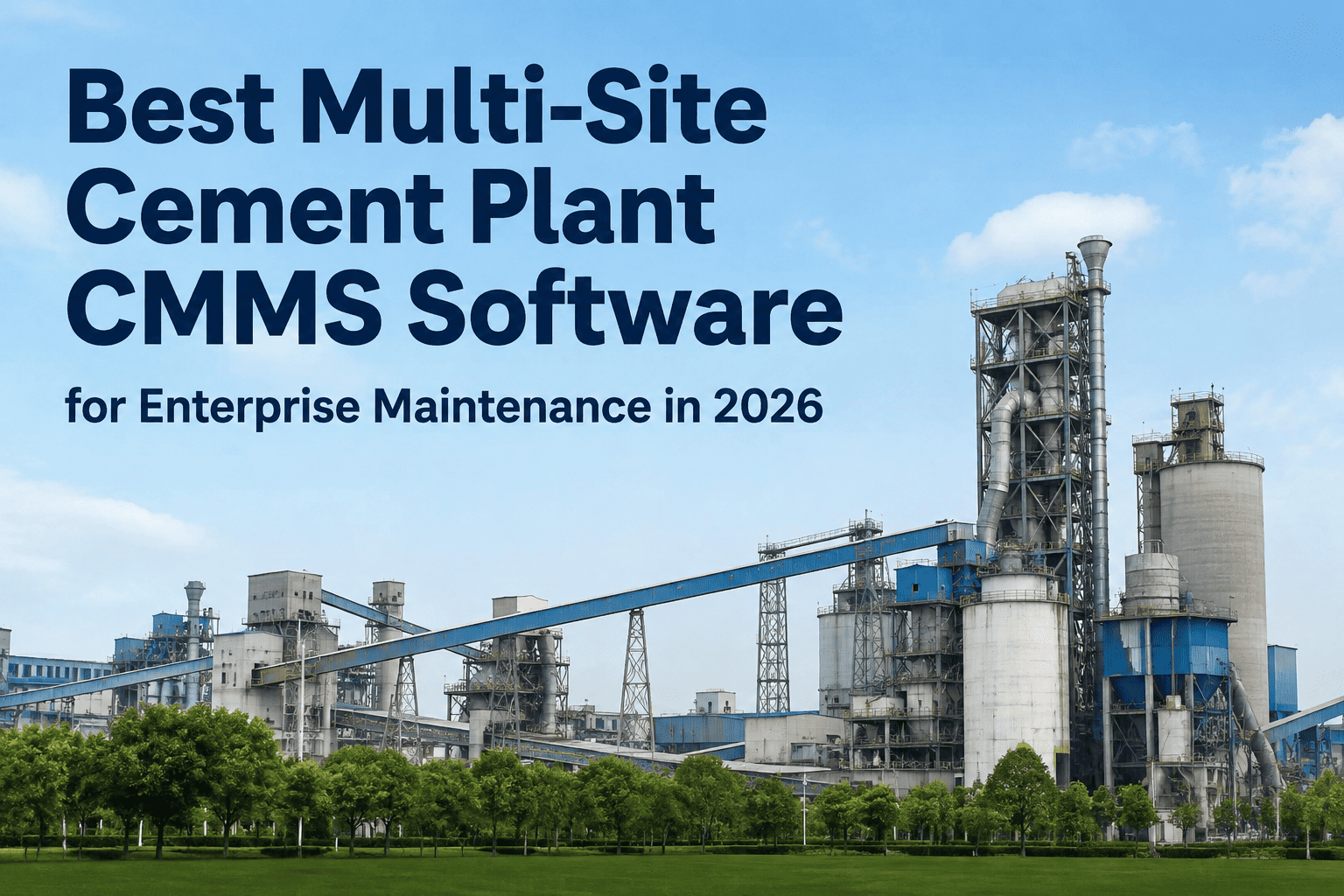
Cement groups running five, fifteen, or fifty plants don't lose money in one place, they lose it in the gaps between plants. A spare part sitting unused at one site while another pays premium for the same part overnight. A PM checklist followed religiously at one kiln and skipped at another. A group maintenance director who can't answer "which plant is our worst performer" without a week of spreadsheet reconciliation. Sign up to see how a single centralized CMMS closes those gaps across every plant in your portfolio.
Why It Matters
Cement groups that centralized maintenance across sites report 68 percent fewer unplanned kiln stops, 84 percent PM compliance group-wide, and group-level visibility live within 90 days of rollout. A single plant CMMS cannot deliver that, it was never built to compare one site against another.
What "Multi-Site Ready" Actually Means
Centralized Asset Hierarchy
Every plant's kilns, mills and conveyors mapped in one shared portfolio-to-component structure
Standardized PM Templates
The same inspection depth and checklist logic applied whether it's plant one or plant thirty
SSO & Role-Based Access
One corporate login controls who sees which plant, shift and module, no orphaned accounts
Cross-Plant KPI Dashboards
Uptime, PM compliance and cost per tonne normalized and compared across every site in one view
Native ERP & SAP Connectors
Work orders, materials and costs sync with group ERP without a custom integration project
Phased 90-Day Rollout
Group-level visibility live fast, site-level depth built out over the following months
What Group-Level Results Look Like
Fewer Unplanned Kiln Stops Group-Wide
68%
PM Compliance Across All Sites
84%
Fewer Critical Spare Part Stockouts
73%
Time To Group-Level Dashboard Live
90 Days
One Dashboard, Every Plant
See how OxMaint normalizes KPIs, standardizes PM and connects to your group ERP across every site. Sign up for a free trial to explore it on your own portfolio data, or book a demo to see it configured for your plants.
Signs Your CMMS Wasn't Built For Multiple Plants
Each plant logs into a separate instance, or worse, keeps its own spreadsheet with no shared login
One plant reports "kiln availability" and another reports "kiln uptime", and nobody at group level knows if they mean the same thing
Emergency parts get purchased at premium pricing while the same part sits idle at a sister plant 200 km away
ERP connectivity for each site is a separate custom project instead of one standard connector rolled out everywhere
Single-Site CMMS vs Enterprise Multi-Site CMMS
| Factor |
Single-Site CMMS |
Enterprise Multi-Site CMMS |
| Asset hierarchy |
Built per plant, structured differently at each site |
One portfolio-to-component structure shared across every plant |
| PM standardization |
Checklists and frequency set locally, drift over time |
Shared templates with defined exceptions, governed centrally |
| Login & access |
Separate credentials per site, manual offboarding |
Single sign-on with role-based access by plant and shift |
| Reporting |
Manually reconciled in spreadsheets, weeks behind |
Normalized KPI dashboard comparing every plant in real time |
The Takeaway
A CMMS that works well for one plant can still fail an enterprise cement group, because the hard part isn't running one site, it's making thirty sites comparable. The gap between your best and worst plant only closes once every site speaks the same language.
Frequently Asked Questions
Q
How long does an enterprise multi-site rollout actually take?
Most cement groups complete initial deployment across all sites within four to six weeks, with full KPI dashboard functionality live within 90 days. The timeline depends mostly on asset data migration and how much existing PM documentation needs standardizing.
Q
Can individual plants keep local procedures while still feeding group reporting?
Yes, this is by design. Centralized multi-site CMMS doesn't replace each plant's local maintenance operation, it normalizes KPI definitions across plants so leadership sees a consistent group view while site teams keep the autonomy to execute locally.
Q
Does SSO replace the need for role-based permissions?
No. SSO handles authentication, confirming who the user is through your corporate identity provider. Role-based permissions then control what that user can see and do inside the CMMS, which plants, shifts and modules they can access. Both work together across a multi-site deployment.
Bring Every Plant Onto One Dashboard
OxMaint centralizes asset hierarchy, standardized PMs, SSO access and ERP connectivity for cement groups running 5 to 50 plants. Sign up for a free trial to explore it on your own plant data, or book a demo to see it configured for your portfolio.