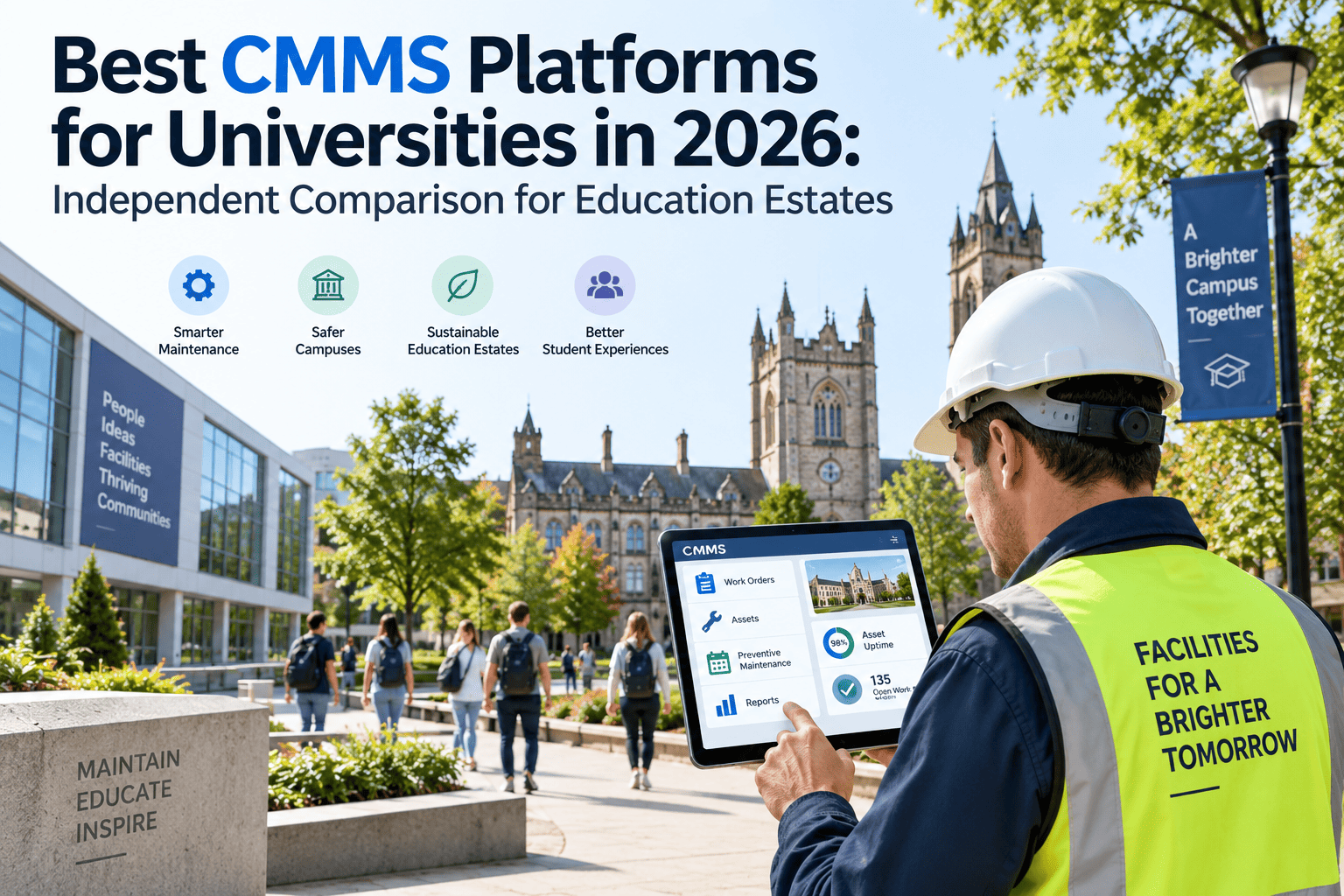
A university facilities director evaluating CMMS software in 2026 is not comparing simple work order tools anymore. The shortlist now has to handle a multi building campus hierarchy spanning teaching blocks, residences, labs, and athletics facilities, talk to the finance and HR systems already running the institution, report energy and sustainability data to governors, and put a usable mobile app in the hands of technicians who range from a new graduate hire to a thirty year maintenance veteran. Most comparison guides either list every CMMS vendor on the market with no context for education, or quietly favour whichever platform paid for the placement, leaving facilities directors to work out the real trade offs on their own after a contract is already signed. This is an independent look at how the leading platforms actually perform against the specific demands of a university estate in 2026, drawing on real deployment patterns rather than marketing copy, including where Oxmaint AI fits alongside longer established names in the sector.
What We Evaluated
Generic maintenance software misses requirements that are specific to higher education. A tool built for a single retail store or a small manufacturing plant simply was not designed around the scale, governance, and reporting demands a campus estate carries every day, and forcing that kind of tool onto a fifty building campus usually surfaces its limits within the first term of use. The five criteria below are what actually separates a platform that works for a single site facilities team from one built to run an entire campus estate across dozens of buildings and thousands of individual assets, and they are the same criteria facilities directors consistently bring up when asked what went wrong with a previous system.
Structure
Multi-Building Hierarchy
The ability to organise assets by campus, building, floor, and room, so a teaching block and a residence hall can be managed separately but reported on together.
Integration
ERP and Finance Connectivity
Clean integration with the finance, HR, and student information systems a university already runs, so maintenance spend reconciles without manual re-entry.
Sustainability
Energy and ESG Reporting
Built in tracking of energy consumption and carbon data tied to individual assets, feeding directly into the sustainability reports governors now expect.
Adoption
Mobile Technician Experience
A mobile app simple enough that every technician actually uses it in the field, not just the facilities coordinator back at a desk.
Budget
Total Cost of Ownership
The real annual cost once implementation, per user licensing, and add on modules are counted, not just the headline subscription price.
Top University CMMS Platforms Compared at a Glance
We ranked the platforms below on how well they meet the five criteria above for a multi building university estate specifically, rather than as generic maintenance software that happens to work on a campus. Each entry reflects patterns seen consistently across education deployments rather than a single institution's experience.
1
Oxmaint
Cloud native multi campus hierarchy, mobile first technician experience, and sustainability tracking built in from day one, without the six figure implementation timeline of legacy enterprise systems. Estates teams typically go live in weeks rather than negotiating a multi year rollout plan.
Best overall for university estates
2
AssetWorks AiM
A purpose built higher education IWMS with deep space management features and a long track record in large university estates, though the interface suits trained administrators more comfortably than frontline technicians learning it on the fly during a shift.
Best for large IWMS deployments
3
Brightly (formerly SchoolDude)
The most recognised brand in education procurement with over a decade of K-12 and higher ed workflow experience, now part of Siemens, though the interface and per user pricing reflect its legacy roots more than a recent cloud native rebuild would.
Best for brand familiarity
4
TMA Systems
Strong asset lifecycle and preventive maintenance depth aimed squarely at facilities and operations teams, with a steady but less modern approach to mobile access and reporting compared with newer cloud built platforms entering the market.
Best for asset lifecycle depth
5
Facilio
A connected platform built around multi campus operations and ESG reporting, positioned more toward large portfolio operators managing dozens of sites than mid sized single university estates with tighter facilities budgets.
Best for large multi campus portfolios
How These Platforms Differ in Day to Day Use
Feature lists on a vendor website rarely capture what changes for a facilities team once a platform is actually running. The differences that matter most in practice tend to show up in three places: how quickly a new technician becomes productive, how much manual work goes into monthly and annual reporting, and how painful it is to add a newly acquired building or a fast growing residence hall into the existing structure without disrupting reporting for the rest of the estate. These are the moments where a platform either earns its reputation or quietly becomes shelfware that nobody outside the facilities coordinator's desk ever opens.
Onboarding
Technician Ramp Up Time
Mobile first platforms typically get a new technician submitting and closing work orders within a single shift, while denser enterprise interfaces often need multiple training sessions first.
Reporting
Compliance Documentation Effort
Platforms with built in digital audit trails turn a fire safety or governance report into minutes of work, compared with the hours some legacy systems still demand to assemble by hand.
Growth
Adding New Buildings
Cloud native platforms generally let an estates team add a new site as a configuration change, while some legacy systems treat it as a fresh implementation project.
See how Oxmaint's multi campus hierarchy, mobile app, and sustainability tracking compare on your own estate, not just on paper or in a sales deck.
Feature Comparison Table
Marketing pages tend to claim every feature a buyer might search for. The table below compares what these five platforms actually deliver on the criteria that matter most for a university estate, based on how each one performs once it is running against real campus operations rather than a sales demo.
| Platform |
Multi-Building Hierarchy |
ERP Integration |
Sustainability Tracking |
Mobile Experience |
Typical Implementation |
| Oxmaint |
Native, campus to room level |
Standard API connections |
Built in energy tracking |
Mobile first design |
Weeks |
| AssetWorks AiM |
Deep, space management focused |
Enterprise grade, complex setup |
Available as a module |
Functional, admin oriented |
Several months |
| Brightly |
Established, education specific |
Available, legacy architecture |
Energy management module |
Dated relative to newer tools |
Months |
| TMA Systems |
Solid, asset centric |
Standard integrations |
Limited native tracking |
Functional, less modern |
Weeks to months |
| Facilio |
Strong, portfolio oriented |
Enterprise grade |
Strong ESG reporting focus |
Modern, cloud native |
Months |
How We Scored These Platforms
Rankings on comparison pages are only useful if the reader can see how they were reached and can question the method rather than just the conclusion. Each platform above was weighed against the five criteria outlined earlier, with extra weight given to two factors that consistently determine whether a CMMS rollout actually succeeds on a campus: how quickly frontline technicians adopt the mobile experience without formal training, and how much of the total cost only becomes visible after the contract is signed. A platform that scores well on paper but requires a lengthy configuration project to reach basic multi building reporting was marked down relative to one that delivers that structure out of the box, and one factor consistently separated the top ranked platforms from the rest: whether the vendor's own reference customers were multi building university estates or single site commercial operations adapted after the fact.
Weight
Real World Adoption
How consistently technicians across different ages and comfort levels with technology actually use the mobile app in daily work, not just log into it once.
Weight
Hidden Cost Exposure
Whether core capabilities like mobile access, ERP integration, and sustainability reporting are included, or sold back as separate paid modules later.
Weight
Time to Value
How quickly an estates team moves from signed contract to a live, usable system covering the full campus rather than a single pilot building.
Why Multi-Building Hierarchy Actually Matters
A single site facilities tool treats every asset as part of one flat list. A university estate needs a structure that mirrors how the campus is actually organised, from the institution down to an individual room, so a maintenance manager can view one building in isolation or roll every building up into a single estate wide report without exporting data into a spreadsheet first and reassembling it by hand every time governors ask a question.
Full Campus or Estate
Building
Floor or Zone
Room or Asset
Platforms that bolt this structure on as an afterthought tend to show cracks once an estate passes ten or fifteen buildings, with reporting that either flattens everything into one undifferentiated list or requires a separate dashboard per site that nobody has time to check consistently. The platforms ranked highest above treat the hierarchy as a foundational design choice rather than a configuration option added later, which is exactly why they scale more gracefully as an estate grows through new construction or acquisition, and why a facilities director evaluating a new platform should ask to see the hierarchy in action on a live estate rather than a simplified demo environment built with only two or three buildings.
Total Cost of Ownership: What Universities Actually Pay
The headline subscription price rarely reflects what a university ends up paying once implementation, training, and add on modules like mobile access or sustainability reporting are factored in. Facilities directors comparing platforms purely on a per seat quote often discover the real gap only after a contract is signed and the first invoice for a mobile module or an API connector arrives, sometimes months into a rollout that was supposed to already be finished. The figures below reflect the pattern seen across legacy enterprise systems compared with modern cloud native platforms serving the same size of estate.
10 to 15x
higher total cost
Typical total cost of ownership for a legacy enterprise system compared with a modern cloud native alternative.
12 to 36x
longer implementation
How much longer a legacy enterprise rollout typically takes compared with a modern platform going live in weeks.
39%
fewer emergency repairs
Reduction in emergency repair spending reported by education institutions after adopting a structured CMMS platform.
We had spent years assuming a bigger, more established vendor automatically meant a better fit for a university. What actually happened with our legacy platform was a compliance report that took a coordinator fourteen hours to assemble by hand, and a mobile access quote that came back as an eighty five thousand pound add on module requiring six months of implementation before anyone could use it. Moving to a modern cloud platform cost us less annually than our old system's maintenance contract alone, and every technician was working from their phone within the first week.
VP of Facilities, UK University Estates Team
Ready to see why more university estates are moving off legacy CMMS platforms in 2026? Compare Oxmaint directly against your current system and see the difference for yourself.
Frequently Asked Questions
These are the questions facilities directors ask most often when shortlisting a CMMS platform for a university estate, whether they are replacing a legacy system or buying their first structured maintenance platform.
What makes a CMMS suitable for a university rather than a single building?
A university specific platform needs a true multi building hierarchy, ERP integration with existing finance and HR systems, sustainability reporting, and a mobile experience simple enough for a large, varied technician workforce to adopt without extensive training or a dedicated IT rollout project.
Is a more established, legacy CMMS always the safer choice for a large estate?
Not necessarily. Legacy platforms often carry longer implementation timelines and higher total cost of ownership once add on modules are included, while modern cloud native platforms increasingly match or exceed their feature depth at a noticeably lower ongoing cost and faster time to value.
How long does it typically take to implement a university CMMS?
Modern cloud native platforms like Oxmaint can go live in a matter of weeks, while legacy enterprise systems commonly take several months to over a year depending on the scope of the ERP integration, data migration, and customisation required across the estate.
Does a university CMMS need to support sustainability and ESG reporting?
Increasingly yes. Governors and funding bodies expect energy and carbon data tied to individual buildings and assets, and platforms without native sustainability tracking usually require a separate specialist tool to fill that gap, adding another system for the estates team to maintain.
How does Oxmaint compare against a legacy enterprise CMMS in practice?
Oxmaint delivers native multi campus hierarchy, mobile first technician workflows, and built in sustainability tracking without the lengthy implementation or per module pricing typical of legacy systems. You can
book a walkthrough to compare it directly against your current platform and see the difference in practice.
Give Your Estate a CMMS Built for 2026, Not 2006
Oxmaint combines multi campus hierarchy, ERP connectivity, sustainability tracking, and a mobile app technicians genuinely use every day, without a six figure implementation project or a year long rollout schedule.