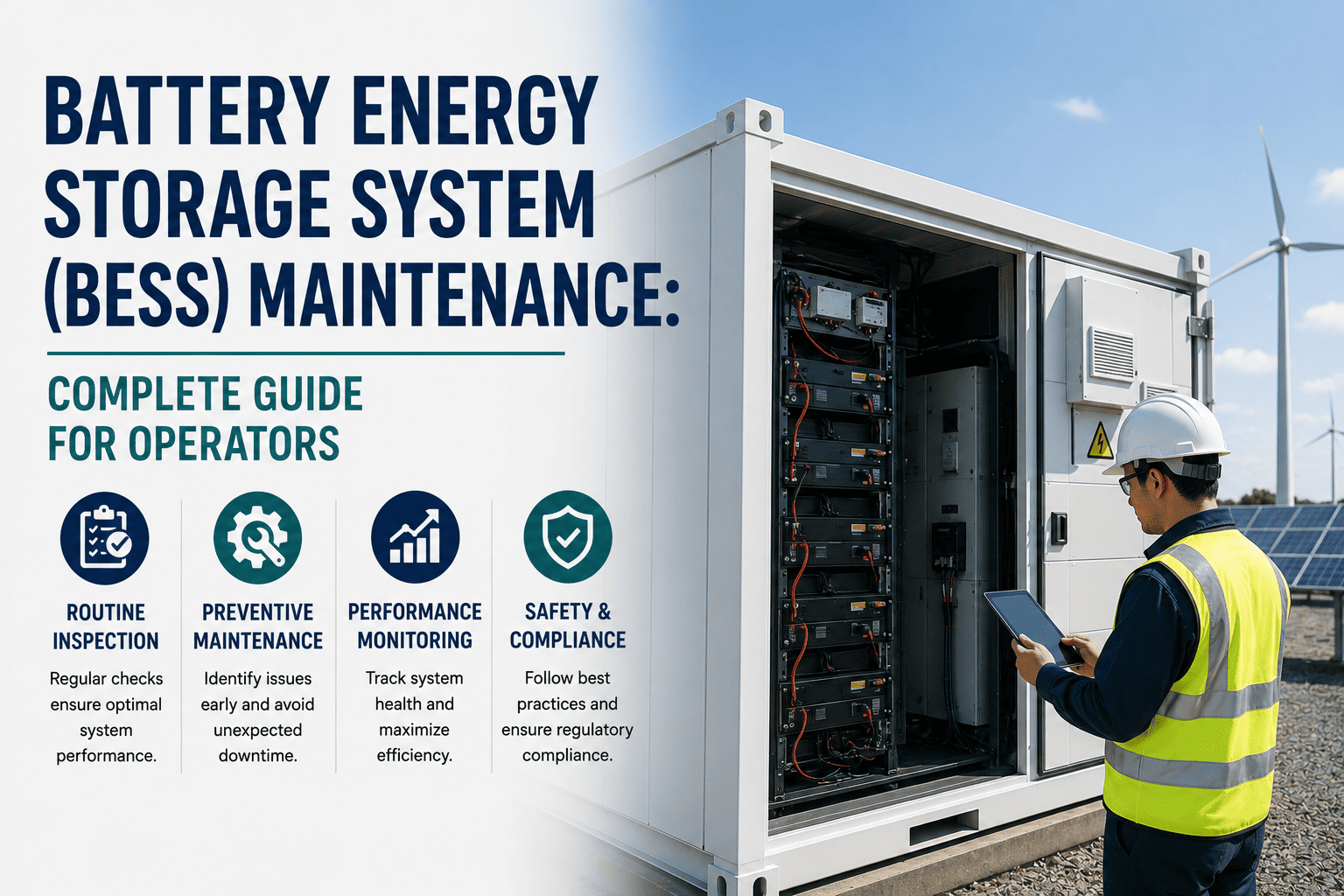
A battery energy storage system doesn't fail like a generator or a transformer — when a lithium-ion cell goes into thermal runaway, water can't reach it and the reaction can reignite hours later. That's why BESS maintenance isn't only about uptime, it's a genuine fire safety control. Sign up free to see how Oxmaint tracks BMS health, thermal management and fire system testing against every enclosure on site.
1,900 L/min
Minimum firefighting water supply recommended by UK fire services for BESS sites
120 minutes
Minimum duration that water supply must be sustained under NFCC guidance
25m
Typical exclusion zone considered around an enclosure in thermal runaway
Zero propagation
What UL 9540A testing must demonstrate before a module design is accepted
Maintenance Is a Fire Safety Control
Thermal runaway happens when a cell generates heat faster than it can dissipate it, and once it starts, the reaction can sustain itself even without oxygen. A battery management system that's drifted out of calibration, a cooling fan that's failed, or a suppression system that's never been tested aren't uptime issues at a BESS site — they're the layers standing between a minor cell fault and a site-wide incident.
What a BESS Maintenance Programme Actually Covers
01
Battery Management System Health Checks
Cell voltage, temperature and balancing, tracked continuously
The BMS is the first line of defence, detecting cell-level faults and isolating them before they escalate. Maintenance here means confirming voltage, temperature and state-of-charge readings against calibration, and reviewing balancing performance across modules, not just checking the system is switched on.
02
Thermal Management and Cooling Servicing
Keeping the system's first defence against runaway working
HVAC units, liquid cooling loops and thermal barriers between switchgear and battery modules all need regular servicing, since a battery generating heat faster than the cooling system can remove it is exactly how a thermal event begins.
03
Fire Detection and Suppression Testing
Gas and smoke detectors, tested, not assumed
Aspirating smoke detection, hydrogen and carbon monoxide sensors and any water misting or suppression system need periodic functional testing. A detection system that's never been tested since commissioning is a gap that only shows up during an actual event.
04
Electrical and Structural Inspection
Inverters, connections and enclosure integrity
Inverter servicing, cable connection checks and enclosure inspection for corrosion or seal damage round out the programme, since a compromised enclosure undermines the separation and containment the whole site design depends on.
Keep Every Enclosure's Safety Record in One Place
Oxmaint tracks BMS health, cooling servicing and fire system testing against each BESS enclosure, so nothing lapses quietly. Sign up for a free trial to load your own site, or book a demo and we'll walk through your maintenance programme together.
Reactive Response vs. Preventive BESS Maintenance
| Reactive Approach |
What It Risks |
Preventive Fix |
| BMS alerts reviewed only after a fault trips |
Slow cell degradation goes unnoticed for months |
Continuous BMS monitoring with trend-based alerts |
| Cooling system serviced on an annual visit only |
Developing hotspots go undetected between visits |
Thermal checks scheduled around seasonal load peaks |
| Fire suppression tested only at commissioning |
A system that may not function when actually needed |
Periodic functional testing logged per enclosure |
| Maintenance records scattered across O&M contractor emails |
No audit trail for insurers or fire and rescue services |
Full safety record for any enclosure pulled in minutes |
Best Practices for BESS Operators
Practice 01
Track Voltage Trends, Not Just Alarms
A cell drifting slowly out of balance rarely trips an alarm early. Reviewing voltage and temperature trends across modules catches degradation while it's still a servicing task, not an emergency.
Practice 02
Service Thermal Management Before Peak Load Seasons
Cooling demand rises with ambient temperature and cycling frequency. Scheduling servicing ahead of peak seasons, rather than on a flat calendar date, keeps the cooling system ahead of the load it will actually face.
Practice 03
Test Detection and Suppression on a Fixed Schedule
Gas sensors, aspirating smoke detection and suppression systems should be functionally tested on a set rhythm, with results logged per enclosure so a gap in coverage never goes unnoticed.
Practice 04
Keep the Site Emergency Information Current
Water supply locations, site maps and shutdown procedures kept in an emergency information box need updating whenever equipment or layout changes, not left as a one-time commissioning document.
How Oxmaint Supports BESS Operators
Oxmaint gives storage operators a single record per enclosure — BMS health checks, cooling servicing, fire detection and suppression tests, and electrical inspections, all timestamped and attributed. Trend alerts flag developing cell or thermal issues early, and a complete safety record for any enclosure is retrievable in minutes for an insurer or fire and rescue service review. Book a demo to see it set up against your own BESS site.
Frequently Asked Questions
Q
What causes thermal runaway in a lithium-ion BESS?
Thermal runaway occurs when a cell generates heat faster than it can dissipate it, often triggered by an internal fault, overcharge or mechanical damage. Once started, the reaction can be self-sustaining and may reignite hours or days after it appears to be extinguished.
Q
What standards govern BESS fire safety in the UK?
The National Fire Chiefs Council publishes grid-scale BESS planning guidance for UK fire services, while NFPA 855 and UL 9540A, both US in origin, are widely applied for installation design and thermal runaway propagation testing in the absence of dedicated UK design standards.
Q
Why is water sometimes used on lithium-ion battery fires if it can't reach the cells?
Water is used to cool surrounding modules and slow cell-to-cell propagation rather than to extinguish the internal reaction directly. Guidance generally treats this as containment, allowing the affected enclosure to burn out in a controlled way rather than fully extinguishing it.
Q
How often should a BMS and thermal management system be inspected?
Continuous monitoring should run at all times, with a scheduled physical inspection and calibration check at set intervals, typically brought forward around seasonal load peaks when cooling systems work hardest and cell stress is highest.
Turn BESS Safety Records Into a Real Maintenance Advantage
Oxmaint gives storage operators one connected record for every enclosure's BMS health, thermal servicing and fire system testing, so safety decisions are backed by data instead of memory. Sign up for a free trial to explore it on your own BESS site, or book a demo and we'll walk through it against your maintenance programme.
BMS Health Monitoring
Thermal Management Tracking
Fire System Testing Logs
Enclosure Safety Records
Audit-Ready Compliance