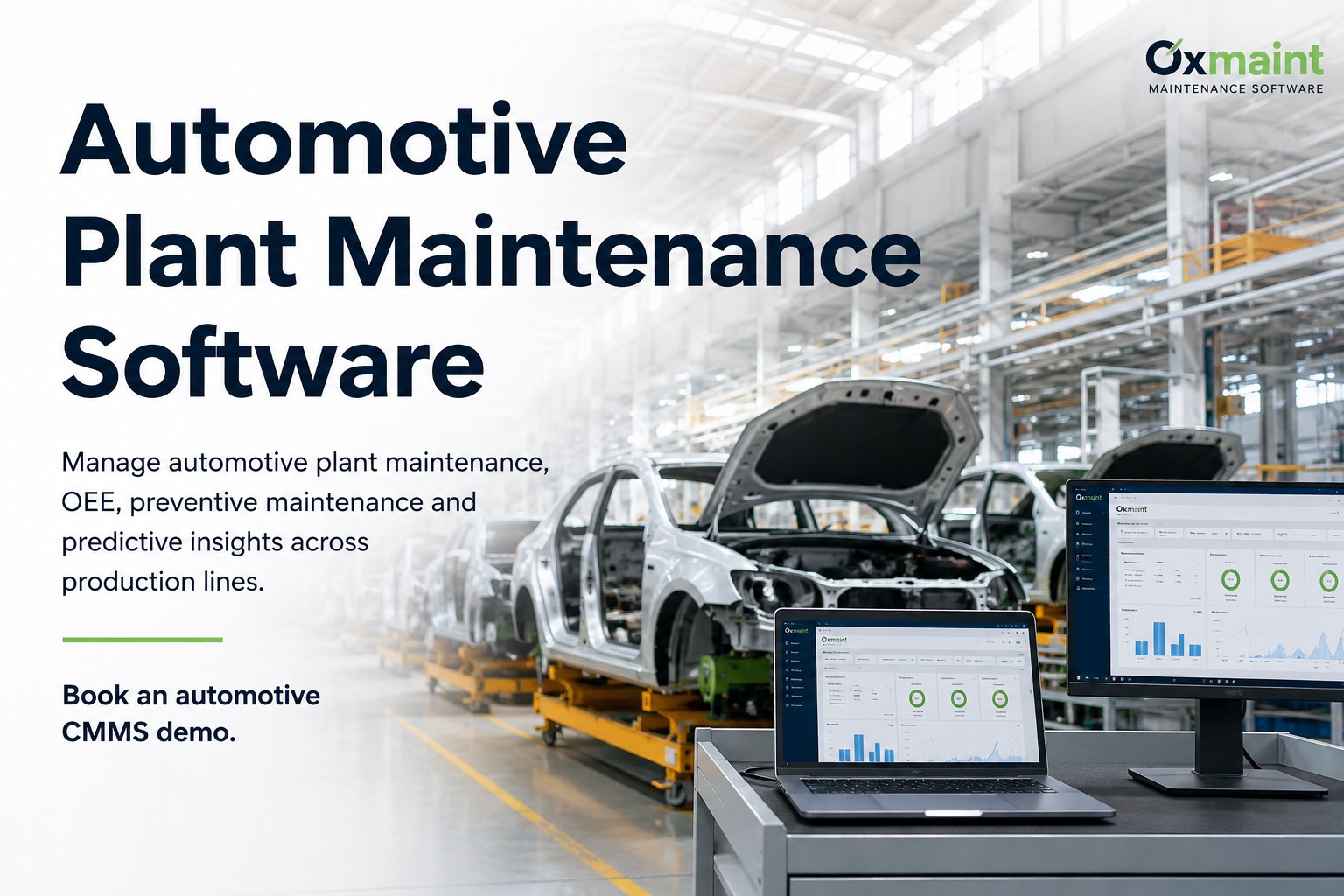
Automotive plants don't have downtime — they have cascade events. A weld gun fault at a body-in-white station backs up stamping, empties the paint booth, starves final assembly, and by hour three the JIT invoice from the OEM has already been calculated. UK automotive plants lose £1.6–£2 million per hour to unplanned stoppages per IDS-INData 2025 — figures Siemens' True Cost of Downtime report confirms across Europe. Oxmaint gives automotive maintenance teams one platform for preventive schedules, predictive alerts, work orders and spares. Book a demo to see automotive CMMS workflows in action.
Automotive Downtime · The Real Numbers
Every stopped minute has a queue behind it
£2m/hr
Peak unplanned downtime cost for UK high-throughput automotive plants — IDS-INData 2025
42%
Share of unplanned downtime attributable to equipment failure — the largest single cause across manufacturing
85%
World-class OEE benchmark for automotive stamping — most operations run 55-70% without predictive strategies
The Automotive Production Line — Where Every Asset Class Meets Maintenance
An automotive plant is not one production system — it's five sequential production systems welded together by conveyors, with a robotics population running through all of them. Maintenance requirements are radically different at each stage: stamping presses need stroke-count-based PM, paint shops need environmental compliance evidence, body shops need weld-gun robot fleets managed at scale. The stage-flow below shows the maintenance shape of a typical UK/EU volume plant.
Stamping → Body → Paint → Assembly → Final
01
STAMPING
Presses & dies · 800-2000 ton
PM scheduled on stroke count, not calendar. Die-change coordination against production plan. Lubrication and hydraulic condition monitoring.
OEE lever: Availability
02
BODY-IN-WHITE
Robots · weld guns · 400+ per line
Robot fleet PM at scale. Weld gun tip dressing schedules. Fault-code capture per robot ID. Real-time weld quality against work order.
OEE lever: Performance + Quality
03
PAINT SHOP
Booths · ovens · HVAC · applicators
Environmental compliance evidence tied to filter-change work orders. Booth humidity/temperature drift tracking. VOC extraction monitoring.
Clean-environment monitoring. Battery test-cell calibration. Formation area humidity control. Coolant leak detection on pack lines.
OEE lever: Quality + Safety
The Downtime Cost Stack — Why the Hourly Figure Is Always Wrong
Ask a plant manager what a stopped line costs and they'll quote the direct production loss. But Siemens' 2024 study and every Tier-1 finance team knows the real number sits under a stack of cascading costs — most of which never show up on the maintenance department's ledger. The visualisation below shows what actually accumulates during a single 4-hour stoppage on a JIT-committed automotive line.
Direct production loss
£1.6-2m/hr
Idle labour cost
+ £45-80k/hr
Expedited freight & premium logistics
+ £15-100k/event
JIT line-down charges from OEM
+ £10k-1m/event
Recovery overtime + weekend shifts
+ 40-80% wage premium
Customer scorecard demerit
Compounds over quarter
Actual downtime costs typically run 2-3× the direct-loss figure quoted in maintenance reports · Source: Siemens True Cost of Downtime 2024
See Live Automotive CMMS Workflows
Walk through production-line asset trees, stroke-count PM on stamping, robot fleet management for body shop, paint booth compliance evidence and OEE-linked work orders — configured against your plant layout. Thirty minutes with the Oxmaint team.
Asset Coverage — Every Automotive Equipment Class in One Platform
Automotive plants run a wider asset diversity than almost any manufacturing sector — from 2000-ton mechanical presses to precision paint applicators to lithium-ion cell handling systems. Oxmaint provides asset templates tuned for each equipment class, with PM logic, spares BOMs and failure-mode libraries pre-configured. Sign up free to explore automotive asset templates.
Stamping Presses
Mechanical & hydraulic · 800-2000 ton
Welding Robots
6-axis arms · spot & MIG weld cells
Paint Booths
HVAC · applicators · VOC extraction
Conveyor Systems
Skid · overhead · EMS · AGV fleets
CNC Machining
Powertrain · block · head machining
EV Battery Lines
Cell handling · pack assembly · formation
Where Automotive Maintenance Actually Breaks Down at Scale
A single-line PM schedule is trivial. Five production stages running two shifts across a 24/6 UK plant, with 400+ robots, 1200+ conveyor drive assemblies, 60+ press dies rotating through stamping, and a paint shop running mandatory environmental compliance — that's where paper systems and generic CMMS platforms fail. The specific failure modes are consistent across UK volume plants: PM slipping past interval because stroke-count wasn't being tracked, spares stockouts on obscure robot end-effectors that halted lines for 8 hours, and paint booth compliance evidence that couldn't be produced during environmental audit. Sign up free to see plant-scale asset structures in action.
Expert Perspective — What Separates Reactive from Predictive Automotive Plants
Every automotive plant runs on the same three metrics — Availability, Performance, Quality — the components of OEE. What changes between a 60% OEE plant and an 85% OEE plant isn't the equipment, it's the maintenance regime attached to that equipment. Reactive plants respond to failures. Preventive plants schedule against calendar or run-hours. Predictive plants attack all three OEE losses simultaneously by reading condition data from the assets themselves — vibration, temperature, current draw, cycle-to-cycle variance — and generating work orders before the failure surfaces. The gap between a 65% and a 78% OEE plant is worth roughly £8-12 million per year on a single volume line. It's not marginal. It's the whole business.
01
Stroke-count PM on presses
Calendar-based intervals miss the wear reality of stamping. Stroke-count PM aligns work orders to actual die and press stress.
02
Robot fleet PM at scale
Managing 400+ robots on individual PM cycles requires templating and bulk scheduling — not manual work orders per unit.
03
Paint booth compliance evidence
Filter changes tied to environmental permit conditions produce audit-ready evidence without extra admin.
04
Condition data → work order
Vibration, temp and current draw feeding automatic work orders means failures get scheduled, not endured.
Who Uses Oxmaint Across Automotive Manufacturing
The platform is used by the specific operational roles that carry maintenance accountability in automotive plants: plant managers running site-wide OEE targets across UK and European facilities, maintenance managers coordinating shift teams across stamping, body, paint and assembly, reliability engineers building failure-mode libraries and condition-monitoring rules, production managers negotiating maintenance windows against takt time, engineering managers scoping capex against reliability data, EV production teams standing up new cell handling and formation lines under aggressive ramp curves, and Tier-1 supplier operations under OEM scorecard scrutiny. Each role sees the same underlying asset data filtered to their view — PM calendar, work order queue, spares dashboard or reliability trend. Sign up free to configure roles across your plant teams.
Getting Automotive CMMS Live
Deployment starts with importing your production-line asset hierarchy — stamping through EV battery — into the Oxmaint platform. Each asset carries its equipment class template with pre-configured PM logic, spares BOM and failure-mode library. Condition monitoring integrations pull vibration, temperature and current data from existing sensors or Oxmaint-supplied wireless kits. Mobile technician workflows go live within the first two weeks; predictive alerts and OEE-linked dashboards typically activate within 30-45 days. Book a walkthrough to see live automotive plant deployments.
Turn Every Production Line Into a Managed Asset
Oxmaint gives automotive maintenance teams one platform for preventive schedules, predictive alerts, work orders, spares and OEE visibility — across stamping, body, paint, assembly and EV battery production lines.
An automotive CMMS (Computerised Maintenance Management System) is a maintenance platform purpose-configured for the equipment classes, production shapes and compliance obligations of automotive manufacturing. Unlike generic CMMS, an automotive CMMS provides templates for stamping presses (stroke-count PM), robot fleets (bulk scheduling), paint booths (environmental compliance evidence) and assembly line equipment (takt-time-aware maintenance windows). It also integrates with OEE systems, condition monitoring sensors and Tier-1 quality reporting workflows to give plant, maintenance and reliability teams a shared view of asset health across the whole facility.
Can predictive maintenance be used on stamping presses?
Yes — and it's one of the highest-ROI predictive applications in automotive manufacturing. Stamping presses are heavily instrumented targets: vibration sensors on the crown, current-draw monitoring on the main motor, hydraulic pressure sensors on cushions, and stroke-count telemetry on the crankshaft position encoder. Combined, this data stream detects bearing wear, tie-rod stress, die-cushion pressure drift and lubrication failures before they cause unplanned stops. Oxmaint ingests these streams and generates predictive work orders scheduled against production plans rather than as emergency callouts.
Can paint shop equipment be managed in a CMMS?
Yes. Paint shops carry unique maintenance requirements combining rotating equipment (booth extract fans, oven burners, applicator motors) with environmental compliance (VOC monitoring, filter change intervals tied to permit conditions, humidity and temperature drift alarms). Oxmaint provides paint-shop-specific asset templates with the correct PM logic, environmental compliance evidence trails, and filter/consumable inventory linked to work orders. Compliance auditors can access the complete filter-change and environmental-monitoring history against permit conditions directly from the platform.
Can maintenance data be connected with OEE systems?
Yes. Oxmaint integrates with OEE and MES platforms via standard APIs to share downtime causes, work order references and asset-level failure data. This means the Availability component of OEE reflects real maintenance events tagged to specific assets, the Performance component can be correlated with condition-monitoring trends, and the Quality component can be traced back to equipment-related root causes. The bidirectional flow means production teams and maintenance teams work from the same numbers — no reconciliation gap between the two.
Can EV manufacturing equipment be managed with Oxmaint?
Yes. EV production adds asset classes that traditional automotive plants don't have — cell handling systems, cathode/anode coating lines, electrolyte filling, formation and grading equipment, and battery pack assembly with high-voltage test cells. Oxmaint supports these with EV-specific asset templates, clean-environment monitoring integrations, formation area humidity control workflows, and high-voltage test cell calibration schedules. UK and European EV plants ramping new lines under aggressive schedules use the platform to keep PM discipline as capacity ramps.