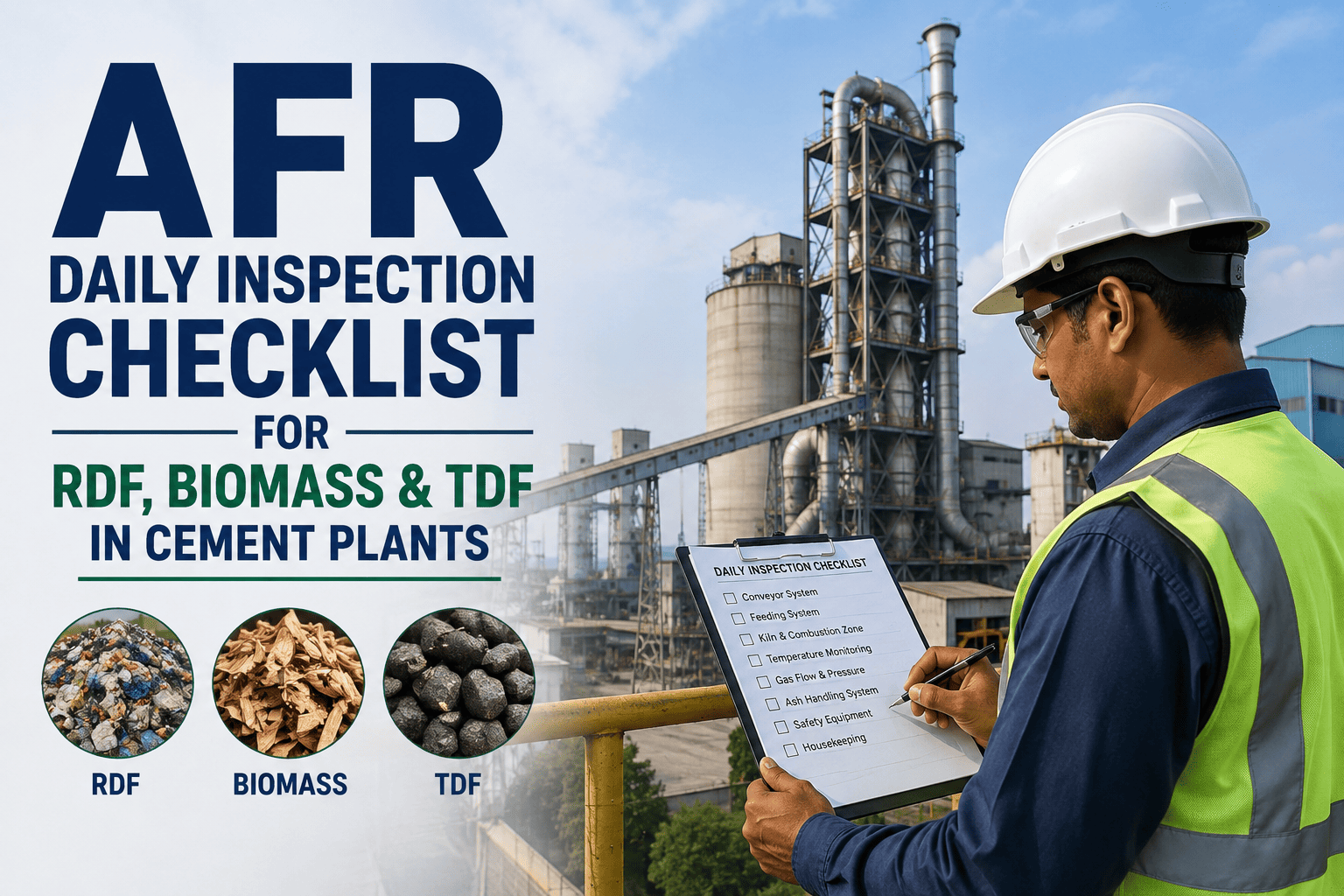
An AFR dosing line doesn't fail because operators skip the checklist, it fails because the checklist lives in someone's head. Feed rate gets eyeballed, moisture gets guessed by feel, and chlorine only gets tested when preheater blockages have already started. RDF, biomass and TDF each swing 15 to 30 percent batch to batch, and a five-minute daily check is what keeps that swing from reaching the kiln. Sign up to log this checklist digitally, batch by batch, shift by shift.
Why It Matters
RDF calorific value can swing 20 to 30 percent batch to batch, and biomass moisture fluctuates 12 to 28 percent seasonally. Undetected, that variance shifts the burning zone, corrodes preheaters with chlorine, and pushes emissions past permit limits. Caught on a daily checklist, it's a dosing adjustment instead of an unplanned stop.
Target Range Cheat Sheet
RDF
NCV 15-20 MJ/kg
Moisture ≤ 15%
Chlorine ≤ 0.8%
Particle size ≤ 60mm
Biomass
NCV 8-18 MJ/kg
Moisture 15-20%
Chlorine 0.2-0.3%
Check for K2O/Na2O ash
TDF
NCV 28-33 MJ/kg
Moisture ≤ 10%
Chlorine ≤ 0.5%
Check wire content
The Daily Inspection Checklist
Feed rate: confirm dosing screw output matches the setpoint for this shift's fuel blend, not yesterday's
Moisture: sample and log against the target range for the fuel type, RDF and TDF drift low, biomass drifts seasonal
Calorific value: check sensor reading against the certified batch value, flag any gap wider than 10 percent
Chlorine: test before dosing, not after, chlorine above threshold means bypass dust and preheater risk
Particle size & contamination: inspect for oversized RDF fragments and TDF wire content that jam shredders
Dosing accuracy: cross-check actual feed against the logged setpoint, drift here is usually the first sign of a worn screw
Stop Logging This On Paper
Every AFR batch, moisture reading and chlorine test linked directly to the dosing system and kiln combustion record for that shift. Sign up for a free trial to try it on your own AFR data, or book a demo to see it configured for your fuel mix.
Red Flags That Should Stop Dosing
Chlorine tests above 0.8 percent for RDF or 0.5 percent for TDF, hold the batch before it reaches the kiln
Moisture readings more than 5 points above the target range, expect flame instability and a downstream burning zone
Calorific value dropping more than 10 percent from certified batch value without a corresponding feed rate adjustment
Visible oversized fragments or wire content in the feed stream, a shredder jam is cheaper than a dosing screw failure
RDF vs Biomass vs TDF: What Breaks Equipment
| Fuel |
Main Risk |
Watch Daily |
| RDF |
Chlorine-driven bypass dust and preheater buildup |
Chlorine test and particle size before dosing |
| Biomass |
High alkali ash causing preheater cyclone blockage |
Moisture swing and ash alkali content |
| TDF |
Steel wire jamming shredders and dosing screws |
Wire content and iron modulus impact on raw mix |
The Takeaway
Six checks, five minutes, every shift, that's the difference between an AFR programme that scales past 20 percent thermal substitution and one that stalls out after the first preheater blockage. The fuel variance isn't going away, but a daily checklist keeps it from reaching the kiln.
Frequently Asked Questions
Q
How often should chlorine actually be tested, every batch or once a shift?
Chlorine should be tested before dosing on every incoming batch, not sampled once per shift. Chlorine above roughly 0.8 percent for RDF creates bypass dust and preheater corrosion risk that a single shift-level average would miss entirely.
Q
Why does biomass moisture need closer daily tracking than RDF?
Biomass moisture fluctuates seasonally between roughly 12 and 28 percent depending on feedstock and storage conditions, a wider swing than RDF typically shows. That variance directly shifts the burning zone downstream, so daily sampling catches drift before it destabilizes the flame.
Q
Can a CMMS actually track this checklist instead of a paper logbook?
Yes. Every AFR batch can be logged with calorific value, moisture, chlorine, particle size and heavy metal readings tied directly to dosing performance and combustion parameters for that shift, so a quality deviation automatically triggers a hold work order instead of getting missed.
Digitize Your AFR Inspection Today
OxMaint logs feed rate, moisture, calorific value, chlorine and dosing accuracy for RDF, biomass and TDF, batch by batch, linked straight to your kiln combustion record. Sign up for a free trial to explore it on your own AFR data, or book a demo to see it configured for your fuel mix.