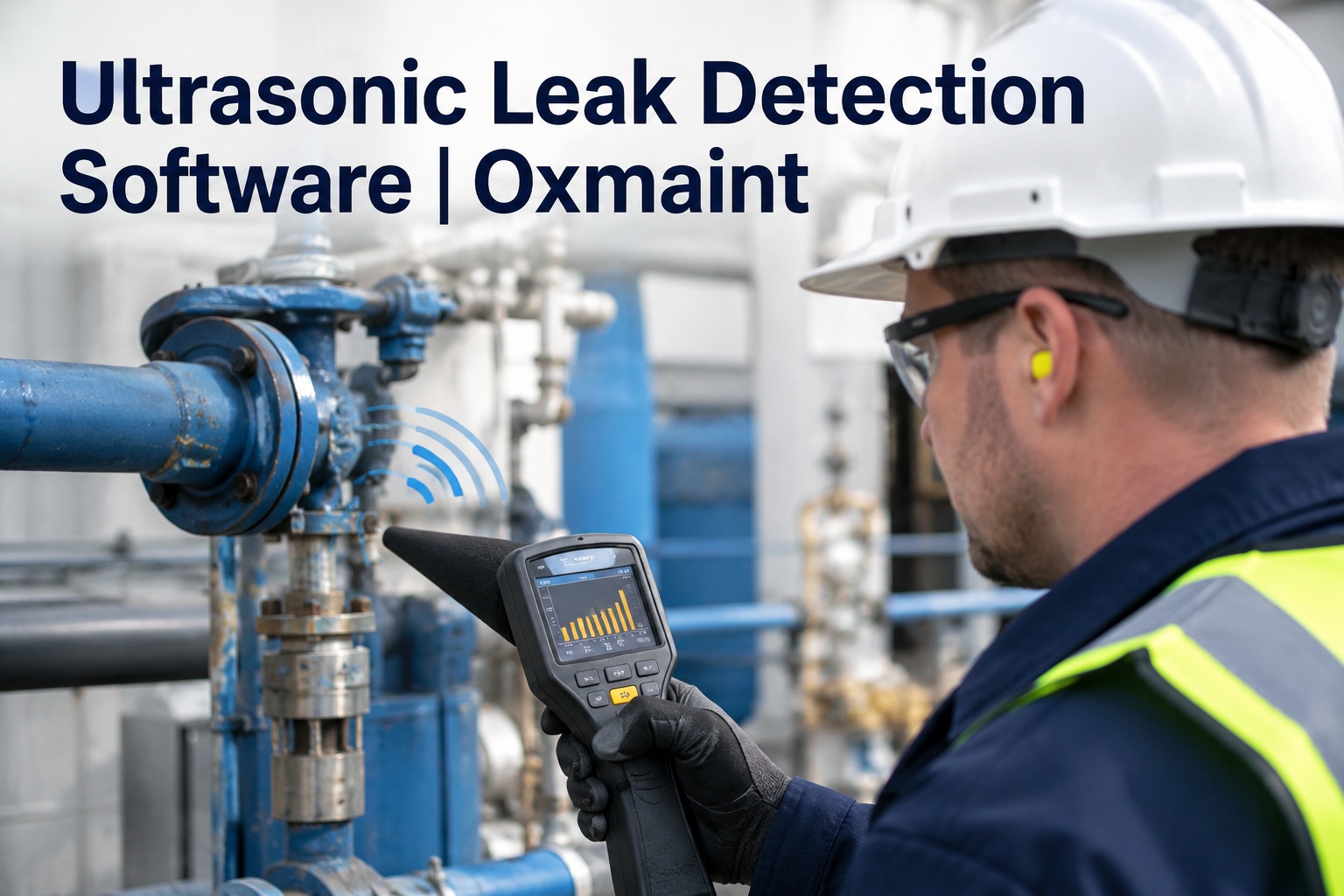
Ultrasonic Leak Detection Software | Oxmaint

By Riley Quinn on August 18, 2026

ultrasonic-leak-detection-maintenance

Ultrasonic leak detection only pays when every leak you find turns into a repair somebody actually completes. Oxmaint captures ultrasonic survey results across compressed air, steam and gas systems, puts a pound figure on each leak, ranks them by payback and raises the work order automatically, then verifies the saving after the fix. Start a free trial or book an energy-loss demo to see your own survey data costed.

Predictive & AI

Ultrasonic Leak Detection Software

Most UK plants already know they have leaks. What stops the repair programme is nobody can say what each one costs, so finance never approves the budget. This page shows how to close that gap and turn a survey into proven savings.

You cannot hear the leaks that cost you most

Loud leaks get fixed because somebody complains about the noise. The expensive ones make no sound a person can detect, which is why they run for years.

95% 5%
Inaudible to the human ear. Found only with ultrasound. Audible. Usually already reported and fixed.

Compressed air accounts for around 10% of UK industrial electricity consumption, and roughly 30% of it escapes through leaks on a typical site with no leak management programme.

What a single leak actually costs

These are the figures that unlock a repair budget. A 1mm hole sounds trivial until it is priced over a year of running.

LeakLossCost per yearDetectable by ear
1mm hole at 7 bar~0.2 litres per second~£400No
Typical small fitting leakFine, continuous escapeUp to £700No
Average leak across UK surveysVaries by pressure~£1,200Rarely
Large single leak recordedSignificant flow~£1,650Sometimes
75 kW compressor at 30% leakage~22 kW wasted continuously~£16,000Partly

Based on around 12p per kWh and typical UK running hours. Compressed air costs eight to ten times more per usable unit of power than the electricity that makes it, and only about 4% of the input energy ends up as usable air.

Why most leak programmes stall

The survey happens. The report arrives. Then nothing changes. Three failure points explain almost every stalled programme.

01 The report is a PDF Ninety tagged leaks in a document nobody can assign, schedule or track. Six months later the tags are still on the pipework.
02 No pound figure per leak Maintenance knows the leaks exist but cannot quantify the waste, so the repair budget never gets past finance.
03 Nobody verifies the fix Without a re-survey and a before and after figure, the saving is a claim rather than a result. Next year's budget gets harder.

The closed loop Oxmaint builds around your survey

Detection is one step of five. The other four are where the money is actually recovered.

1Capture
Survey findings logged against the asset with location, decibel reading, photo and system pressure.
2Quantify
Flow and annual cost estimated from pressure, reading and your actual tariff and running hours.
3Prioritise
Ranked by payback, not by whoever shouts loudest. The top ten usually carry most of the loss.
4Repair
Work order raised automatically with parts, severity and assignee, then tracked to completion.
5Verify
Re-check after the fix, close the leak and bank the saving as a figure you can show finance.

What UK surveys have actually found

£250,000 Annual waste identified at a washing powder plant, from over 100 leaks found in a two day survey.
£102,000 Annual losses found by a leak detection programme at a UK vehicle manufacturing plant.
£49,000 Worth of leaks pinpointed during a three day survey at a food manufacturer.
75% Of one manufacturer's £100,000 air bill was waste. They were about to buy a second compressor. They did not need one.

Fixing only the largest ten leaks commonly recovers 50 to 70% of the waste within the first month, and structured leak programmes typically pay back in six to 24 months.

Three systems, one workflow

Compressed air Fittings, hoses, drops, couplings and quick connects. The largest single recoverable energy loss on most sites, and the easiest to prove.
Steam and traps Failed traps pass live steam continuously and stay invisible on a walk round. Ultrasound distinguishes a passing trap from a working one.
Gas and vacuum Process gas, nitrogen and vacuum lines where escape is both a cost and a safety matter. Surveyed live, under normal pressure.

Surveys run while the system is pressurised and production continues. No shutdown required.

Questions we get asked

Do we need to stop production to survey? No. Ultrasonic detection needs the system pressurised, so it works during normal running.
How often should we survey? Annually for most sites. Systems develop new leaks continuously as fittings, hoses and seals age.
Does Oxmaint supply the detector? Oxmaint is the software layer. It takes readings from your instrument or contractor and turns them into costed, tracked jobs.
How is the cost per leak calculated? From system pressure, the ultrasonic reading, your electricity tariff and actual compressor running hours.
Can we prove the saving afterwards? Yes. Re-verification after repair closes each leak with a before and after figure you can hand to finance.
Will it work with our existing CMMS? Yes. Oxmaint connects to existing systems rather than requiring you to replace what already works.

Turn your next survey into a costed repair plan

Bring your last leak report, or your compressor rating and tariff if you have not surveyed yet. In thirty minutes we will show you what the waste is worth and how the repair programme would be tracked. The free trial runs without a credit card.



Share This Story, Choose Your Platform!