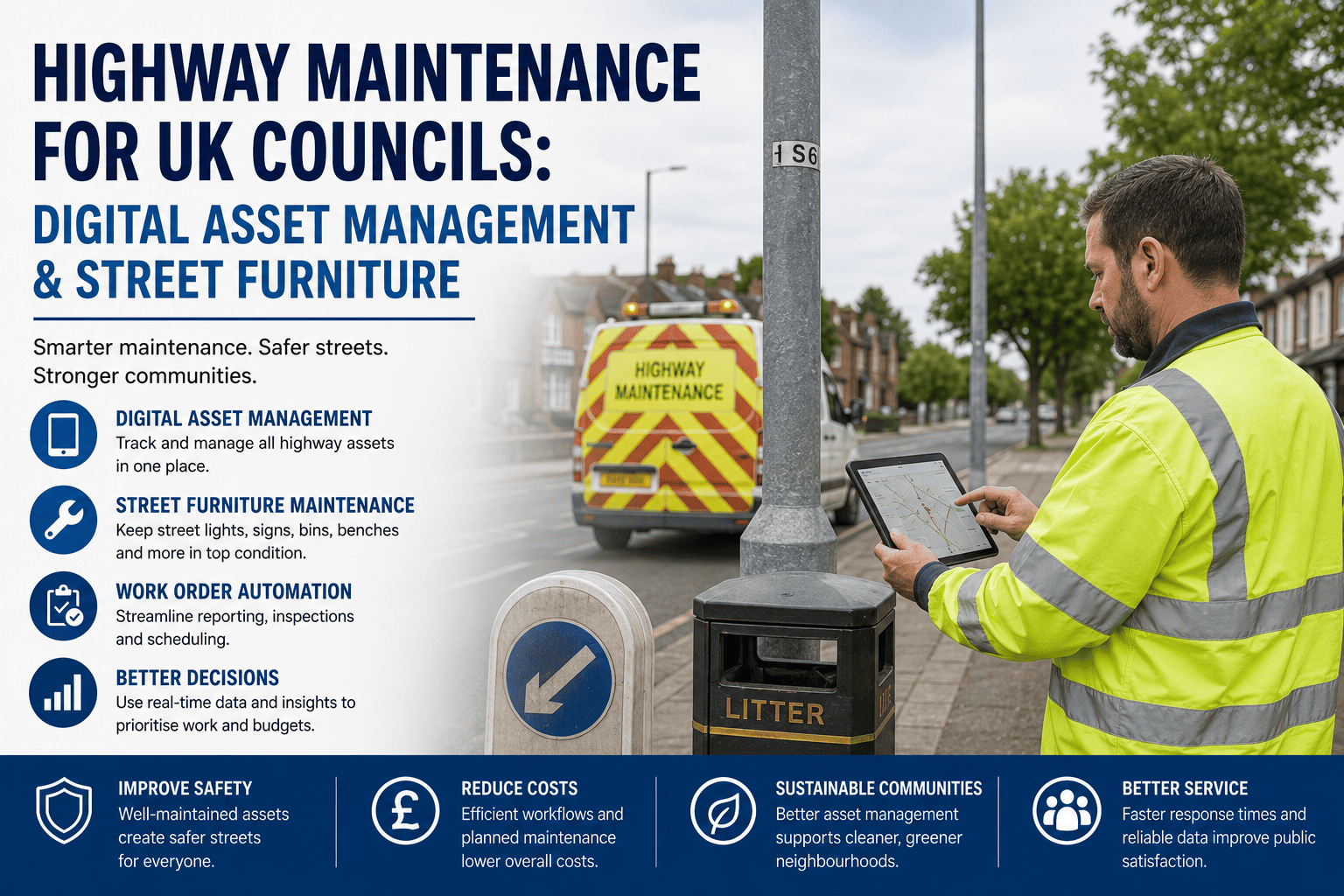
When a pothole claim lands on a highways team's desk, the outcome rarely hinges on the pothole itself. It hinges on whether the inspection record can prove the council had a reasonable system in place under Section 58 of the Highways Act 1980. England and Wales now face an £18.62 billion carriageway repair backlog that would take 12 years to clear, and every gap in an inspection log makes that defence harder to hold. Start a free trial to see how Oxmaint turns highway inspections into defensible, timestamped records.
£18.62bn
Carriageway repair backlog across England and Wales, per the 2026 ALARM survey
12 yrs
Estimated time needed to clear the current backlog at present funding levels
40mm
Typical depth threshold councils use as an internal trigger for emergency pothole repair
20 days
Statutory window to respond to an FOI request for a road's inspection history
What Section 58 Actually Tests
Section 41 places an absolute duty on a highway authority to maintain the road. Section 58 is the only way out of that duty — but it flips the burden of proof onto the council. It's not enough to say a road was inspected. The authority has to show inspection frequency, road categorisation, inspector competence and repair response times were all reasonable, and prove it with records, not recollection.
Three Things Courts Scrutinise in Every Claim
Case law keeps circling back to the same three questions. Get any one of these wrong on paper, even if the work was actually done, and the Section 58 defence starts to weaken.
Test 1
Inspection Frequency
Was the road inspected at the interval set by its category, and can the date and route be proven, not just claimed?
Test 2
Road Categorisation
Courts have overturned defences where a road was placed in the wrong hierarchy tier, setting the wrong inspection frequency from the outset.
Test 3
Repair Response Time
Once a defect is logged, was it repaired within the timescale its category demands, with a timestamp to prove it?
Beyond the Carriageway: The Street Furniture Blind Spot
01
Street Lighting Faults Reported by Phone
A dark column becomes an unrecorded risk overnight
A resident calling in a faulty street light often gets logged in a general contact system, not tied to the actual column asset. If that light contributes to a later trip or collision claim, there's no clean record linking the report to a repair timeline.
02
Gully Cleaning Records Live Outside the Inspection System
Flooding claims need drainage records, not just carriageway ones
Gully clearance is often contracted separately and tracked on its own spreadsheet. When a flooding claim follows a blocked gully, the highways team needs that clearance history on hand immediately, not requested from a third-party contractor days later.
03
Inspection Routes Aren't Verified by Location Data
A walked inspection claim needs more than a witness statement
Case law has already shown GPS data undermining a council's own claim that an inspector walked a route. Without location-stamped inspection records, the defence rests entirely on an individual's recollection months or years after the fact.
Build a Defensible Inspection Record, Automatically
Oxmaint logs every carriageway inspection, gully clearance and street furniture fault against its exact asset and location, with a timestamp attached. Sign up to trial it against your own network, or book a demo to see it mapped to your inspection hierarchy.
Highway Risk, Root Cause and the Fix
| Risk to the Authority |
Root Cause |
Fix |
| Section 58 defence rejected in court |
Inspection dates or routes can't be independently verified |
Location and time-stamped digital inspection logs by default |
| Reported defect missed until it's actionable |
Public reports and inspector logs sit in separate systems |
One defect register feeding both public reports and routine inspections |
| Flooding claim with no drainage evidence |
Gully clearance tracked separately from the highway record |
Gully and drainage assets logged on the same platform as the carriageway |
| FOI request takes days to fulfil |
Records held across paper logs, spreadsheets and contractor files |
Exportable inspection and repair history for any road in minutes |
What a Modern Highways Asset System Should Do
Capability 01
Location-Verified Inspection Logging
Every inspection is stamped with time and location the moment it's completed, giving the Section 58 defence hard evidence instead of a witness statement written months later.
Capability 02
Defect Categorisation Tied to Intervention Levels
Potholes, sign faults and lighting outages get logged against the correct category from the start, with repair timescales that match the defect's severity.
Capability 03
Gully and Drainage Scheduling on the Same Record
Gully clearance sits alongside carriageway inspections on one asset register, so drainage history is instantly available for any flooding-related claim.
Capability 04
Public Reports and Routine Inspections in One Register
A resident's phone report and a scheduled inspector visit both feed the same defect record, so nothing gets triaged twice or missed because it sat in the wrong system.
How Oxmaint Supports Highways Teams
Oxmaint gives highways engineers one system for carriageway inspections, street lighting, signage, gullies and drainage, with every entry time and location-stamped for Section 58 evidence. Defects are categorised against your intervention levels automatically, and full inspection history is exportable in minutes for FOI requests or claims. Book a demo to see it configured against your road hierarchy.
Frequently Asked Questions
Q
What actually defeats a council's Section 58 defence in court?
Courts have rejected Section 58 defences where inspection routes couldn't be verified against independent data, where a road was categorised in the wrong hierarchy tier, or where reported defects sat unaddressed past the response window their category required. The common thread is unproven or inconsistent records, not necessarily poor physical maintenance.
Q
Does street furniture like lighting and signage carry the same legal exposure as potholes?
Yes. A faulty street light or a missing sign can contribute to a collision or trip claim in the same way a carriageway defect can, and the authority needs the same standard of inspection and repair evidence to defend it. Street furniture is often tracked less rigorously than the carriageway, which makes it a weaker point in many councils' overall defence.
Q
How quickly should an FOI request for inspection records be answerable?
Authorities have 20 working days to respond under the Freedom of Information Act, but claimants' solicitors treat delay as a signal worth probing. Being able to pull a clean, exportable inspection history within minutes rather than days strengthens the authority's position well before the request deadline is even reached.
Q
What's the first step toward a more defensible highway inspection process?
Move inspection logging off paper and personal recollection and onto a system that captures time and location automatically at the point of inspection. That single change removes most of the ambiguity that claimant solicitors look to exploit when challenging a Section 58 defence.
Turn Every Inspection Into Evidence You Can Trust
Oxmaint gives highways teams one location and time-stamped record for carriageways, street lighting, signage and gullies, built to hold up under FOI requests and Section 58 challenges alike. Sign up for a free trial to see it against your own network, or book a demo and we'll walk through it with your inspection hierarchy.
Section 58 Evidence
GPS-Stamped Inspections
Street Furniture Tracking
Gully & Drainage Scheduling
FOI-Ready Reporting