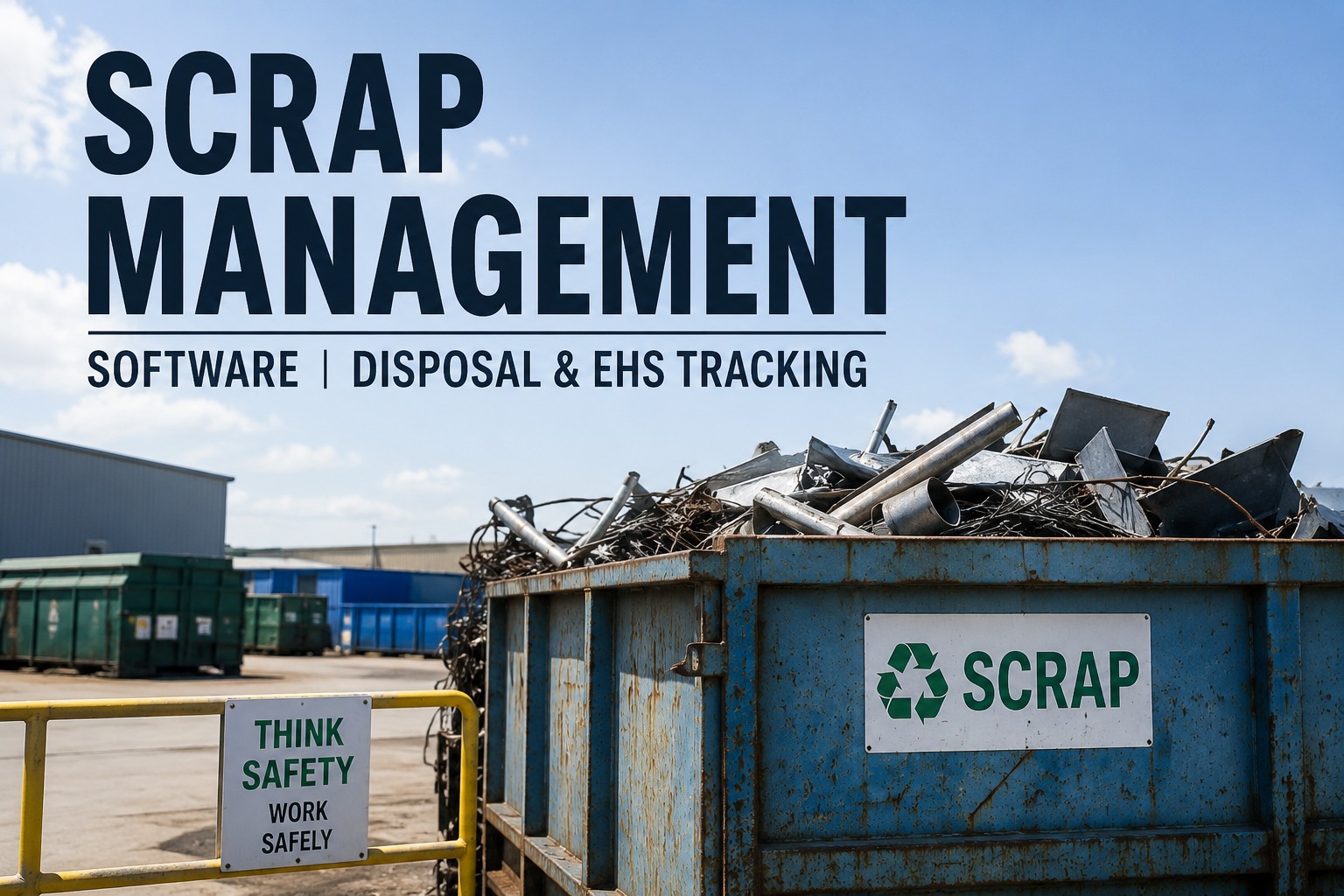
Scrap Management Software | Disposal & EHS Tracking

By Riley Quinn on September 2, 2026

scrap-management-cmms-compliance

A single scrap event generates three problems at once. An operational problem — a part rejected, a machine to investigate. A financial problem — raw material lost, labour absorbed, true cost buried under the wrong line item. And a compliance problem — controlled waste sitting under Section 34 of the Environmental Protection Act 1990 with paperwork obligations that survive the skip leaving the yard. Most plants handle these in three separate systems. A CMMS holding the full lifecycle closes all three at once. Book a 30-minute demo to see live scrap lifecycle workflow.

The Scrap Event Lifecycle
Six Stages · Three Parallel Tracks · One Connected Record
Every scrap event travels operational, financial and compliance tracks in parallel · the CMMS holds all three · month-end reconciliation becomes a filter query
Operational · shop floor action
CMMS data · what is captured
Regulatory · evidence obligation
01
Generation
OPPart rejected · scrap bin flagged · operator captures reason
CMTimestamp · asset ID · part number · shift · operator
RGProduction log baseline · waste inventory update
02
Root cause
OPCause linked · asset drift · tooling wear · operator error
CMRoot cause code · linked work order · asset history entry
RGISO 9001 nonconformity record · corrective action trigger
03
Cost capture
OPTrue cost calculated · material + labour + overhead absorbed
CMCost per event · rolled to asset · rolled to product line
RGCost of quality metric · month-end reconciliation
04
Segregation
OPMaterial sorted · hazardous separated · container labelled
CMEWC code assigned · weight logged · storage location
RGDuty of Care Regulations 1991 · List of Wastes classification
05
Documentation
OPNote prepared · WTN or hazardous consignment · signed before movement
CMDigital transfer note · carrier link · consignment code
RGWTN 2yr retention · consignment 3yr · both regulator-inspectable
06
Disposal + recovery
OPAuthorised carrier collects · disposal site confirms · recovery paid
CMConsignee return recorded · recovery value credited · loop closed
RGChain of custody complete · Section 34 duty discharged

The UK Regulatory Framework Every Producer Must Follow

Section 34 of the Environmental Protection Act 1990 places a duty of care on everyone who produces, holds, carries or disposes of controlled waste in Great Britain. That duty does not end when the skip leaves the yard — it follows the producer. Non-hazardous waste moves under a Waste Transfer Note retained for at least 2 years. Hazardous waste moves under a Hazardous Waste Consignment Note retained for at least 3 years, with consignee returns confirming proper disposal. Penalties range from £300 fixed notices to unlimited fines on prosecution. Curious how the digital paperwork workflow closes the audit chain? Book a demo of the waste documentation workspace.

S34
Environmental Protection Act 1990
Duty of care for producers · applies from generation through final disposal · statutory obligation to authorised carrier
DOC
Duty of Care Regulations 1991
Every transfer needs sufficient information for safe handling · missing field is not a technicality · WTN retained 2 years
HWR
Hazardous Waste Regulations 2005
Consignment note format · EWC code with asterisk marks hazardous · HP codes 1-15 · consignment retained 3 years
EWC
List of Wastes / EWC codes
Six-digit classification per waste type · mandatory on every note · asterisk suffix identifies hazardous entries

Hazardous vs Non-Hazardous: The Split That Changes Everything

Ordinary waste and hazardous waste move under different legal instruments with different retention periods and different consequences for error. A mixed skip that contains hazardous waste treated as non-hazardous exposes the producer to prosecution under the Hazardous Waste Regulations 2005. The CMMS that assigns EWC codes at the point of segregation and routes the record automatically to the correct note type is the CMMS that eliminates the classification errors that regulators find in half of all site inspections. Teams new to structured waste classification can sign up free to explore the waste classification workspace.

Non-hazardous
Waste Transfer Note
Retention2 years minimum
FormatStandard WTN · both parties sign
EWC codeSix-digit · no asterisk
ExamplesCardboard, timber, metal offcuts, clean plastics
Hazardous
Consignment Note
Retention3 years minimum · consignee return required
FormatConsignment code · producer + carrier + consignee
EWC codeSix-digit · asterisk suffix · HP codes
ExamplesCutting oils, solvents, contaminated absorbents, WEEE, asbestos

The True Cost of Scrap Nobody Calculates Correctly

Most plants underestimate scrap cost by 60-70% because they only count raw material. A part scrapped at final inspection has absorbed the full processing cost — every labour, machine and overhead hour consumed up to the moment it was declared unrecoverable. Add disposal handling, documentation, replacement production run and downstream late-shipment impact, and the true cost per scrapped part typically runs three to four times the material value alone. Recycling recovers only 10-30% of original value — a useful offset, but nowhere near a break-even. Want to see the full cost formula applied to a live plant scenario? Book a demo of the scrap cost analysis workspace.

Complete Scrap Cost Formula — Five Components Every Plant Underestimates
Raw material value
30-40%
The obvious cost · the one plants always count · direct material consumed
Processing absorbed
35-50%
Labour · machine hours · overhead applied up to point of scrap · biggest hidden component
Disposal + documentation
5-10%
Handling · segregation · WTN/consignment paperwork · carrier fees
Replacement run
10-15%
Extra line time · additional setup · sometimes rush overtime · schedule disruption
Downstream impact
5-15%
Late shipment penalties · customer disruption · reputational cost when repeat
Recovery value from recycling offsets typically 10-30% of raw material only · net scrap cost remains overwhelmingly a prevention target

Material Recovery Value: What Scrap Actually Sells For

Scrap that cannot be prevented should be captured at maximum recoverable value. That depends heavily on material type, purity and sortation. Clean segregated aluminum can return over £1,700 per tonne; the same aluminum contaminated with steel returns a fraction of that. Copper commands premium pricing per kilo. Steel scrap sits at the lower end but at high volume. The CMMS that records material type and accurate weight per scrap event enables secondary sale pricing, recycling claim submission, and month-end reconciliation between what was generated and what was disposed of. Want to see the material recovery workflow in a live workspace? Book a demo of the recovery value tracking module.

Steel scrap
£280-£440/tonne
Highest volume in most plants · sortation grade drives price · contamination discount significant
Aluminum scrap
£1,700-£2,000/tonne
High-value recovery · clean segregation critical · mixed loads lose 40-60% of potential value
Copper
£3-£5/kg high-grade
Premium pricing · strong recycling demand · often smallest volume but highest per-kg return
Mixed / contaminated
Discount tier
Sortation cost recovered by carrier · producer receives lowest tier · always worth investing in segregation upstream
See Scrap Lifecycle in a Live Workspace
Watch a 30-minute demo of Oxmaint capturing scrap events end-to-end — generation to consignee return — with root cause linkage, cost tracking and full UK compliance evidence built in.

Scrap-to-Maintenance Linkage: Where Prevention Actually Lives

The most powerful use of scrap data is not measuring scrap — it is preventing it. Scrap generated by degraded tooling, worn bearings or a drifting temperature controller is a maintenance problem masquerading as an operator problem. When the CMMS holds scrap events with asset linkage, cross-referencing against maintenance history reveals the pattern. An asset generating three times its baseline scrap rate on a given shift should automatically trigger a maintenance inspection work order — not wait for the monthly scrap review meeting. This linkage is what turns scrap tracking from a bookkeeping exercise into a predictive maintenance signal. Curious how scrap-to-work-order automation configures against your asset base? Book a demo of the scrap-triggered work order workflow.

Expert Perspective: The Compliance Chain Is a Business Asset

Waste compliance in manufacturing gets treated as a cost of doing business, but the plants that handle it well discover it doubles as an operational asset. When every scrap event is captured with the same rigour as a work order — timestamp, asset, root cause, weight, EWC code, disposal chain, consignee return — the data structure that satisfies the Environment Agency also feeds the cost-of-quality metric, the OEE quality rate calculation, the supplier audit response and the sustainability report. One data capture, four downstream uses. The plants still running scrap on a paper logbook and a separate waste transfer folder are paying to capture the same information twice, missing the maintenance linkage entirely, and exposing themselves to duty-of-care prosecution risk. Structured scrap management is not overhead. It is the audit chain, the cost-of-quality baseline, and the predictive maintenance signal, all in one workflow.

Curious how scrap capture feeds cost-of-quality and predictive maintenance simultaneously in a live plant? Book a demo of the connected scrap workflow.

A Realistic Rollout for UK Manufacturing Plants

A scrap management CMMS rollout should follow the compliance risk first, then the cost signal. Consignment notes and EWC codes before anything else — because that is where prosecution exposure lives. Cost capture and root cause linkage second. Predictive automation third. Teams planning phased deployment can book a demo and we will scope the rollout against your scrap streams.


Weeks 1–4
Compliance foundation
EWC code library configured
WTN + Consignment templates loaded
Authorised carrier register
2yr and 3yr retention rules live
Weeks 5–8
Cost + root cause
Cost formula per material class
Asset linkage on scrap events
Root cause code taxonomy
Recovery value tracking
Weeks 9–12
Automation + reporting
Baseline drift alerts configured
Scrap-triggered work orders
Cost-of-quality dashboard live
Sustainability + audit evidence packs

Frequently Asked Questions

Does Oxmaint support UK Waste Transfer Notes and Consignment Notes?
Yes. Both note types are supported as structured digital records with all mandatory fields required under the Environmental Protection (Duty of Care) Regulations 1991 and the Hazardous Waste Regulations 2005. EWC codes and HP codes are held as reference libraries with hazardous flag routing automatically to the correct note type. Retention periods are enforced automatically — 2 years for WTNs, 3 years for consignment notes with consignee returns retained. Notes are regulator-ready and inspection-searchable at any point.
Can scrap events auto-trigger maintenance work orders?
Yes. Each scrap event is linked to the asset that produced it, and rolling baselines are calculated per asset per shift. When scrap rate exceeds a configurable multiple of baseline — typically 3x — an inspection work order fires automatically with the scrap event data attached. This closes the biggest hidden loss in most manufacturing operations: scrap generated by asset degradation that goes unaddressed because the monthly scrap review meeting arrives too late. Real-time linkage turns scrap tracking into predictive maintenance signal.
How does the CMMS calculate true scrap cost?
Cost per scrap event is calculated as raw material value plus processing absorbed (labour, machine, overhead applied up to the point of scrap) plus disposal and documentation cost plus replacement run cost plus downstream impact where measurable. Recovery value from recycling is credited against the total. Rollups are held at asset, product line, shift and plant level, and month-end reconciliation runs automatically. This eliminates the 60-70% underestimation that plants suffer when they count only raw material.
How does the platform handle hazardous vs non-hazardous classification?
EWC codes are held as a reference library with hazardous flag on entries carrying the asterisk suffix. When a scrap event is segregated, EWC assignment routes the record automatically to Waste Transfer Note or Hazardous Waste Consignment Note workflow. HP codes 1-15 are captured on hazardous entries. Mixed loads trigger warnings if hazardous entries are being routed as non-hazardous — closing the classification error that regulators find in most site inspections and eliminating the mis-classification prosecution risk.
Does Oxmaint support the upcoming UK digital waste tracking initiative?
Yes. The UK-wide digital waste tracking initiative is designed to replace paper waste transfer notes with structured digital records that can be shared with regulators automatically. Oxmaint captures waste movements natively in digital form with all required fields, EWC codes, weights, carrier references and consignee returns. Once the digital waste tracking service goes fully live, the underlying data structure already matches the required format — no re-work needed. Producers using Oxmaint are prepared for the transition rather than caught by it.
One Scrap Record · Compliance, Cost and Maintenance in Sync
Let Oxmaint show you a scrap management workspace where every event holds root cause, cost, disposal chain and audit evidence — with UK regulatory compliance built into the workflow from day one.

Share This Story, Choose Your Platform!