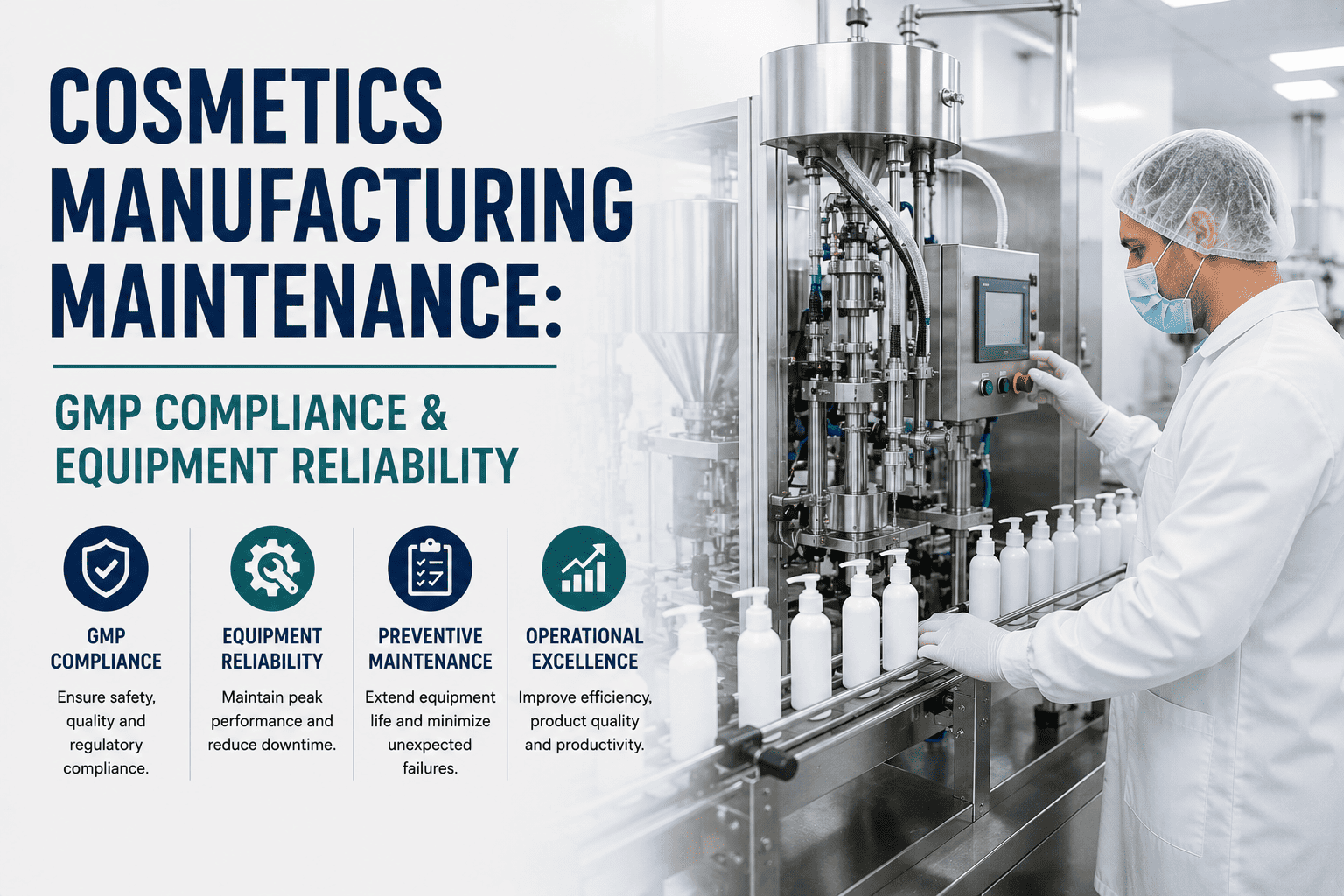
Almost 77% of cosmetic product recalls trace back to microbial contamination, and a single recall averages upward of $10 million once product destruction, business interruption and reputational damage are counted. Under ISO 22716, equipment maintenance isn't a separate operational task — it's a defined GMP requirement sitting alongside personnel training and raw material control, because a mixer or filling nozzle that isn't cleaned, calibrated and qualified on schedule is a direct contamination risk. Sign up free to see how Oxmaint keeps cosmetics manufacturing equipment audit-ready between inspections.
76.8%
Of cosmetic product recalls caused by microbial contamination, the leading recall reason by far
$10M+
Average total cost of a product recall once destruction, downtime and reputational impact are included
49%
Share of total recall cost that comes from business interruption alone, more than product destruction
3
Equipment qualification stages ISO 22716 expects to be documented and kept "in status" — IQ, OQ, PQ
Maintenance Is a GMP Requirement, Not a Side Task
ISO 22716 sets clear requirements for personnel training, facility cleanliness, raw material handling — and equipment maintenance sits directly alongside them, not below them. Every piece of production machinery, from mixers to filling nozzles, must be built from materials that won't react with the product and must be maintained on a strict, logged schedule of cleaning, calibration and preventive work. A missed calibration isn't a paperwork gap; it's a direct risk to every batch that equipment touches afterward.
Four Maintenance Domains ISO 22716 Actually Expects
01
Equipment Design & Materials
The first line of defence against contamination
Production equipment must be constructed from materials compatible with both the product and the cleaning agents used on it, and designed for easy sanitisation. That design intent only holds up over time if wear, corrosion and seal degradation are tracked and addressed before they compromise cleanability.
02
Cleaning & Calibration Schedules
Non-negotiable and non-optional under the standard
ISO 22716 explicitly requires a strict schedule for maintenance, cleaning and calibration, with detailed logs kept as proof of diligence. Regular calibration is what confirms equipment performs precisely as intended, ensuring every batch stays consistent and within specification.
03
Equipment Qualification: IQ, OQ, PQ
Kept "in status," not just completed once
Installation, operational and performance qualification aren't a one-time commissioning exercise. Equipment has to be kept in a qualified status across its life, which means every repair, part change or recalibration needs to be evaluated against whether it affects that qualification.
04
Documentation & Deviation Traceability
The record an auditor actually asks for
When a deviation occurs, internal audit and closed-loop CAPA processes need to reference exactly what maintenance state the equipment was in at the time. Scattered paper logs make that reconstruction slow; a connected maintenance record makes it immediate.
Keep Every Piece of Equipment Audit-Ready
Oxmaint logs cleaning, calibration and qualification status against every mixer, filler and production line asset, timestamped and ready to export. Sign up for a free trial to see it on your own equipment list, or book a demo and we'll walk through your GMP maintenance schedule together.
Reactive Maintenance vs. GMP-Structured Maintenance
| Reactive Approach |
GMP Exposure Created |
GMP-Structured Fix |
| Calibration tracked on a spreadsheet by memory |
Overdue calibrations go unnoticed until an audit finds them |
Automated calibration due dates linked to each asset |
| Cleaning verification recorded on paper checklists |
Sign-off can't be tied conclusively to a specific batch |
Digital line clearance logged against the batch record |
| Repairs made without re-evaluating qualification status |
Equipment runs "out of status" without anyone knowing |
IQ/OQ/PQ status flagged for review on every repair event |
| Deviation records scattered across email and paper |
Days to reconstruct equipment history during an audit |
Every event logged against the asset, exportable in minutes |
Best Practices for GMP-Compliant Equipment Maintenance
Practice 01
Tie Every PM Task to a Documented SOP
A cleaning or calibration task without a linked, version-controlled SOP is a gap the moment an auditor asks how the technician knew what to do.
Practice 02
Link Maintenance Records to Batch Numbers
If a contamination event does occur, being able to pull exactly which batches ran on that equipment since its last verified cleaning cuts investigation time from days to minutes.
Practice 03
Treat Qualification Status as a Living Field
Every part replacement or repair should trigger a prompt to confirm whether requalification is needed, rather than relying on someone remembering to check.
Practice 04
Make Audit Exports a Routine, Not a Fire Drill
Run a mock export of a full equipment maintenance history quarterly, so an actual internal or external audit is a formality rather than a scramble.
How Oxmaint Supports Cosmetics GMP Compliance
Oxmaint tracks cleaning, calibration and qualification status for every piece of cosmetics production equipment, with each task linked to its SOP and each completion timestamped and attributed. Deviation and repair events are logged against the asset in real time, so equipment history is instantly retrievable for internal review or a regulatory inspection. Book a demo to see it configured for your ISO 22716 maintenance program.
Frequently Asked Questions
Q
Why does ISO 22716 treat equipment maintenance as a GMP requirement?
Because equipment condition directly affects contamination risk and batch consistency. Materials that resist reaction with the product, plus a strict cleaning and calibration schedule with logged proof, are what the standard relies on to keep every batch safe and consistent.
Q
What's the difference between IQ, OQ and PQ for cosmetics equipment?
Installation qualification confirms equipment is installed correctly, operational qualification confirms it functions as specified, and performance qualification confirms it consistently produces conforming product. All three need to be kept current, not just completed once at commissioning.
Q
Why is microbial contamination the leading cause of cosmetic recalls?
Cosmetics formulations often provide conditions bacteria and fungi can exploit if equipment isn't cleaned and sanitised thoroughly between batches. Bacterial contaminants, particularly Pseudomonas species, are the most frequently identified culprits, which is why cleaning verification tied to specific equipment and batches matters so much.
Q
Where should a cosmetics manufacturer start if maintenance records are still on paper?
Start with calibration and cleaning schedules for the highest-risk equipment — mixers, fillers and anything in direct product contact — before digitising the wider preventive maintenance program. That's where contamination risk and audit exposure concentrate first.
Make GMP Compliance a Byproduct of Good Maintenance
Oxmaint gives GMP operations teams one connected record for cleaning, calibration and qualification status across every piece of cosmetics production equipment. Sign up for a free trial to explore it yourself, or book a demo and we'll walk through it against your own ISO 22716 program.
Calibration Scheduling
Cleaning Verification Logs
IQ/OQ/PQ Status Tracking
Batch-Linked Records
Audit-Ready Reporting