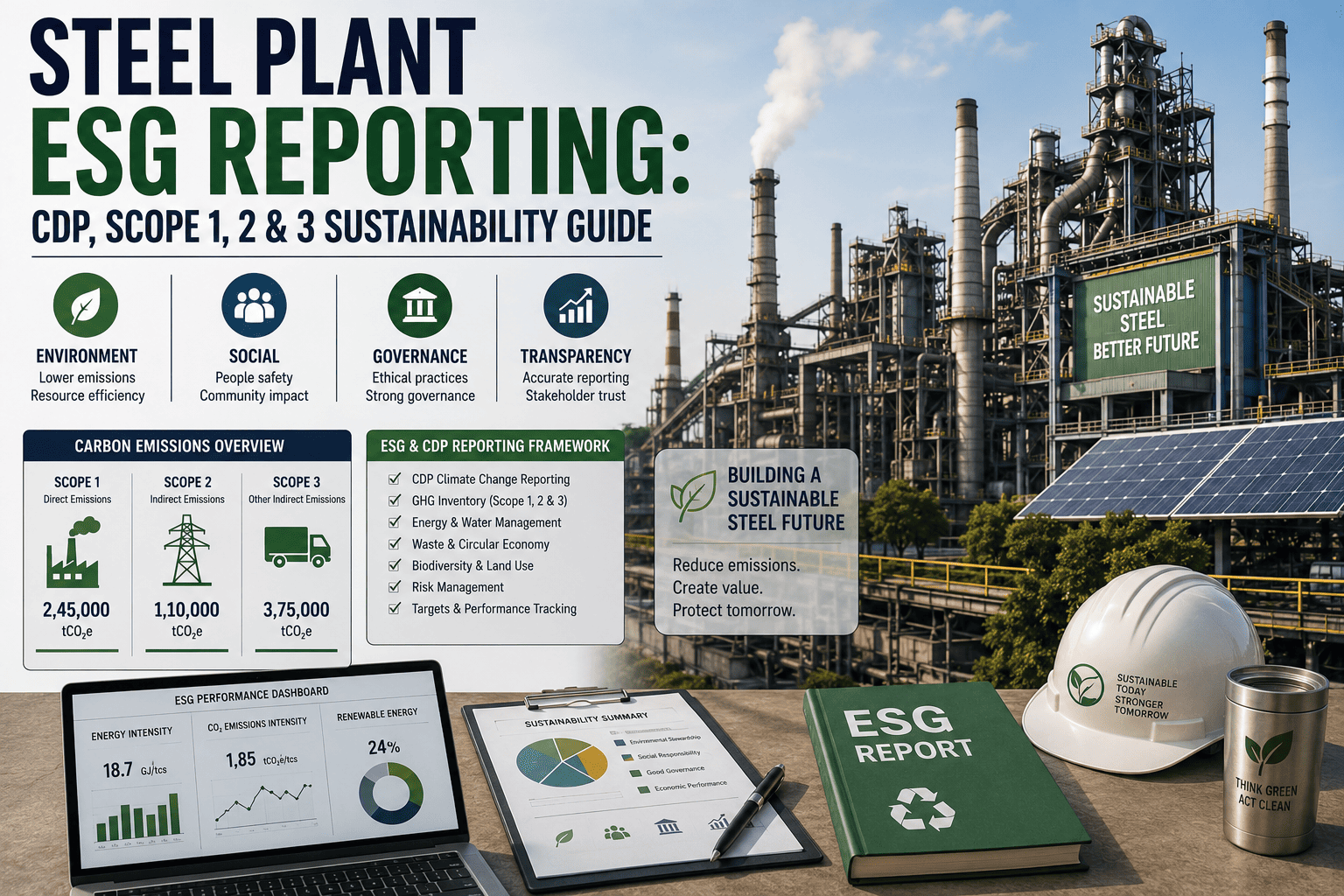
Steel is one of the harder industries to decarbonize on paper, and one of the hardest to report on accurately in practice. The furnace burns fuel you can measure directly, but the emissions baked into the raw material trucked in last week are a different kind of number entirely. Getting Scope 1, 2, and 3 right starts with data that's actually being tracked, not estimated at year-end. Sign up to see how Oxmaint turns everyday maintenance and energy data into ESG-ready numbers.
3 Scopes
Direct, purchased energy, and value chain emissions that make up a full carbon footprint
Majority Share
Of a steel plant's total footprint typically sits in Scope 1, from furnace and kiln combustion
Investor-Driven
CDP disclosure is increasingly requested by investors, lenders, and major customers, not just regulators
Hardest to Trace
Scope 3 emissions from raw materials and logistics are consistently the most difficult category to quantify
Why ESG Reporting Is Genuinely Hard for Steel Plants
A software company's carbon footprint is mostly office energy and cloud compute. A steel plant's footprint runs through furnaces, coking operations, purchased power, transported ore, and the eventual use of the finished product downstream. That spread across Scope 1, 2, and 3 means the data lives in different systems, energy meters, maintenance logs, procurement records, and pulling it together accurately at reporting time is where most plants lose weeks every year.
Scope 1, 2, and 3 in Plain Steel Plant Terms
| Scope |
What It Covers |
Steel Plant Example |
| Scope 1 |
Direct emissions from sources the plant owns or controls |
Furnace and kiln combustion, plant vehicle fleet |
| Scope 2 |
Indirect emissions from purchased electricity, steam, or heat |
Grid electricity powering mill motors and lighting |
| Scope 3 |
Everything else across the value chain, upstream and downstream |
Ore transport, purchased raw materials, product end use |
Your Maintenance Data Is Already Half the ESG Report
Oxmaint tracks energy consumption, equipment efficiency, and maintenance events against every asset automatically, giving you real Scope 1 and 2 figures instead of year-end estimates. Sign up for a free trial to see your own energy data organized, or book a demo and we'll walk through what's already trackable in your plant.
Where Maintenance Data Quietly Feeds Your ESG Numbers
| Maintenance Data Point |
What It Feeds Into |
| Fuel and energy consumption per asset |
Direct input into Scope 1 and Scope 2 calculations |
| Equipment efficiency trends over time |
Evidence of emissions intensity improvement year over year |
| Leak and flare event logs |
Fugitive emissions data often missed in manual reporting |
| Preventive maintenance completion rate |
A proxy for equipment running at its efficient operating point |
Manual ESG Data Collection vs a CMMS-Connected Approach
Manual Collection
Spreadsheets pulled together from multiple departments at year-end
Energy figures often estimated rather than measured per asset
Difficult to defend numbers under investor or auditor scrutiny
CMMS-Connected
Energy and maintenance data logged continuously against each asset
Reports generated on demand instead of assembled once a year
A traceable, auditable record behind every reported figure
How Oxmaint Supports ESG and CDP Reporting
Oxmaint logs energy consumption, equipment runtime, and maintenance events against every asset as they happen, so your Scope 1 and 2 figures are built from actual measurements instead of year-end estimates. That same asset-level history gives your sustainability team a traceable source behind every number reported to CDP or included in an annual disclosure. Book a demo to see how it maps to your current reporting process.
Frequently Asked Questions
Q
Is CDP disclosure legally required for steel plants?
CDP itself is a voluntary disclosure platform, not a regulator, but it's increasingly requested by major customers, lenders, and investors as part of due diligence, which makes it a practical requirement even without a legal mandate.
Q
Why is Scope 3 so much harder to report than Scope 1 or 2?
Scope 1 and 2 come from data the plant directly measures. Scope 3 depends on suppliers, logistics partners, and customers reporting their own emissions accurately, which is largely outside the plant's direct control.
Q
Can maintenance software really improve ESG reporting accuracy?
Yes, because a large share of Scope 1 and 2 data, fuel use, electricity draw, equipment runtime, already flows through maintenance and asset systems. Connecting that data directly removes the manual estimation step most plants rely on today.
Q
Where should a plant start if ESG reporting is still mostly manual today?
Start by connecting energy meter data to your highest-consumption assets, kilns, furnaces, major motors, so Scope 1 and 2 figures are measured rather than estimated. Scope 3 data collection from suppliers can follow once the internal data is solid.
Build Your ESG Numbers From Real Data, Not Year-End Estimates
Oxmaint gives steel plant teams asset-level energy tracking, maintenance event logging, and traceable data ready for CDP disclosure and Scope 1, 2 sustainability reporting. Sign up for a free trial to see your own data organized, or book a demo and we'll walk through it against your current reporting process.