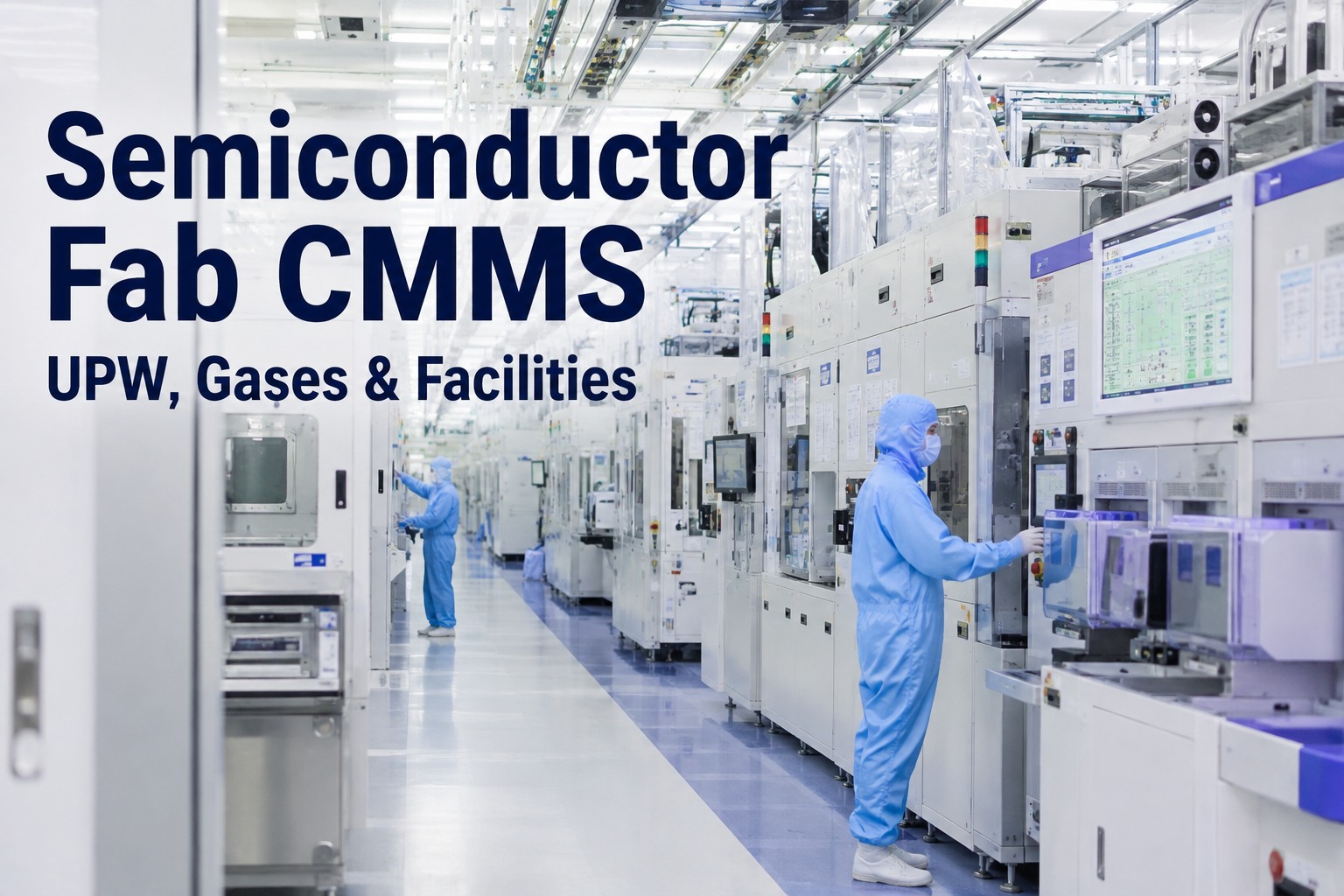
A semiconductor fab is not one factory — it is three parallel utility systems feeding a single wafer. Ultrapure water at 18.2 MΩ·cm resistivity. Specialty process gases (silane, arsine, phosphine, tungsten hexafluoride) delivered at 6N purity through electropolished stainless piping. Process cooling water held to ±0.1°C for scanner tools. Every one is a maintainable utility train with its own asset classes, purity metrics, audit expectations. When any drifts, wafer yield collapses. This is where fab facilities CMMS earns its keep. Book a 30-minute demo to see a live semi fab facilities workspace.
UPW: Five Continuous Metrics That Cannot Drift
Ultrapure water for advanced semiconductor manufacturing is defined by five continuous parameters — each with its own sensor, its own calibration cadence, and its own maintenance implication. Resistivity is the master metric, but by the time resistivity drifts, TOC or silica have already been climbing for hours. The fabs holding sub-7nm yield are those monitoring all five in parallel with structured maintenance responses defined for each. Curious how the five-metric monitoring maps onto your central UPW plant? Book a demo of the UPW monitoring module.
The Gas Cabinet: Small Enclosure, Enormous Consequence
A gas cabinet is the primary engineering control that stands between the fab and a pyrophoric or toxic gas release. Silane ignites on contact with air. Arsine and phosphine cause severe harm at parts-per-million exposure. HF and chlorine are corrosive and toxic. Every one of hundreds of gas cabinets in a leading-edge fab holds not just cylinders but automated changeover systems, cross-purge sequences, RFO orifices, and multi-technology gas detection. Getting the maintenance discipline right on all of them is a fab-scale problem that only structured CMMS can hold. Teams new to gas cabinet asset management can sign up free to explore the gas cabinet workspace.
The Multi-Sensor Reality of Toxic Gas Detection
The most expensive assumption in fab safety is that one sensor technology covers every gas. It does not. Silane needs one technology. HF needs another. Chlorine needs a third. VOCs need a fourth. The plants that pass safety audits do it by matching sensor technology to gas type with a documented gas-to-sensor matrix, and by holding calibration records per sensor. Want to see the multi-technology sensor matrix in a live workspace? Book a demo of the gas detection asset workspace.
Point-of-Use Excursions: Why Central Plant Data Is Never Enough
A leading-edge fab may have world-class UPW leaving the central plant at 18.2 MΩ·cm, and still fail at a wafer clean tool because point-of-use resistivity has drifted. Distribution piping, unheated dead legs, membrane fittings, and even ambient temperature all shift metrics between central plant and process tool. The plants running high yield monitor both — central plant as the utility baseline, point-of-use as the wafer reality. Want to see the central-plus-point-of-use monitoring architecture live? Book a demo of the point-of-use excursion workflow.
Expert Perspective: Why Fab Facilities CMMS Is Different
Fab facilities is the highest-consequence discipline in industrial maintenance I have worked with. When a tissue plant loses a bearing, the shift stops and the plant recovers. When a semiconductor fab loses UPW resistivity for four hours, dozens of scanner tools take wafers out of spec, and the yield loss can run into eight figures on advanced nodes. What that demands from the CMMS is not just work order management — it is central-plant plus point-of-use monitoring, tied to per-tool history, tied to gas cabinet fleet, tied to sensor calibration records, tied to sanitisation cadence on the UPW loop, all as one integrated data structure. And for many customers, it needs to run on-premises because the fab process recipe data cannot leave the site. This is where the CMMS choice actually matters at the enterprise level, not just the maintenance department level.
Curious how the on-premises deployment model works for your specific fab? Book a demo scoped to your deployment and security requirements.
UK Semi Fab Context: Newport, Pragmatic, IQE and the National Strategy
UK semiconductor manufacturing sits at a strategic inflection point. Newport Wafer Fab under Vishay is the UK's largest compound semiconductor operation. Pragmatic Semiconductor at Durham is scaling flexible integrated circuit production. IQE at Cardiff is a global leader in compound semiconductor epi wafers. The UK National Semiconductor Strategy commits over £1 billion over ten years, with focus on compound semi, advanced packaging, and photonics. Add the quantum computing clusters around Oxford, Bristol and Cambridge, and the UK semi ecosystem demands maintenance discipline that international customers recognise from day one. Teams new to unified fab utility evidence can book a demo scoped to UK semi sector requirements.
A Realistic Rollout for a UK Semi Fab
A fab facilities CMMS rollout should follow the yield-loss risk. UPW first — because that is the largest continuous asset. Specialty gas fleet second — because that is the largest safety exposure. Process cooling and utility integration third. Teams planning a phased deployment can book a demo and we will scope the rollout against your fab utilities topology.