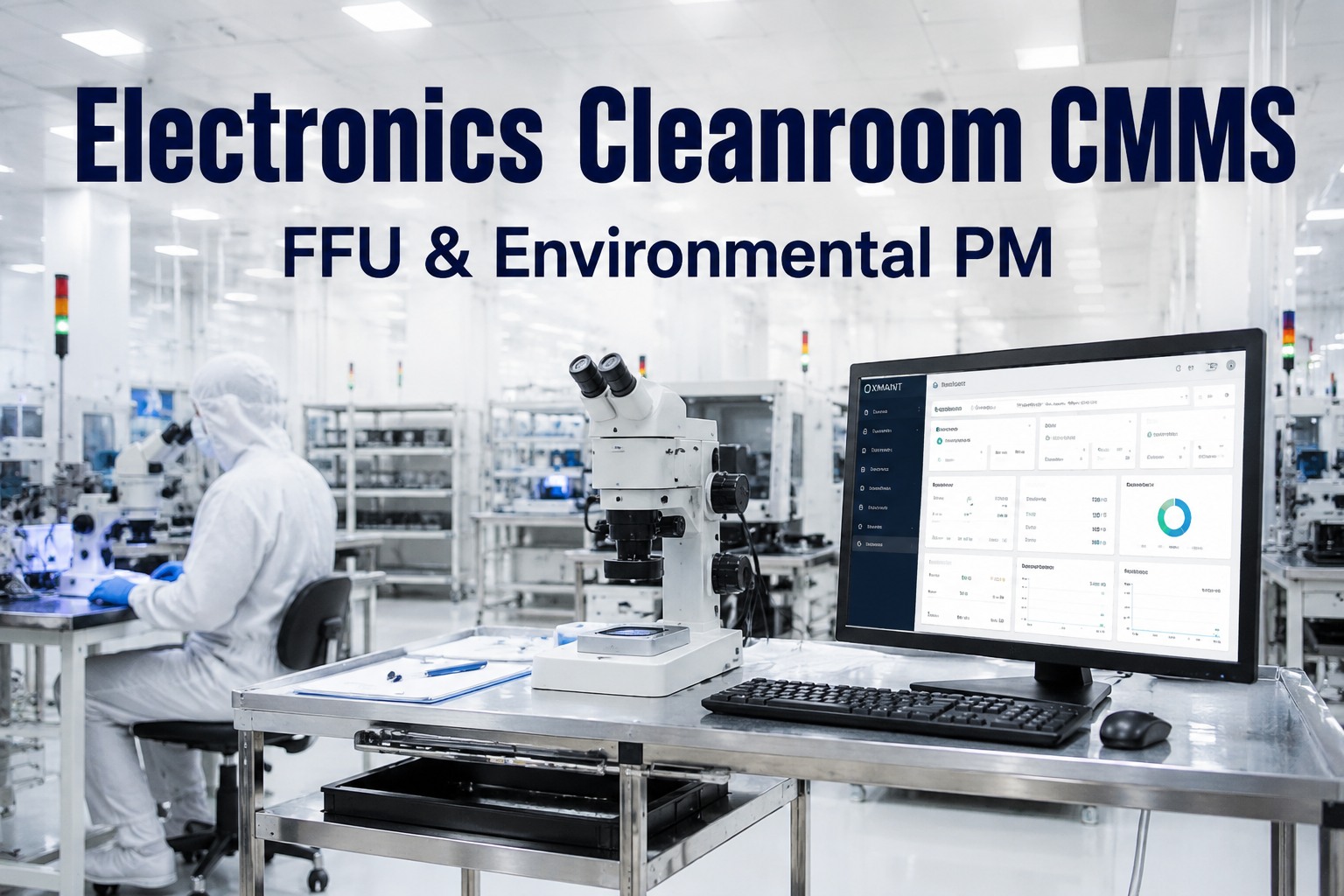
An electronics cleanroom is not really a room — it is a continuous environmental control system dressed up as a workspace. Hundreds of Fan Filter Units driving laminar airflow. Thousands of HEPA filters holding particle counts to ISO 14644 specification. Continuous differential pressure gradients between rooms. Every one is a maintainable asset with its own PM cadence, its own audit expectation, and its own consequence when it drifts. A single ISO class breach can invalidate a production window and consume weeks of audit reconstruction. Book a 30-minute demo to see a live cleanroom CMMS workspace.
The FFU Farm Reality: Hundreds of Individual Assets, One Room
The FFU is the pillar asset of every electronics cleanroom, and cleanroom operators quickly discover that they are not maintaining a room — they are maintaining a fleet. A modest ISO 6 electronics cleanroom might have 80-150 FFUs. An ISO 5 wafer-adjacent space runs 400-800. A large semiconductor fab pushes into the thousands. Each FFU is an individual maintainable asset with its own filter cartridge, motor, pre-filter, and pressure-drop signature. Managed as a fleet from day one, the maintenance scales. Managed as a room, it collapses. Want to see the fleet-management workflow in action? Book a demo of the FFU fleet workspace.
The HEPA Integrity Test: The Ritual Nobody Can Skip
Every HEPA or ULPA filter installation must be scan-tested for integrity after installation and at defined intervals thereafter. This is the DOP or PAO scan — an aerosol challenge introduced upstream while a photometer scans the filter face for penetration. Miss one integrity test, and a subsequent audit finding potentially invalidates every production run made through that filter since the last valid scan. The plants running clean audit histories treat every filter change as a five-step ritual with mandatory sign-off before the FFU is released back to production. Want to see how the integrity workflow enforces sign-off? Book a demo of the HEPA integrity ritual workflow.
Four Parameters. Continuous. Non-Negotiable.
An electronics cleanroom lives or dies by four continuous environmental parameters, monitored at defined sample points, with defined action thresholds. Any parameter drift outside spec is a deviation event that must be captured, investigated, and closed with corrective action. The CMMS that treats these four as one integrated environmental record is the difference between an audit that takes hours and one that takes weeks. Curious how the four parameters converge in one live workspace? Book a demo of the environmental monitoring module.
The Deviation Event: What Actually Happens When Class Breach Fires
A particle count excursion, a pressure inversion, an FFU offline in a critical zone — each is a deviation event that must be captured, investigated and closed. The plants that pass audits smoothly do it because the deviation workflow is structured software, not an email chain. Teams evaluating deviation management workflow can book a demo of the environmental deviation module.
Expert Perspective: The Reconstruction Trap
The single most expensive discovery in my cleanroom consulting work has been the reconstruction trap. A customer audit turns up a two-week window nine months ago where a particle counter recorded an excursion. The auditor wants to know which wafers were exposed, what corrective action was taken, and whether the corrective action was verified. If that information lives across an email chain, a paper logbook, a maintenance clipboard, and a supervisor's memory — the reconstruction takes three weeks of full-time work, and it still leaves gaps the auditor flags. If it lives in one connected CMMS with the deviation record, the FFU maintenance history, the personnel entry log, and the post-action requalification certificate all linked together, the same reconstruction takes 20 minutes. This is where cleanroom CMMS earns its keep — not in daily convenience, but in audit crisis.
Curious how the deviation record integration model maps onto your specific cleanroom class? Book a demo scoped to your ISO class and audit history.
UK Cleanroom Context: Semi, Photonics, Medical and Defence
UK electronics cleanroom operations span four demanding customer sectors. Semiconductor at Newport Wafer Fab (Vishay), Pragmatic Semiconductor Durham, IQE Cardiff and the emerging cluster around the National Semiconductor Strategy. Photonics and quantum computing in the Oxford, Bristol and Cambridge triangles. Medical device electronics in the Cambridge and Oxford med-tech corridor under ISO 13485 and MDR. Defence electronics at BAE Systems, Thales UK, MBDA and QinetiQ with security-cleared cleanroom operations. Each carries different audit expectations layered onto ISO 14644-1 as the common floor. Teams new to unified cleanroom evidence can sign up free to explore the audit workspace.
A Realistic Rollout for a UK Electronics Cleanroom
A cleanroom CMMS rollout should follow the audit risk. FFU fleet first — because that is where the audit questions concentrate. HEPA integrity records second — because that is the recurring compliance activity. Environmental monitoring integration third. A phased plan captures FFU-fleet visibility inside the first month. Teams planning a phased deployment can book a demo and we will scope the rollout against your ISO class and cleanroom footprint.