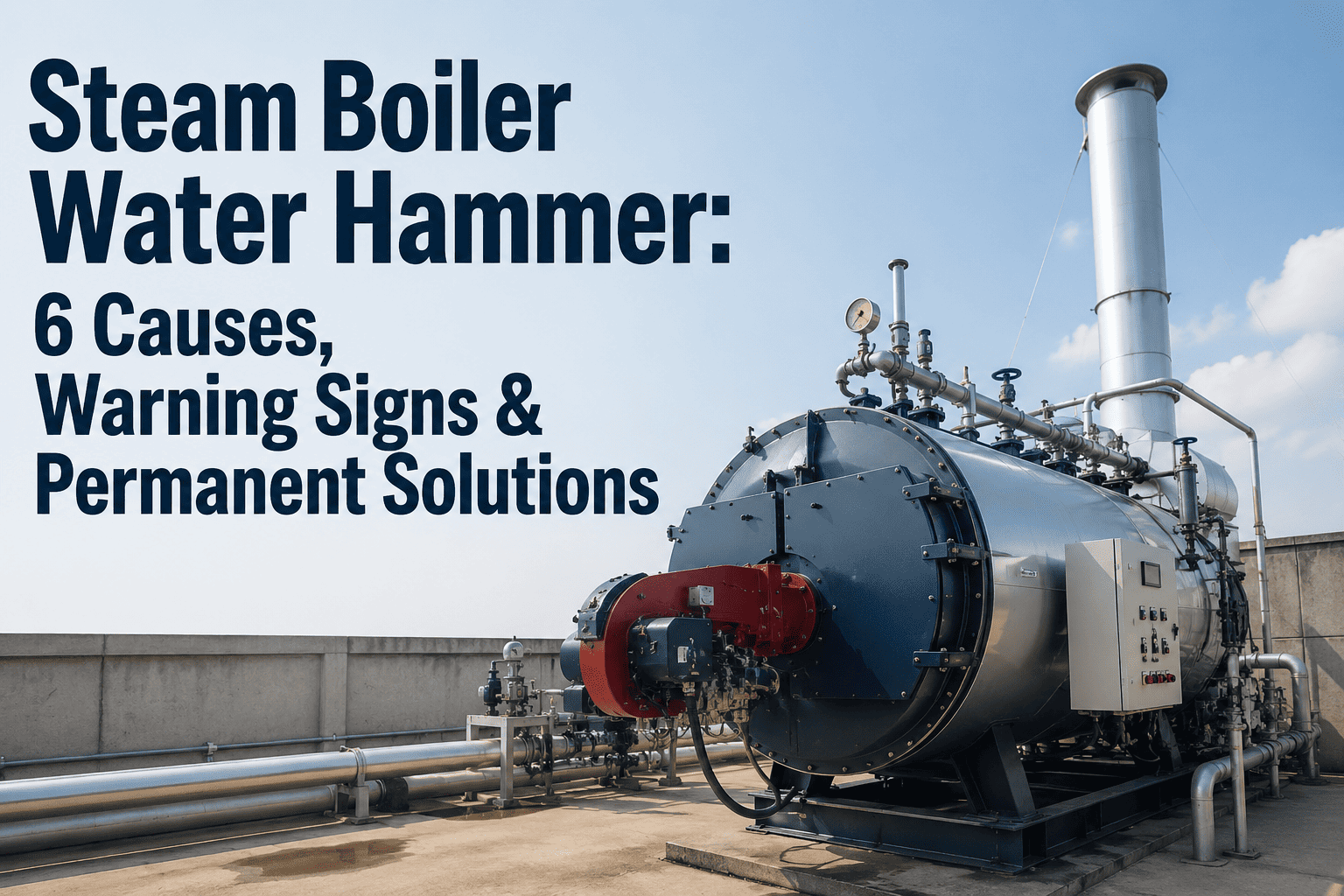
That banging noise in your steam lines is not the building settling. It is not a loose pipe hanger. It is water hammer — condensate slugs travelling at steam velocity, slamming into bends, fittings, and valves with enough force to split flanges, crack welds, and destroy steam traps in a single event. Every ignored bang is metal fatigue accumulating. Start a free trial to see how Oxmaint tracks steam trap health, condensate return trends, and boiler startup procedures before water hammer causes structural pipe failure.
6
Root causes of steam boiler water hammer — each addressed with a permanent fix, not a workaround
$25K+
Typical emergency repair cost when water hammer ruptures a steam main in a commercial building, excluding system downtime
70%
Of commercial steam trap failures result in either condensate pooling or live steam blowthrough — both direct water hammer contributors
48hr
Window after first symptoms appear where fixing root cause avoids pipe and fitting replacement entirely
What Is Actually Happening
Steam travels at 25–40 metres per second. Condensate sits as a liquid at the bottom of the pipe. When steam velocity is high enough, it picks up the condensate and forms a slug — a mass of water moving at steam speed. That slug hits a bend, a valve, a trap inlet, or a tee and transfers its full kinetic energy as a pressure shock. The pipe did not fail. The system conditions created a projectile. Fix the conditions.
Warning Signs Your Boiler System Has Water Hammer
These symptoms appear in a recognisable sequence. Water hammer rarely announces itself as a single catastrophic event — it escalates through observable stages. If you are seeing two or more of these, pipe and fitting damage is already occurring.
Sign 01
Banging on Startup
Loud knocking or banging when the boiler fires, especially after an overnight or weekend shutdown. Cold condensate sitting in pipes encounters steam suddenly. This is the most common presentation and is consistently dismissed as normal — it is not.
Sign 02
Pipe Movement or Vibration
Pipes visibly jumping at hangers, or hanger brackets pulling away from ceiling or wall. Each slug impact imposes a lateral force load the support system was not designed to absorb repeatedly. Loosened hangers accelerate the next impact.
Sign 03
Repeated Steam Trap Failures
Steam traps failing at intervals far shorter than their rated service life — particularly at the same locations across multiple replacements. Slug impacts shatter internal components. Replacing the trap without removing the water hammer is reinstalling into a destruction cycle.
Sign 04
Leaking Flanges or Valve Packings
Flange gaskets failing or valve packing beginning to weep without obvious cause — no thermal cycling change, no overpressure event on record. The micro-shock loading from sustained water hammer fatigues gasket material and loosens bolting progressively.
Sign 05
Inadequate Heating in Zones
Radiators or coils not reaching design temperature despite boiler operating normally. Condensate pooling in mains from failed traps or poor pitch blocks steam distribution. The zones at the end of long mains show symptoms first.
6 Root Causes of Steam Boiler Water Hammer — and Permanent Fixes
Water hammer is never the fault of the pipe. Something upstream created the slug. Identifying which of these six causes is active in your system determines the correct fix — and prevents the same repair from repeating every season.
01
Failed or Bypassed Steam Traps
A steam trap that fails closed allows condensate to pool in the line. A trap that fails open floods the condensate return with live steam, building back-pressure that forces condensate back into the steam main. Both failure modes create the condensate accumulation that water hammer requires. Failed traps at multiple points compound the hazard — a blocked trap upstream creates the pool; a blocked trap downstream traps it.
Permanent Fix
Survey all steam traps with ultrasonic testing or infrared thermography. Replace failed units and document each trap's failure mode — closed or open — against the CMMS asset record. Schedule steam trap inspection on a defined annual or biannual cycle, not in response to water hammer events. Trap failure rate above 15% of the total population indicates a system-wide problem: oversized traps, contaminated condensate, or chronic overpressure.
Every trap that fails closed is both a water hammer source and a heat transfer loss. A single failed trap in a long steam main can pool enough condensate to produce slug flow within one heating cycle.
02
Incorrect Pipe Pitch and Condensate Drainage
Steam mains must pitch in the direction of flow at a minimum of 1 inch per 20 feet so condensate drains continuously to drip legs and traps. When hanger sag, building settlement, or original installation error creates a reverse-pitch section or a low point with no drain, condensate pools between firing cycles. On startup, steam hits that pool and produces slug flow immediately. This is the single most common cause of startup water hammer in older commercial buildings.
Permanent Fix
Walk the steam mains and check pitch at every hanger with a level. Any section pitching against the direction of flow must be re-supported. Drip legs must be present at the end of every main, ahead of every riser, and ahead of every pressure-reducing valve. Add drip legs at any low point identified during the survey. This is a physical pipe support correction — no operational fix substitutes for proper drainage geometry.
Pipe hanger inspection and pitch verification should be on the annual PM schedule. Building settlement of 5mm per decade is enough to reverse pitch in a flat-run section over 15 years.
03
Rapid Startup Without Warm-Up Procedure
A boiler that is fired to full pressure quickly after a cold shutdown pushes steam into pipes that are still cold and contain significant condensate from the previous cycle. The thermal shock accelerates condensate formation at the steam front and the rapid pressure rise drives that condensate as a high-velocity slug before the system can drain it through traps. Facilities without a documented startup procedure rely on operator experience — and that experience varies across shifts and contractors.
Permanent Fix
Implement and enforce a warm-up procedure: bring the boiler to low fire and hold until steam pressure is stable and condensate has had time to drain through traps before advancing to operating pressure. Open manual drains on steam mains at startup and close only after sustained steam flow is confirmed. Document the procedure in the CMMS as a required checklist on every cold-start work order — it cannot be a verbal instruction passed between shifts.
Startup water hammer is almost entirely a procedural problem. The fix costs nothing if done before the first pipe fails — and everything if done after a weld cracks on a pressurised main.
04
Boiler Carryover — Water Entering the Steam Main
Carryover occurs when boiler water — not just steam — is entrained and carried into the steam distribution system. It is caused by an overfilled boiler, sudden load surges that drop the boiler operating pressure rapidly, or contaminated boiler water with high dissolved solids that causes priming. Water entering the steam main at boiler-outlet velocity produces an immediate and severe slug — often the most violent water hammer in the system because it originates at the source of maximum steam velocity.
Permanent Fix
Maintain boiler water level at the correct operating range — never above the midpoint of the gauge glass. Test water chemistry monthly for dissolved solids and blowdown on schedule to keep TDS within manufacturer limits. Install a steam separator or moisture separator on the boiler outlet if carryover is recurring despite correct water level. Investigate any sudden load changes that could cause rapid pressure drops — pressure control valve response time may need adjustment.
Carryover also contaminates the condensate return with boiler treatment chemicals, damages heat exchangers, and fouls steam traps — it is never an isolated event. Link the boiler carryover work order to the full downstream impact in your CMMS.
05
Rapid Valve Closure and Pressure Surges
A globe valve or control valve closing quickly arrests steam flow abruptly. The momentum of the steam column — and any entrained condensate — must be absorbed instantaneously by the pipe and fittings at the point of closure. This hydraulic shock is distinct from slug-flow water hammer but equally destructive to flanges, valve bodies, and pipe welds. Pneumatic control valves that fail to their closed position on signal loss are a frequent cause in automated systems.
Permanent Fix
Specify slow-close actuators on steam control valves — a closure time of 3–5 seconds is sufficient to prevent the pressure wave associated with instantaneous closure. Install pressure relief or surge arrestors downstream of critical valves on high-pressure steam systems. Audit all automatic valve failure positions and confirm that fail-closed valves have adequate close-time settings in the BMS. Valve closure time should be documented in the equipment record alongside its location and service.
Water hammer from rapid valve closure is particularly damaging because it is cyclic — every automatic shutdown creates a shock event. In a system cycling 4–6 times per day, this is hundreds of impact loads per month on the same fittings.
06
Insufficient A-Dimension and Condensate Return Height
On gravity-return steam systems, the vertical space between the boiler water line and the bottom of the steam main — the A-Dimension — must be at least 28 inches to allow returning condensate to stack and re-enter the boiler against system pressure. When a new, shorter boiler replaces an older unit, the A-Dimension is reduced. Condensate backs up into the steam main. Steam finds water where it expects clear pipe and water hammer results mid-cycle, not just at startup.
Permanent Fix
Measure the A-Dimension on any gravity-return system. If it is below 28 inches — particularly following a boiler replacement — either lower the boiler into a pit to restore the required height, or convert the return to a condensate pump system that returns condensate mechanically and eliminates the dimensional dependency. When specifying replacement boilers, require the installer to confirm A-Dimension compliance before sign-off — this is a design condition that must be in the commissioning checklist.
A-Dimension water hammer is often first attributed to a bad boiler installation, when the root cause is a specification oversight. Document the A-Dimension in the boiler asset record so it survives every future contractor handover.
Your Steam System Has Already Logged the Warning
Steam trap failure history, startup procedure compliance, boiler carryover events — Oxmaint connects these signals into a pre-water-hammer alert before the first pipe fitting fails. Sign up free or book a demo to see it live on your assets.
How Damage Escalates — The Water Hammer Timeline
Water hammer damage is cumulative and non-reversible. What begins as a nuisance noise becomes a structural pipe failure. The cost multiplier at each stage is not incremental — it is exponential. Sign up to Oxmaint to catch the early signals before the timeline reaches the critical stage.
Noise Only — No Physical Damage
Banging on startup. Hanger vibration. System otherwise operating normally. Root cause correction at this stage — trap survey, pitch correction, startup procedure — requires no parts replacement. This is the lowest cost point in the timeline by a significant margin.
Steam Trap and Hanger Failures
First steam trap failures at the impact points — typically the traps immediately downstream of low-pipe sections. Hanger brackets loosening or pulling from their mounting surface. Trap replacement cost is low individually but will recur at increasing frequency until the slug source is addressed.
Flange and Valve Damage Begins
Flange gaskets weeping at elbows and tees — the points of highest slug impact. Valve packing requiring repeated tightening. At this stage the facility is typically in a repeated repair cycle: replace the trap, replace the gasket, retighten the packing. The root cause has still not been identified in most cases.
Pipe Weld or Fitting Failure — Emergency Event
A weld fails or a pipe fitting cracks under repeated impact loading. Live steam at operating pressure is now a personnel hazard. Emergency shutdown, pipe repair or replacement, system re-commissioning, and potential insurance and compliance implications. Total cost is typically 8–15 times what root cause correction would have cost at the Week 1–2 stage.
Preventive Maintenance Schedule — Steam Boiler Water Hammer
| Frequency |
PM Task |
Water Hammer Risk Addressed |
| Weekly |
Visual and audible check on startup — noise, pipe movement, boiler water level gauge |
Early symptom detection; carryover from high water level before slug formation |
| Monthly |
Boiler water chemistry test and blowdown, condensate return temperature and flow log, startup procedure audit |
Carryover from high TDS; condensate return back-pressure; procedural compliance |
| Quarterly |
Steam trap survey with ultrasonic or infrared, hanger and pipe support inspection, automatic valve close-time verification |
Failed trap condensate pooling; loose hangers amplifying slug impact; rapid valve closure shock |
| Annual |
Full pipe pitch survey, A-Dimension measurement and record update, flange bolt torque check at all impact-risk elbows and tees, drip leg drain and clean |
Settlement-driven pitch reversal; A-Dimension condensate backup; fatigue-loosened flanges; blocked drip legs |
| Post-Event |
Root cause documented in CMMS against the boiler and affected steam trap assets — confirm root cause corrected before system restart, not just the damaged component replaced |
Prevents reinstating system into unchanged conditions — the primary driver of repeated water hammer events in the same location |
Why Water Hammer Repeats in the Same System
The steam trap is replaced. The flange is re-gasketed. The system is restarted. Two months later, the same trap fails and the same flange weeps again. This is not a coincidence — it is a facility without a CMMS linking the repair to its root cause. Oxmaint records every steam trap failure against the asset, tracks the root cause to closure, and flags when post-repair operating data — condensate return temperature, trap cycling frequency — deviates from the post-fix baseline. Book a demo to see the steam asset workflow.
Frequently Asked Questions
Q
Is a banging steam boiler dangerous, or just noisy?
It is dangerous. Water hammer has caused fatalities and serious injuries when pressurised steam lines have failed catastrophically. Beyond the safety risk, sustained water hammer fatigues welds, cracks fittings, and destroys steam traps at a rate that constitutes a structural integrity problem — not a noise management issue. Facilities that tolerate water hammer as background noise are accumulating unreported damage on a pressurised system.
Q
Can I diagnose water hammer cause without calling a specialist?
You can narrow it significantly before calling a specialist. Note when the noise occurs — startup only suggests condensate pooling from poor pitch or cold pipe; mid-cycle suggests failed traps or carryover. Note where the noise is loudest — near the boiler suggests carryover or A-Dimension issues; at end-of-run elbows suggests slug flow from poor drainage upstream. Documenting this in the CMMS work order before the specialist arrives reduces diagnostic time and cost considerably.
Q
How often should steam traps be tested in a commercial building?
At minimum annually, with ultrasonic or infrared testing on every trap in the system. Buildings with a history of water hammer or high condensate load — process steam, large heating coils — should survey quarterly. A failure rate above 10–15% of the trap population on any single survey indicates systemic problems: oversized traps, chronic pressure issues, or contaminated condensate requiring investigation beyond trap replacement.
Q
What records should a facility keep after a water hammer event?
Every water hammer event should be logged against the boiler and affected distribution assets with: exact time and operating conditions at occurrence, location of noise and any observed physical damage, root cause determined — not just the component replaced — all corrective actions with parts used, and post-repair verification data confirming the condition is resolved. Without this documentation in a CMMS, the next contractor or technician has no context for why the same trap or flange has been replaced three times in two years.
Stop Replacing Traps. Fix the Water Hammer.
Oxmaint tracks steam trap failure history, startup procedure compliance, boiler water chemistry trends, and post-repair verification data against every asset in your steam system — so your team identifies water hammer conditions before the first pipe fitting cracks, not after an emergency shutdown. AI root cause analysis, automated PM scheduling, CAPA closure tracking, and full compliance documentation in one platform.
Steam Asset Intelligence
AI Root Cause Analysis
Automated PM Scheduling
CAPA Closure Tracking
Post-Repair Verification