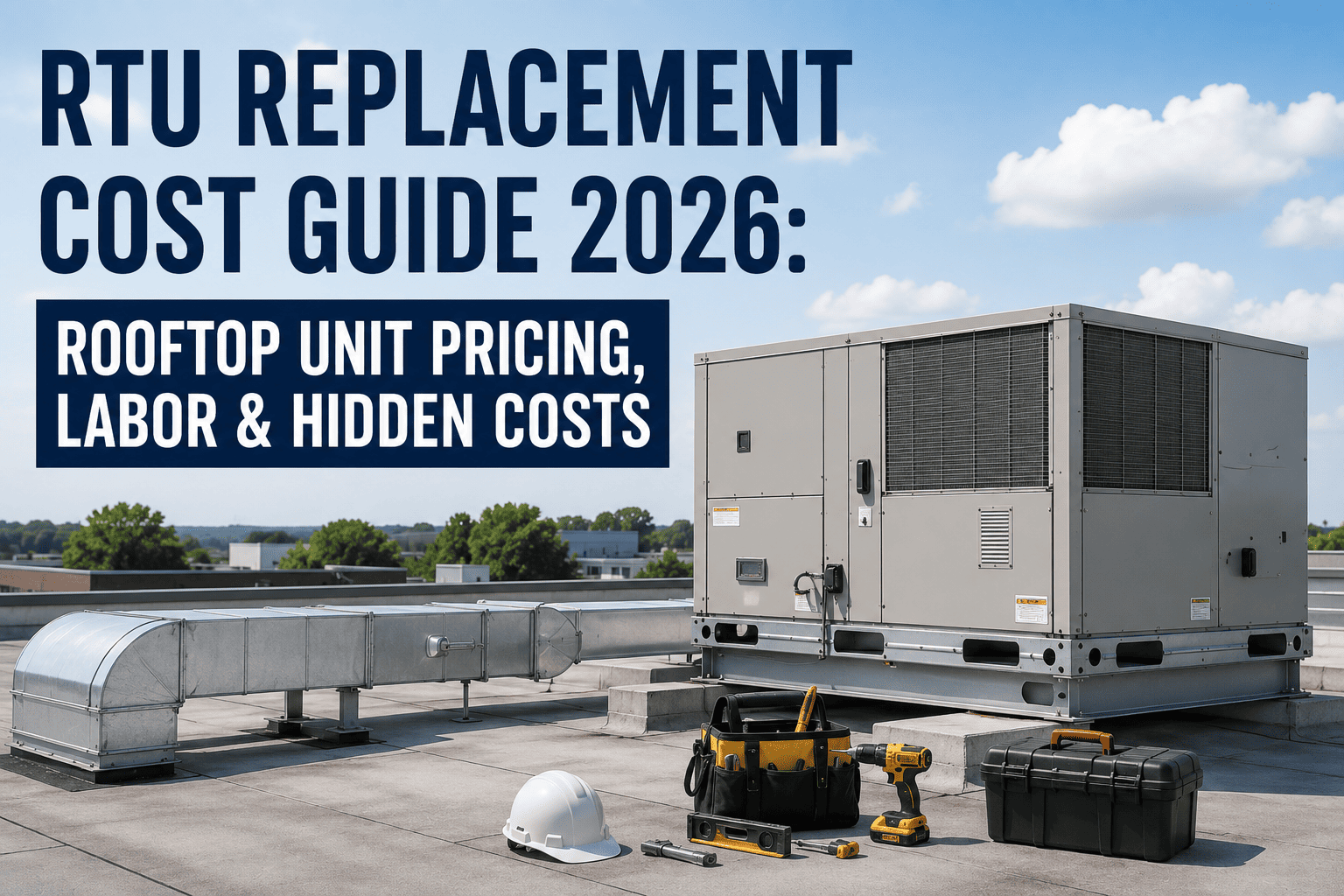
Replacing a rooftop unit is one of the largest unplanned capital expenses a facility manager can face in 2026 — total project costs range from $8,000 for a small packaged unit to over $60,000 for a large commercial installation. The equipment line item is only part of the story. Crane fees, curb adapters, electrical upgrades, and refrigerant disposal routinely add $3,000–$8,000 on top of every base quote. This guide breaks down every cost variable so you can plan RTU replacements with confidence — not sticker shock. Sign up free to track your HVAC asset age and service history in OxMaint, or book a demo to see how planned replacements beat emergency ones every time.
RTU Replacement Cost by Tonnage — 2026 Pricing Reference
Equipment cost scales with tonnage, but so does every associated line item. Use the table below as your baseline — then add the hidden cost layer from the next section. Sign up to log your existing RTU tonnage and track accumulated repair costs against replacement thresholds.
| Tonnage | Typical Use | Equipment Cost | Install Labor | Total Installed Range | Cost Per Ton |
|---|---|---|---|---|---|
| 3–5 Ton | Small retail, offices under 2,000 sqft | $3,500–$6,500 | $1,500–$3,000 | $5,000–$9,500 | $1,600–$2,800/ton |
| 6–10 Ton | Mid-size offices, restaurants, retail | $5,500–$12,000 | $2,500–$4,500 | $8,000–$16,500 | $1,500–$2,400/ton |
| 10–20 Ton | Large retail, warehouses, schools | $11,000–$28,000 | $4,000–$8,000 | $15,000–$36,000 | $1,800–$2,500/ton |
| 20–40 Ton | Big-box retail, manufacturing, hospitals | $24,000–$45,000 | $7,000–$14,000 | $31,000–$59,000 | $1,800–$2,200/ton |
| 40+ Ton | Industrial, large commercial campuses | $40,000–$65,000+ | $12,000–$20,000+ | $52,000–$85,000+ | $1,600–$2,000/ton |
Ranges reflect standard gas-electric packaged rooftop units. High-efficiency models (IEER2-rated, VSD drives, BMS-ready) add 15–25% to equipment cost. Regional labor rates vary — urban markets run 20–30% above the midpoint figures above.
The Hidden Cost Layer — What Every Base Quote Misses
A single-line quote with no breakdown is not a deal — it is a surprise waiting to happen. These are the six line items that routinely inflate RTU replacement budgets beyond what was approved. Book a demo to see how OxMaint stores full replacement project cost history so future budgets are based on real data.
Planned vs. Emergency Replacement — The Cost Difference Is Significant
Reactive replacements outside normal business hours carry 20–40% labor surcharges before any other cost variable is considered. A well-maintained RTU with a tracked service history gives you the lead time to plan — and planning eliminates every emergency premium. Sign up to start tracking your RTU age and repair cost accumulation automatically.
When to Replace vs. Repair — The Decision Framework
Not every aging RTU needs immediate replacement. The right decision depends on age, repair cost accumulation, and PM history — all of which OxMaint tracks automatically per asset. Book a demo to see how the repair cost curve works in practice for your fleet.
RTU Lifecycle Cost — The Number That Changes the Decision
Purchase price and installation cost are the visible part. The full lifecycle cost over 15–20 years is the number that makes replacement decisions defensible to leadership. Sign up and OxMaint builds this cost picture automatically from work order history.
What to Check Before Accepting Any RTU Replacement Quote
Frequently Asked Questions
What is the average total cost to replace a commercial rooftop unit in 2026?
Total installed cost ranges from approximately $8,000 for a 3–5 ton packaged unit up to $60,000 or more for units above 20 tons, before hidden costs are added. The three most commonly missed line items — crane mobilization, curb adapter, and electrical upgrades — collectively add $3,000–$8,000 on top of every base quote. Always request an itemized breakdown before approving any replacement project. Sign up free to track replacement costs per asset in OxMaint.
How long does a commercial RTU last before replacement is needed?
A well-maintained commercial RTU typically lasts 15–20 years. Units with poor PM history often fail at 10–12 years — significantly accelerating replacement CapEx timelines. The difference between a 10-year and 20-year lifespan on the same equipment often comes down entirely to PM compliance. Book a demo to see how OxMaint PM scheduling extends asset lifespan with automated compliance tracking.
What is a curb adapter and why does it matter for RTU replacement cost?
A curb adapter is a custom fabricated steel transition piece that bridges the gap between your existing roof opening and a new RTU whose footprint does not match the old curb dimensions. Manufacturer footprints change between model generations — and always differ across brands. When the fit does not match, a curb adapter ($800–$3,000) or full curb replacement ($3,200+) is required. This is the single biggest surprise cost in most RTU replacement projects and is almost never included in an initial quote without being specifically requested.
Are utility rebates available for commercial RTU replacements?
Most utility providers offer commercial HVAC rebates of $50–$200 per ton for qualifying high-efficiency replacements. Federal tax incentives under Section 179D may also apply to qualifying commercial buildings. Rebate eligibility must be assessed before the replacement is completed — most programs require pre-approval. Ask your contractor to confirm eligibility as part of the quote process, as rebate amounts can meaningfully offset the premium cost of high-efficiency equipment. Sign up to track your RTU replacement projects and energy data in OxMaint.
How does a CMMS help reduce RTU replacement and lifecycle costs?
A CMMS like OxMaint tracks PM compliance, repair cost accumulation, and asset age — enabling planned replacements that avoid emergency premiums entirely. When the accumulated annual repair cost curve approaches 40–50% of replacement cost, OxMaint surfaces this in the asset dashboard so facility managers can plan capital spending in the budget cycle rather than reacting to failure. Equipment with 85%+ PM compliance consistently reaches the 15–20 year lifespan, deferring significant replacement CapEx. Book a demo to see how the asset cost tracking works for HVAC equipment.