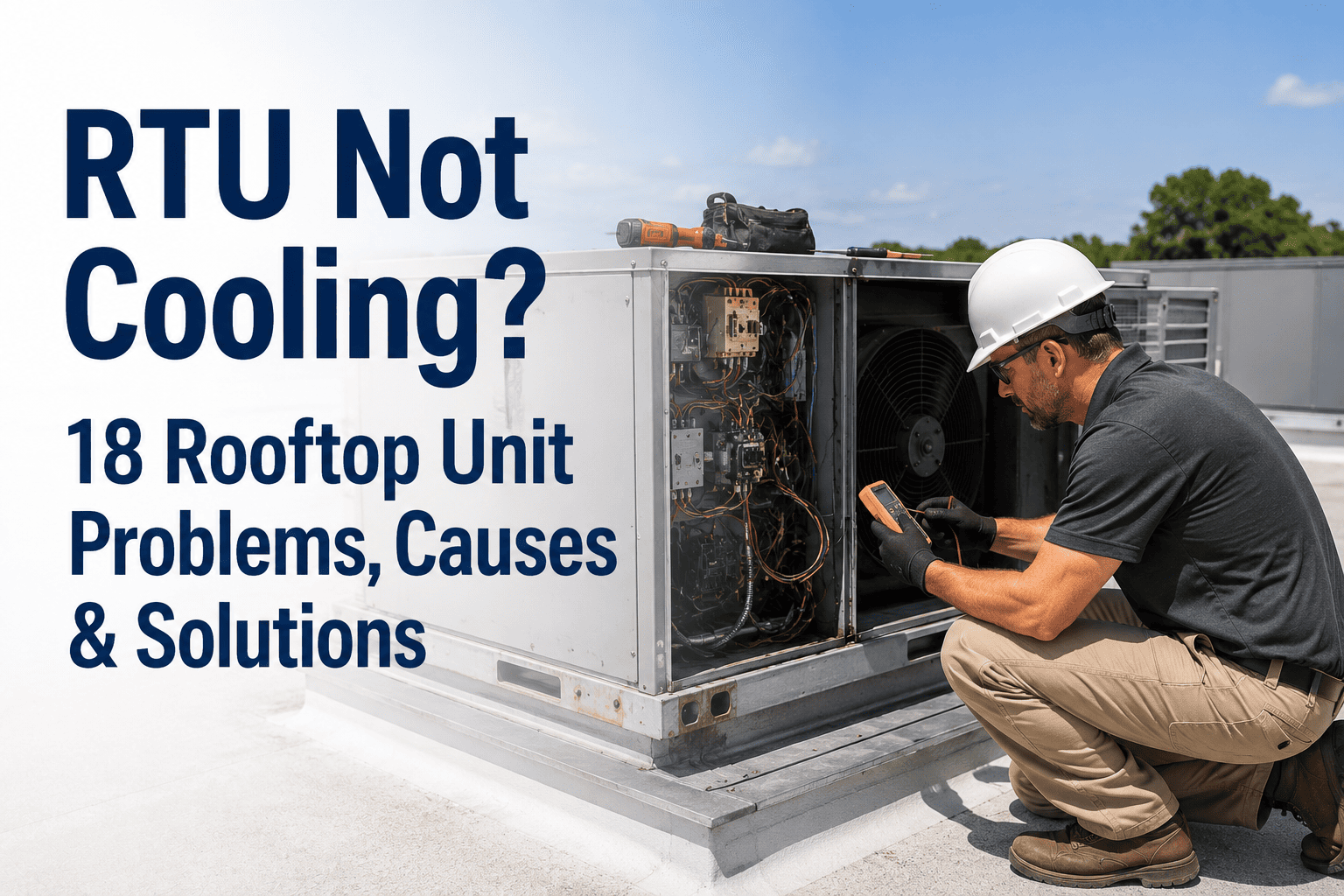
Rooftop units are the silent workhorses of commercial facilities — until they stop cooling. When an RTU fails mid-July in a retail store, restaurant, or warehouse, every hour of downtime costs money, comfort, and reputation. The good news: most RTU cooling failures share identifiable patterns, and most are preventable with the right maintenance system in place. This guide walks through 18 real problems, their causes, and what to do about them — so your team stops reacting and starts preventing. Sign up free to start tracking your HVAC assets in Oxmaint, or book a demo to see how facility teams eliminate repeat RTU failures.
A rooftop unit (RTU) is a self-contained HVAC system with the compressor, condenser, evaporator coil, expansion device, and air handler all housed in one cabinet installed on a building roof. When any one subsystem inside that cabinet fails, the entire cooling output drops — or stops. Understanding which subsystem is responsible cuts diagnostic time dramatically.
The 18 RTU Cooling Problems — Causes and Solutions
Warm supply air despite compressor running. Hissing or bubbling sounds near refrigerant lines. Ice formation on evaporator coil. Gradually worsening cooling over days or weeks.
Aging copper lines, vibration fatigue, corrosion at fittings, or physical damage from rooftop work or weather events.
Pressure test to locate leak. Repair or replace damaged section. Recharge to manufacturer specification. Document refrigerant charge level in CMMS for baseline comparison at next service.
High liquid line pressure (400+ psig on R-410A). High liquid line temperature (170–180°F). Low subcooling reading. Compressor running but poor cooling output.
Previous technician added refrigerant without measuring correctly. Metering device failure causing abnormal system pressures that mimic undercharge symptoms.
Connect manifold gauges and compare suction and discharge pressures against manufacturer P-T charts. Calculate superheat and subcooling — deviations over 10–15 psig indicate refrigerant circuit issue requiring recovery and correct recharge.
Inconsistent superheat readings. Coil flooding or starving. Compressor running but cooling capacity dramatically reduced.
Blocked TXV from moisture or debris. Failed EEV stepper motor. Incorrect TXV bulb positioning losing contact with suction line.
Verify TXV bulb is clamped correctly to suction line. Check EEV wiring and stepper motor response. Replace valve if stuck open or closed — symptoms mirror refrigerant charge issues so verify before adding refrigerant.
Fan runs but no cooling. Compressor contactor engages but motor does not start. High amperage draw followed by thermal cutout.
Failed start capacitor. Defective compressor contactor. Low voltage to compressor terminals. Compressor mechanically seized or refrigerant-locked after leak down.
Test capacitor with capacitance meter. Inspect contactor for burned contacts. Measure voltage at compressor terminals during attempted start. If mechanically seized — compressor replacement required.
Compressor starts and stops every 2–5 minutes. Building never reaches setpoint. Elevated energy bills. Accelerated compressor wear.
Low refrigerant charge triggering low pressure cutout. High head pressure from dirty condenser coils or failed condenser fan. Oversized unit for the space.
Check system pressures. Clean condenser coils. Verify condenser fan operation. Confirm low-pressure cutout settings against manufacturer spec. Log cycle times in CMMS to track pattern before and after repair.
Burning smell from unit. Acid test positive in compressor oil. Compressor runs but produces no compression — suction and discharge equalize quickly after shutdown.
Extended operation with insufficient lubrication from low refrigerant. Liquid slugging from refrigerant flooding. Repeated electrical faults causing motor winding failure over time.
Compressor replacement is required. System must be cleaned — suction line filter drier installed. Flush refrigerant circuit if acid content is high. Identify and correct the root cause that led to burnout before restarting.
Oxmaint logs fault history, maintenance records, and refrigerant charge data for every RTU in your fleet — so repeat failures stop happening and compliance documentation takes hours, not days.
Reduced airflow from supply registers. Ice visible on coil or suction line. Unit runs constantly but space temperature rises slowly or not at all.
Severely restricted filters reducing airflow below coil freeze threshold. Low refrigerant charge dropping suction temperature below freezing. Dirty coil surface reducing heat transfer.
Shut unit down and allow full defrost before any other diagnosis — operating a frozen coil causes compressor damage. Replace filters. Clean coil with approved coil cleaner. Verify airflow is above minimum CFM for coil size.
High head pressure. Compressor short cycling on high pressure cutout. Reduced cooling on hot days specifically. Unit that cooled fine in spring now struggles in summer.
Cottonwood, debris, and dust packing between condenser fins. Cottonwood season is the single biggest seasonal RTU failure driver in northern climates. Grease-laden air near restaurant exhausts causes rapid coil fouling.
Annual condenser coil cleaning — semi-annual for restaurant environments. Fin comb badly bent fins before cleaning. Schedule coil cleaning as a preventive maintenance task in CMMS — not a reactive work order. Book a demo to see how Oxmaint automates seasonal PM scheduling for your RTU fleet.
Weak airflow at supply registers. Increased energy consumption. Possible coil icing. Temperature differential below 14°F across the unit.
Filters not replaced on schedule. High-particulate environments requiring more frequent replacement than standard interval. Incorrect filter type installed with too high a MERV rating for the fan capacity.
Replace filters immediately. Establish a calendar-based filter replacement PM task in the CMMS — the most common RTU failure cause is also the most preventable. Log filter condition at every PM to track interval adequacy.
Uneven cooling across zones served by the unit. Rooms distant from the unit consistently warmer. Static pressure readings higher than design spec.
Duct joints separating from thermal cycling over years. Ductwork physically blocked by debris or a closed damper. Poor original duct sizing reducing terminal velocity.
Walk and inspect accessible duct sections. Verify all damper positions. Seal any disconnected joints with duct mastic. Contact a technician for duct rebalancing if zone complaints are persistent.
Unit completely off — no fan, no compressor. Breaker in tripped position at electrical panel.
Compressor or fan motor drawing locked rotor amperage from a capacitor failure. Ground fault inside unit. Nuisance trip from undersized breaker. Wiring short from rodent damage or vibration wear.
Shut down from local disconnect before resetting breaker. If breaker holds after reset — inspect for intermittent fault. If breaker immediately re-trips — fault is still present inside unit, do not continue cycling. A breaker that holds after reset does not mean the fault is resolved; monitor amperage at next PM.
Compressor or fan motor hums but does not start. Motor runs at reduced speed. Warm start on hot days — unit that starts fine in the morning fails when ambient temperature peaks.
Capacitors degrade over 5–7 years under heat stress. Rooftop environments — extreme heat, UV, thermal cycling — accelerate capacitor failure. Summer peak demand is the highest stress period.
Test with capacitance meter — replace if reading is more than 10% below rated MFD. Proactive capacitor replacement at year 5–6 is lower cost than the emergency service call. Add capacitor testing to your annual PM checklist in the CMMS.
Unit cycles randomly. Space temperature fluctuates widely around setpoint. Unit runs in heat mode when cooling is called. Occupant complaints persist after filter and coil checks confirm clean.
Faulty thermostat failing to sense space temperature correctly. Frayed wiring or loose connections between thermostat and unit controller. Sensor placed near a heat source giving a false elevated reading.
Verify thermostat is set to COOL mode. Check wiring connections at both thermostat and unit terminals. Replace thermostat if calibration check confirms sensing error. Log thermostat type and calibration history in CMMS for each unit.
Error codes displayed that do not match any confirmed physical fault. Unit behaves erratically — operates in wrong mode, fans run at wrong speed, compressor does not engage despite thermostat calling.
Lightning strike or power surge damaging board circuits. Age-related component failure on multi-year-old units. Moisture intrusion through degraded cabinet seals.
Retrieve stored fault codes before replacing board — some apparent board failures are actually sensor or wiring faults misread. Verify input voltages at board. If inputs are correct and outputs are wrong — board replacement required. Sign up to log fault codes and repair history for each RTU in Oxmaint.
High head pressure. Compressor trips on high pressure cutout. No airflow across condenser coil visible from outside. Fan blade stationary while compressor runs.
Motor bearing failure from lack of lubrication. Capacitor failure stopping motor from starting. Winding failure from extended overload or moisture.
Do not run compressor with condenser fan failed — high pressure failure will follow within minutes. Test motor windings and capacitor. Replace failed component. Check fan blade for balance — a bent blade accelerates bearing wear on the replacement motor.
Very low airflow despite fan running. Unusual noise from air handler section. Low static pressure. Most common after motor replacement or electrical work.
Three-phase motor connected with reversed phase sequence after replacement. Single-phase motor reinstalled with reversed capacitor wiring.
Verify supply fan rotation direction matches the arrow on the scroll housing. For three-phase motors — swap any two of the three phase leads. Simple fix, frequently overlooked on post-repair commissioning. Add rotation check to post-maintenance signoff checklist.
Squealing noise on startup. Reduced airflow gradually worsening over weeks. Belt dust visible inside unit cabinet. Error code indicating limit switch fault — belt slippage can trigger false limit faults.
Belt stretch from normal use exceeding adjustment range. Belt glazing from misaligned sheaves. Age hardening on units with infrequent PM.
Inspect belt tension and condition at every biannual PM — deflection should be no more than 1 inch per foot of belt span. Replace glazed or cracked belts regardless of apparent tension. Align sheaves before installing new belt.
Water dripping or pooling inside the building below the unit. High humidity complaints despite unit running. In some units — float switch shuts down cooling when pan overflows.
Algae or debris blocking condensate drain line. Improper unit levelness causing pan to drain toward blocked end. Float switch failure.
Flush condensate drain line with condensate tabs or dilute bleach solution annually. Verify unit is level — drain should slope toward outlet. Clear any debris from pan. Include pan inspection in biannual HVAC PM checklist. Book a demo to see how Oxmaint structures HVAC PM checklists for each unit type in your fleet.
RTU Maintenance Frequency Reference
| Maintenance Task | Frequency | Failure It Prevents | Priority |
|---|---|---|---|
| Air filter inspection and replacement | Monthly (high dust) / Quarterly (standard) | Coil icing, reduced airflow, compressor overload | Critical |
| Condenser coil cleaning | Annual (spring) / Semi-annual (restaurant) | High head pressure, compressor short cycling, early burnout | Critical |
| Capacitor testing | Annual | Compressor / fan motor no-start on peak days | Critical |
| Belt inspection and tension check | Bi-annual | Reduced airflow, limit switch faults, coil icing | High |
| Condensate drain flush | Annual (spring startup) | Water intrusion, humidity problems, float switch shutdown | High |
| Refrigerant charge verification | Annual or after any refrigerant work | Coil icing, compressor liquid slugging, TXV mimic faults | High |
| Electrical connection inspection | Annual | Nuisance trips, contactor burn, motor winding failure | High |
| Fault code log review | Every PM visit | Early detection of intermittent faults before failure | Standard |
Oxmaint structures every task in this table as a scheduled PM work order — auto-assigned, with a digital checklist, and escalated if overdue. Your team stops forgetting seasonal PM tasks. Your RTUs stop failing the same way twice. Sign up free or book a demo to see the HVAC PM workflow in action.
How Oxmaint Eliminates Repeat RTU Failures
Every RTU in your facility is registered in Oxmaint with its model, age, refrigerant type, and service history. Every fault code, every work order, every technician note — logged against the unit. When a failure occurs, the full history is visible in seconds, not buried in a filing cabinet.
Filter changes, coil cleanings, capacitor tests, belt inspections — all scheduled and auto-assigned in Oxmaint based on your frequency rules. No seasonal PM gets missed because nobody remembered. Digital checklists confirm every task was completed, not just that the work order was closed.
When an RTU fails, Oxmaint's AI RCA engine cross-references sensor history, maintenance records, and prior failure events to surface the most probable root cause in seconds — not after a 4-day manual investigation. The identified cause becomes a closed CAPA, not a forgotten PDF finding.
If a compressor capacitor fails on Unit 3, Oxmaint alerts you to check the capacitors on Units 1, 2, and 4 — all the same age, all the same operating environment. The failure on one unit becomes the intelligence that prevents failures on every other unit before the peak season hits.
Stop Troubleshooting the Same RTU Twice
Oxmaint connects every RTU fault event to its maintenance history, closes the corrective action that was left open, and prevents the same failure from reaching your fleet again. Asset tracking, PM scheduling, AI RCA, and CAPA management — live in 5 weeks.