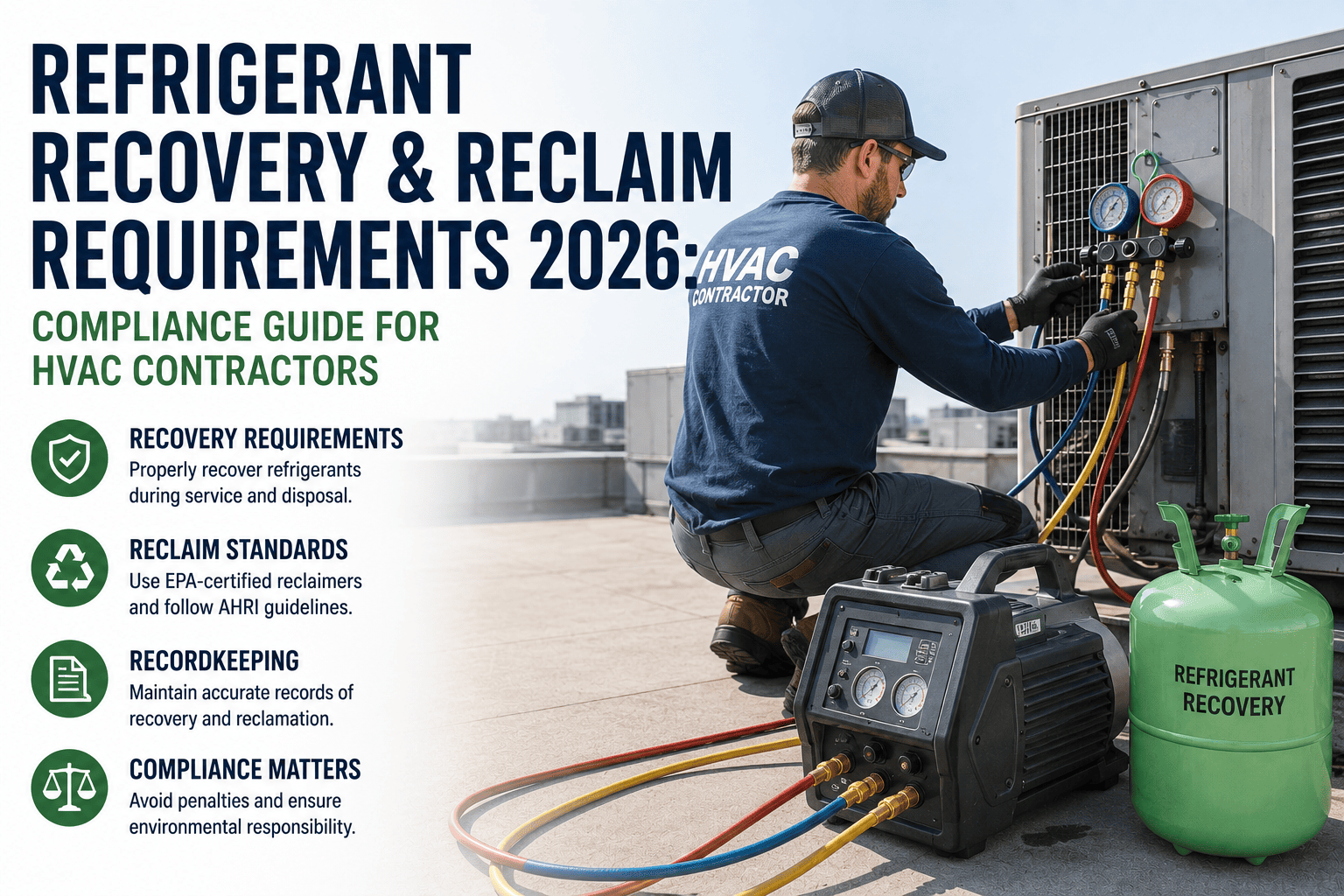
Every pound of refrigerant you recover is a legal event. In 2026, EPA rules under the AIM Act and Section 608 tightened what you must document, how recovered refrigerant can move, and what happens when the chain of custody breaks. For HVAC contractors, the compliance gap between knowing the rules and proving you followed them is where violations — and five-figure fines — happen. This guide covers exactly what is required, what changed in 2026, and how to run a compliant operation. Sign up free on OxMaint to track recovery documentation per work order, or book a demo to see it in action.
Close Every Refrigerant Chain of Custody — Automatically
OxMaint embeds refrigerant recovery documentation into every work order — refrigerant type, weight recovered, cylinder ID, technician cert number, and reclaimer receipts. EPA-ready records generated at every handoff, no paperwork required.
The Three Rs: What They Mean and Why the Difference Matters
Recovery, recycling, and reclamation are not interchangeable terms under EPA law. They carry legally distinct definitions, different documentation requirements, and different rules about what you can do with the refrigerant afterward. Getting them wrong is one of the most cited sources of contractor violations. Sign up on OxMaint to log every recovery event with the correct classification from the field.
01
Recovery
Remove refrigerant from a system and store it in an external container. No processing required. No purity standard required.
Reuse Rule
Can only be returned to the same system or other systems owned by the same equipment owner. Cannot be sold to another owner.
02
Recycling
Clean refrigerant on-site through oil separation and filter-drier passes. Reduces contaminants but does NOT meet AHRI 700 purity standards.
Reuse Rule
Restricted to the system it came from, or other systems owned by the same person. Cannot be sold to a new owner under any circumstances.
03
Reclamation
Reprocessed at an EPA-certified facility to AHRI 700 virgin-equivalent purity standards. Only reclaimed refrigerant can be sold to a new owner.
Legal to Sell
The only path to legally transferring refrigerant to a new owner. Certified reclaimer issues purity documentation for every batch.
What the 2026 Rules Actually Changed
The EPA's Emissions Reduction and Reclamation (ER&R) rule under 40 CFR Part 84 Subpart C became fully effective January 1, 2026. Here is what is new and what it means for your operation. Book a demo to see how OxMaint helps contractors stay current with every requirement.
NEW
Reclaimed Refrigerant Label Requirement
As of January 1, 2026, all containers of reclaimed refrigerant being sold or distributed must carry a permanent label certifying that contents do not exceed 15 percent virgin regulated substances by weight. Contractors receiving refrigerant for service work must verify this label is present.
NEW
Leak Repair Requirements for Systems 15 lbs and Over
Systems with a full charge of 15 pounds or more of HFC refrigerant with a GWP above 53 are now subject to mandatory leak repair requirements effective January 1, 2026. When a system cannot be repaired to meet established leak rate limits, the owner or operator must create and implement a retrofit or retirement plan.
TIGHTENED
Sale and Transfer Prohibition on Unreclaimed HFCs
The rule prohibits the sale, distribution, or transfer to a new owner of any HFC refrigerant recovered from stationary equipment unless it has been reclaimed by an EPA-certified reclaimer. Selling or transferring recovered-but-not-reclaimed refrigerant to a different owner is now explicitly prohibited.
TIGHTENED
Automatic Leak Detection for Certain Commercial Systems
Units installed in 2026 must have operational automatic leak detection systems at installation. For existing applicable units, the requirement takes effect January 1, 2027. Systems with significant refrigerant charges and high GWP refrigerants are the primary targets under 40 CFR 84.108(b).
ONGOING
EPA Section 608 Certification — No Change, More Enforcement
Section 608 technician certification requirements are unchanged. Any technician who attaches and detaches hoses and gauges to add or remove refrigerant must be certified. Enforcement attention has increased as the AIM Act phase-down progresses — violations now carry penalties up to $44,539 per day per violation.
Recovery Equipment and Vacuum Level Requirements
Recovery is not just removing refrigerant — it is removing it to specified vacuum levels that vary by system type and refrigerant charge size. Using equipment that does not meet EPA requirements, or stopping short of required vacuum levels, constitutes a violation regardless of how much refrigerant you captured.
HCFC/HFC systems (manufactured after Nov 15, 1993)
Less than 200 lbs
0 psig or 4 in. Hg vacuum
EPA-certified recovery equipment
HCFC/HFC systems (manufactured after Nov 15, 1993)
200 lbs or more
4 in. Hg vacuum
EPA-certified recovery equipment
Systems manufactured before Nov 15, 1993
Less than 200 lbs
4 in. Hg vacuum
EPA-certified recovery equipment
Very high-pressure systems (R-744, etc.)
Any size
0 psig
EPA-certified recovery equipment
A2L refrigerants (R-454B, R-32) require spark-proof, A2L-rated recovery equipment. Standard recovery machines used for R-410A are not compliant for A2L systems.
Documentation: What You Must Be Able to Prove
A 2024 industry survey found 58% of HVAC contractors have incomplete or missing recovery documentation for at least a quarter of their annual recoveries. The EPA requires cradle-to-grave records for every pound of refrigerant. Sign up free on OxMaint to build compliant records directly from the field on every work order.
At Recovery
Refrigerant type and weight recovered (before and after)
Source appliance ID — equipment make, model, serial number
Recovery cylinder ID and DOT approval number
Technician name and EPA 608 certification number
Date, time, and work order reference
At Transfer
Cylinder transfer log — from field tech to company storage
Refrigerant type, weight, and cylinder ID at each handoff
Chain-of-custody documentation for every owner change
Proof that HFC refrigerant will be sent to certified reclaimer before sale to new owner
At Reclamation
EPA-certified reclaimer receipt with weight accepted
Reclaimer name and EPA certification number
AHRI 700 purity verification documentation
Label confirming reclaimed content does not exceed 15% virgin refrigerant
Retention Rule
All refrigerant records must be kept for a minimum of 3 years
Electronic records are acceptable — must be accessible from business address via internet
Cloud storage is EPA-compliant and recommended for multi-site operations
The Penalty Reality: What Non-Compliance Actually Costs
These are not theoretical numbers. State-level enforcement actions in 2026 against major HVAC operations have resulted in six-figure fines. Violations that seem minor — missing documentation, incomplete chain of custody, wrong cylinder labeling — compound quickly under per-day, per-violation penalty structures.
$44,539
Per day, per violation
Standard civil penalty for Clean Air Act refrigerant violations — applies to both buyer and seller in a non-compliant transaction
$124,426
Maximum per day, per violation
Maximum civil penalty under current enforcement guidelines — applies to willful or repeated violations and systemic documentation failures
Criminal
Knowing violations
Willful venting or deliberate falsification of recovery documentation can result in criminal liability, not just civil penalties
Lost Cert
Certification risk
Contractors found in violation may lose EPA Section 608 certification — preventing them from legally handling refrigerant at all
The Recovery Procedure: Step by Step
Compliance starts with field procedure. Every recovery event must follow the same sequence to produce a defensible, complete record. Book a demo to see how OxMaint structures this as a mandatory work order checklist your technicians complete from their phone.
1
Identify and log the appliance
Record make, model, serial number, refrigerant type, and estimated charge from the nameplate. This is the source record that anchors the chain of custody.
2
Verify recovery equipment certification
Confirm recovery machine is EPA-certified for the refrigerant type. For A2L refrigerants (R-454B, R-32), verify A2L-rated, spark-proof equipment is in use — standard R-410A recovery machines are not compliant.
3
Recover to required vacuum level
Evacuate to the vacuum level required for the system type and charge size. Document the vacuum achieved — not just that recovery was performed.
4
Weigh and record the recovered amount
Weigh cylinder before and after. Record the recovered weight in pounds on the work order. This number is the foundation of all downstream documentation.
5
Tag the cylinder and log the transfer
Label the DOT-approved recovery cylinder with refrigerant type, weight, source equipment ID, date, and technician certification number. Log the cylinder into your inventory system at point of transfer.
6
Send to EPA-certified reclaimer
Recovered HFC refrigerant that will change ownership must be sent to an EPA-certified reclaimer for AHRI 700 reprocessing before it can be sold or transferred to any new owner. Obtain and retain the reclaimer receipt.
Recovery vs. Reclaim: Quick Reference for Field Use
Recovered refrigerant, same owner's other equipment
Return to same owner's system — no reclaim needed
Recovery weight, source equipment ID, cylinder ID, tech cert
Recovered refrigerant, selling to different contractor
Must be reclaimed first — direct sale of recovered HFC is prohibited
Full chain of custody + certified reclaimer receipt + AHRI 700 purity cert
Recycled refrigerant (cleaned on-site)
Return to same owner's systems only — cannot be sold
Recovery and recycling log, system IDs, owner documentation
Purchasing reclaimed refrigerant for service
Legal — verify label shows 15% or less virgin content
Purchase receipt, label verification, supplier certification number
System with 15+ lb charge showing chronic leaks
Leak repair required — if unrepairable, retrofit or retirement plan mandatory
Leak rate calculation, repair records, retrofit or retirement plan if applicable
How OxMaint Builds Compliance Into Every Recovery
Documentation failures happen because recovery compliance is managed in parallel to service work — separate spreadsheets, paper logs, and separate filing. OxMaint puts the documentation requirement inside the work order, so compliance is built into how the job gets done, not added after. Sign up free — no hardware required to start.
WO
Recovery Fields in Every Work Order
Refrigerant type, weight recovered, cylinder ID, and technician certification number are mandatory fields before a work order closes. Technicians log from the field on mobile — no paper, no later entry.
CH
Chain-of-Custody Records
Every recovery event is linked to a source asset ID. Cylinder transfers, reclaimer receipts, and purity documentation attach to the same record — giving you a complete audit trail from recovery through reclamation.
LK
Leak Repair Tracking
Systems with 15+ pound charges that receive repeated refrigerant top-ups are automatically flagged. OxMaint tracks refrigerant additions per asset over time — the exact data needed to document leak rates under the 2026 rule.
AU
Audit-Ready Export
All refrigerant records are stored in the cloud with a minimum 3-year retention, accessible from any location. Export EPA-ready reports per technician, per asset, or per site — exactly what an audit or enforcement inquiry requires.
Stop Managing Recovery Compliance in Spreadsheets
OxMaint tracks refrigerant recovery weight, cylinder chain of custody, reclaimer receipts, and leak repair history per asset — so your documentation is complete before you leave the job site, not the night before an audit.
Frequently Asked Questions
What are the EPA refrigerant recovery requirements for HVAC contractors in 2026?
Under EPA Section 608 and the AIM Act ER&R rule effective January 1, 2026, HVAC contractors must: hold EPA 608 certification before touching any refrigerant, use EPA-certified recovery equipment and evacuate to required vacuum levels, document every recovery event with refrigerant type, weight, source equipment ID, cylinder ID, and technician certification number, and send recovered HFC refrigerant to an EPA-certified reclaimer before it can be sold or transferred to any new owner. All records must be kept for a minimum of three years and must be accessible electronically. Civil penalties for violations reach up to $44,539 per day per violation. Sign up on OxMaint to build these records automatically from every work order.
Can I sell recovered refrigerant to another contractor without reclaiming it first?
No. Under the 2026 rules, the sale, distribution, or transfer of any HFC refrigerant recovered from stationary equipment to a new owner is prohibited unless it has first been reprocessed by an EPA-certified reclaimer to AHRI 700 purity standards. Recovered refrigerant that has not been reclaimed can only be returned to the same equipment or other systems owned by the same equipment owner. Transferring recovered-but-unreclaimed HFC refrigerant to a different contractor or owner is an explicit violation under 40 CFR Part 84 Subpart C, subject to penalties up to $44,539 per day per violation.
What is AHRI 700 and why does it matter for refrigerant reclamation?
AHRI Standard 700-2016 specifies the purity standards that reclaimed refrigerant must meet before it can be sold as equivalent to virgin refrigerant. EPA-certified reclaimers are required to reprocess recovered refrigerant to these specifications and verify purity using the analytical methods set out in the standard. Reclaimed refrigerant that meets AHRI 700 is the only recovered refrigerant that may legally be sold to a new owner. The reclaimer must also certify that no more than 1.5 percent of the refrigerant is released during the reclamation process. When purchasing reclaimed refrigerant for service work, verify the label — from January 1, 2026, all containers must certify that contents are no more than 15 percent virgin regulated substances by weight.
What new requirements apply to systems with refrigerant charges of 15 pounds or more?
Effective January 1, 2026, systems containing 15 pounds or more of HFC refrigerant with a GWP above 53 are subject to mandatory leak repair requirements under EPA's ER&R rule. When a leak is identified, repairs must be completed within a specified timeframe. If a system cannot be repaired to meet established leak rate limits, the equipment owner or operator must create and implement a retrofit or retirement plan for the equipment. Additionally, systems installed in 2026 must have automatic leak detection operational at installation; existing systems must comply by January 1, 2027. Book a demo to see how OxMaint tracks refrigerant additions and leak events per asset.