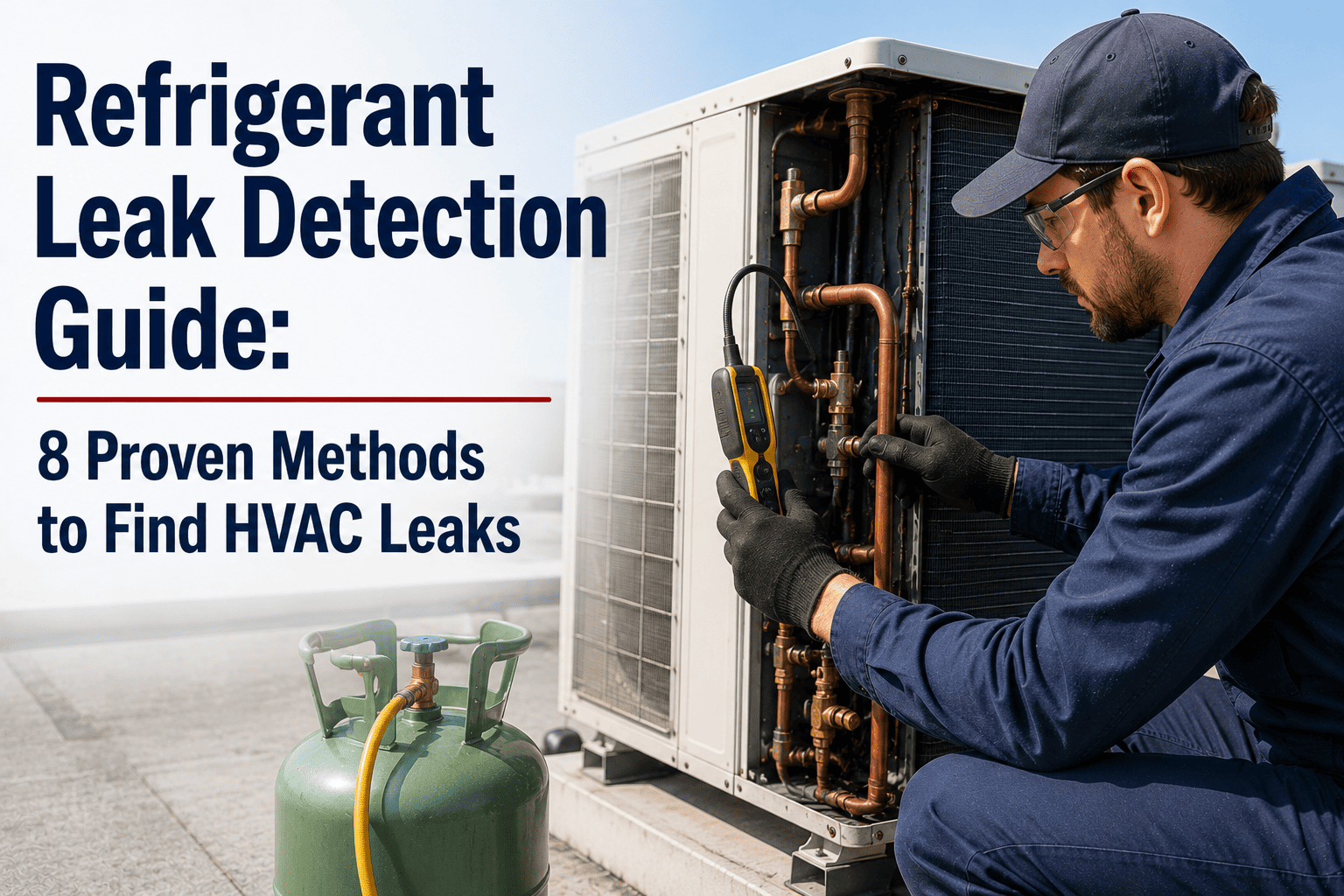
A refrigerant leak does not announce itself — it quietly reduces system capacity, spikes energy bills, damages compressors, and crosses EPA compliance thresholds before most teams realize there is a problem. For commercial HVAC systems with more than 50 lbs of refrigerant charge, the stakes are high: leak rates above 10% for comfort cooling and 20% for commercial refrigeration trigger mandatory repair timelines and documentation under EPA Section 608 — with fines reaching up to $69,733 per day for non-compliance. Sign up free or book a demo to see how OxMaint centralizes refrigerant records, automates inspection schedules, and flags chronic-leak units before thresholds are breached.
Why Refrigerant Leaks Are a Compliance Emergency
8 Proven Refrigerant Leak Detection Methods
No single method works for every situation. The right choice depends on system type, leak severity, access constraints, and whether you need pinpoint accuracy or wide-area screening. Here is every method your team needs to know — with the correct use case for each.
The industry standard for EPA-documented inspections. A heated diode sensor burns a small amount of refrigerant vapour and detects changes in electrical resistance — producing an audible alarm when refrigerant concentration rises. Sensitivity down to 1 ppm makes it effective for pinpointing small leaks.
Detects the high-frequency turbulent sound produced when pressurised refrigerant escapes through a gap — not the refrigerant chemistry itself. This makes ultrasonic detectors uniquely effective for ammonia, CO2, HFCs, and HFO systems alike, and useful in areas with ambient heat that would confuse infrared sensors.
OEM-approved dye is injected into the refrigerant circuit and circulates with the refrigerant. At any leak point, dye escapes with the refrigerant and fluoresces bright yellow-green under a UV lamp. Particularly effective for confirming suspected leak locations in complex pipework after electronic detection has narrowed the zone.
Infrared detectors measure the absorption of IR light at wavelengths specific to refrigerant molecules. More accurate and longer-lasting than heated diode sensors — the sensor element does not degrade from refrigerant exposure — making them the preferred choice for technicians running high-volume inspection programmes.
An HVAC-rated bubble solution is applied directly to suspected joints, flare fittings, brazed connections, and Schrader valve cores. Bubbles form at any point where refrigerant is escaping under pressure. Simple, low-cost, and universally applicable — best used after electronic detection has identified a suspect zone.
The system is evacuated of refrigerant, then pressurised with dry nitrogen to working pressure. Any leak produces an audible hiss or measurable pressure drop on gauges over a set period. The gold standard for commissioning new systems and verifying leak-free status after major repairs — before refrigerant is introduced.
Permanently mounted sensors in plant rooms, compressor areas, and refrigerant zones provide 24/7 monitoring. Alerts fire automatically to maintenance teams within minutes of threshold breach. From 2025, new EPA requirements mandate automatic leak detection for systems in certain categories — fixed sensors meet this requirement and integrate directly with CMMS platforms for automatic work order generation.
IoT sensors continuously log suction and discharge pressures alongside ambient and coil temperatures. Declining suction pressure trends, rising superheat values, and unexplained capacity drops are statistically correlated with refrigerant loss — enabling early warning before leak rates cross compliance thresholds. Pairs with CMMS for automatic inspection dispatch.
Choosing the Right Method — Decision Matrix
Match the detection method to your asset type and risk profile. Using a single method for every situation leads to missed leaks, wasted time, or failed audits.
| Situation | Primary Method | Confirm With | Document |
|---|---|---|---|
| Scheduled EPA walkdown inspection | Electronic (heated diode or IR) | Bubble solution at flagged joints | Method, location, technician cert, reading |
| Machine room / chiller plant | Fixed continuous sensors | Electronic handheld on alarm | Sensor ID, alarm timestamp, follow-up result |
| Ammonia or CO2 system | Ultrasonic detector | Bubble solution | Method, refrigerant type, location, reading |
| Slow or intermittent leak suspected | UV fluorescent dye | Electronic sweep 48 hrs later | Dye type, injection date, UV inspection result |
| New installation commissioning | Nitrogen pressure test | Bubble solution at all joints | Test pressure, hold duration, result, technician |
| Post-repair verification | Bubble solution | Electronic confirmation | Repair method, parts, recharge quantity, date |
| Multi-site early warning programme | IoT pressure monitoring | Electronic on alert dispatch | Trend data, alert threshold, inspection result |
Common Leak Locations to Inspect First
EPA Section 608 Compliance — What to Document
Every commercial HVAC system with 50 lbs or more of refrigerant charge falls under EPA Section 608 recordkeeping requirements. The documentation burden has increased significantly following AIM Act amendments — facility managers need to track far more than just recharge quantities. Book a demo to see how OxMaint handles this automatically.
Leak Detection Inspection Checklist
Use this field-ready checklist for every scheduled refrigerant inspection. OxMaint auto-generates this checklist per asset and frequency, assigned to a certified technician with pass/fail tracking and photo evidence per task.
Frequently Asked Questions
What is the most accurate refrigerant leak detection method?
For scheduled EPA inspections, electronic heated diode or infrared detectors provide the best combination of sensitivity and point-source accuracy — detecting leaks down to 1 ppm. For slow or intermittent leaks in complex pipework, UV fluorescent dye is the most reliable confirmation method. The recommended commercial strategy is fixed continuous sensors for machine rooms, combined with electronic handheld detectors for scheduled walkdown inspections.
How often do commercial HVAC systems need refrigerant leak inspections?
Under EPA Section 608, systems with 50 or more lbs of charge must be inspected when annual leak rates exceed 10% (comfort cooling) or 20% (commercial refrigeration). Under F-Gas Regulation in the EU and UK, inspection frequency is determined by CO2-equivalent charge — systems above 5 tCO2e require annual inspection, above 50 tCO2e require semi-annual inspections. OxMaint auto-schedules the correct interval per asset and jurisdiction.
Can UV dye damage an HVAC system?
Only if incompatible dye is used. OEM-approved dye formulated for the specific refrigerant and lubricant type is safe and will not affect compressor oil viscosity or system components. Unapproved or mismatched dye formulations can contaminate compressor oil and void manufacturer warranties. Always log dye type and injection date in the asset's service record — OxMaint tracks this per unit.
What documentation does EPA require for refrigerant leaks?
For systems with 50 or more lbs of charge: refrigerant purchase records with technician certification numbers, annual leak rate calculations, inspection records showing method and location, repair documentation addressing root cause, and post-repair verification. All records must be retained for at least 3 years and made available to EPA inspectors on request. OxMaint stores and organises all of this automatically.
How does a CMMS help with refrigerant compliance?
A CMMS like OxMaint centralises refrigerant recharge logs, inspection records, and repair histories by asset — calculates running leak rates, flags units approaching compliance thresholds, schedules inspections to the correct EPA and F-Gas intervals, and exports a complete audit package on demand. It replaces spreadsheets and disconnected service records with a single source of truth across your entire refrigerant-bearing asset portfolio.