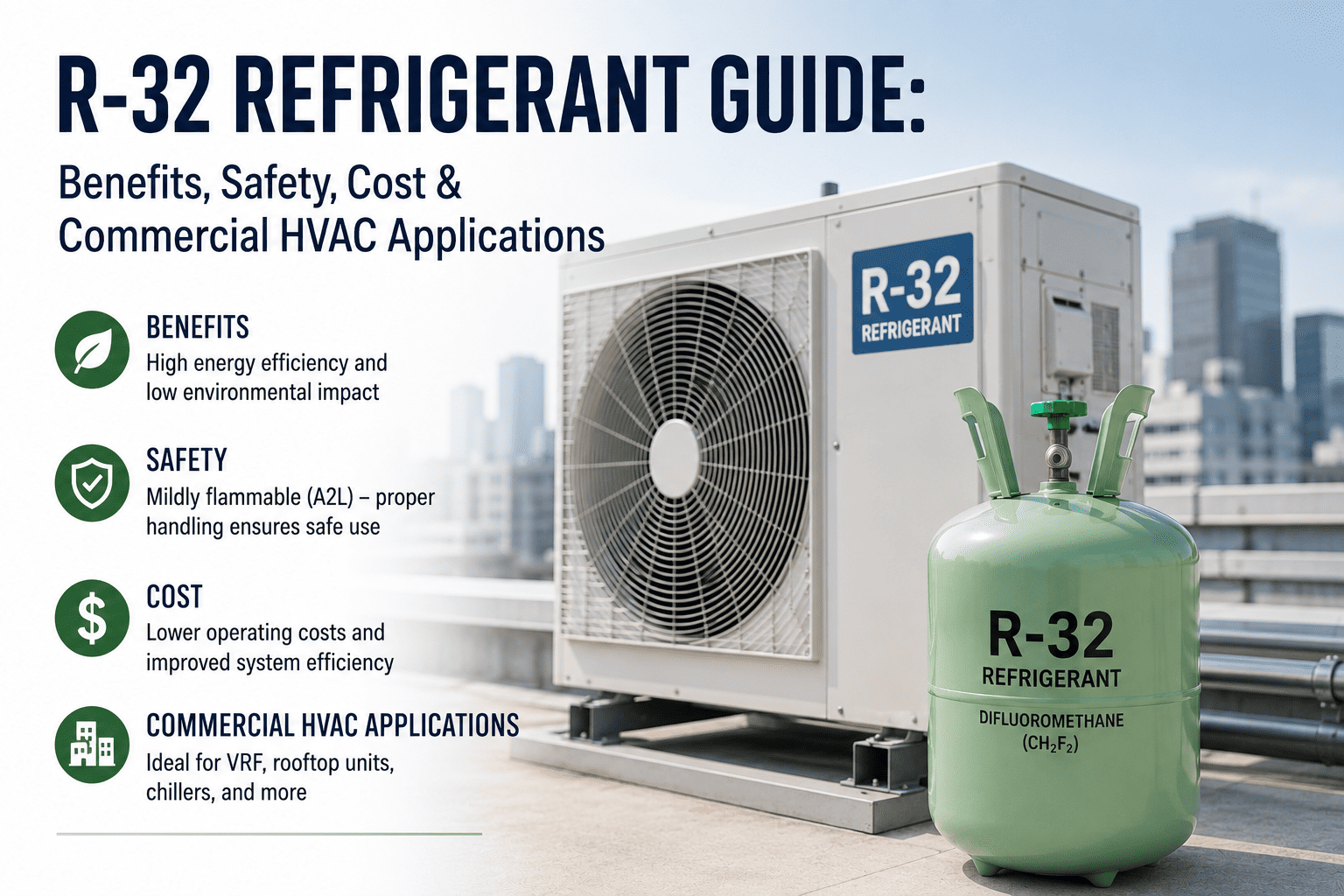
R-32 is the world's most widely deployed low-GWP refrigerant — with over 160 million units installed globally and now the standard charge in new VRF and mini-split equipment from Daikin, Mitsubishi, LG, Fujitsu, and Panasonic. For commercial facility managers and HVAC teams, R-32 isn't a future consideration — it's already arriving in your building. Understanding its properties, safety requirements, and maintenance implications is now a core operational responsibility. Sign up free on OxMaint to tag every R-32 asset, auto-assign A2L checklists, and keep your team audit-ready from day one.
Manage Every R-32 Asset with the Right Maintenance Program
OxMaint auto-assigns A2L-compliant inspection checklists to R-32 equipment, tracks technician certifications, schedules leak sensor calibration, and maintains refrigerant charge records — one CMMS for your entire A2L portfolio.
What Is R-32 and Why Does It Matter Now
R-32 (difluoromethane) is a single-component HFC refrigerant with a GWP of 675 — 68% below R-410A's 2,088. Unlike blend refrigerants such as R-454B or R-410A, R-32 is a pure compound. There is no fractionation risk during partial charge recovery, which simplifies field service considerably. Daikin introduced R-32 mini-splits in Japan as early as 2012, and the refrigerant has dominated Asia-Pacific markets since. In the United States, EPA AIM Act mandates that took effect January 1, 2025 ended new R-410A equipment production — and R-32 is now the factory charge in new VRF systems from every major global OEM. Book a demo to see how OxMaint manages mixed-refrigerant portfolios across commercial facilities.
The Four Key Benefits of R-32 for Commercial HVAC
Higher Energy Efficiency
R-32 increases heat transfer efficiency by approximately 20% compared to R-410A and allows more cooling capacity per unit of refrigerant volume. Commercial VRF systems using R-32 achieve up to 12% energy savings in large-scale environments such as office buildings and retail stores. Higher volumetric capacity also means smaller refrigerant charges achieve the same cooling work — reducing both material cost and environmental risk per system.
Simpler Field Servicing
Because R-32 is a pure single-component refrigerant, technicians can top up a partial charge without full recovery and recharge. There is no fractionation — the blend composition cannot shift during servicing the way it can with R-454B or R-410A. This translates directly to shorter service calls, lower labor cost per event, and fewer charge-management errors in the field.
Deep Global Service Network
R-32 has been in commercial deployment since 2012 across Japan, Australia, Europe, and Southeast Asia. Over 160 million units are installed worldwide by 2026. Technician familiarity and parts availability for R-32 VRF and mini-split systems are substantially broader than for newer blend refrigerants — reducing service lead times and contractor qualification risks for facilities relying on imported OEM equipment.
Regulatory Stability Through 2036
At GWP 675, R-32 comfortably clears the EPA's 700 GWP ceiling for new equipment and qualifies for manufacture through at least 2036 under the AIM Act phasedown schedule. Equipment purchased today carries a clear regulatory runway for its full 15–20 year service life. California's CARB 750 GWP limit for new stationary AC equipment — among the strictest in the US — is also met by R-32 without modification.
Commercial Applications: Where R-32 Fits Best
Variable Refrigerant Flow Systems
R-32 is the standard refrigerant for new commercial VRF systems from Mitsubishi, LG, Daikin, and Fujitsu. Effective January 2026, R-32 VRF products are the primary offering from these OEMs in the US market. Enhanced IEER ratings and improved heating COP scores make R-32 VRF a strong total cost of ownership play for multi-zone commercial buildings.
Ideal FitDuctless Mini-Split Zones
Office fit-outs, server room spot cooling, restaurant supplemental zones, and retail space conditioning — R-32 mini-splits are the established choice for applications under 20kW. The 3-ton R-32 mini-split system averages around $3,500 installed, versus $4,000 for comparable R-454B central systems, making it cost-competitive at the zone level.
Ideal FitLight Commercial Splits
For light commercial split systems in the US market below approximately 20kW, R-32 is increasingly available through Asian OEMs. However, traditional US manufacturers (Carrier, Trane, Lennox) have largely standardized on R-454B for their US commercial split lines — meaning parts availability and warranty support may favor R-454B for some applications.
Context DependentLarge Rooftop Units (above 20kW)
For commercial RTUs and large packaged systems above 20kW, R-454B dominates the US market. Carrier, Trane, and Lennox have standardized on R-454B for their commercial rooftop lines, and equipment availability, contractor training, and OEM support are substantially deeper for R-454B in this segment.
R-454B PreferredR-32 Safety Requirements: What Changes for Your Facility
R-32's A2L classification — mildly flammable, low toxicity — requires meaningful changes to installation, maintenance, and documentation practices. These are not optional upgrades. ASHRAE 15-2022, UL 60335-2-40, and the 2024 International Mechanical Code (IMC) govern how A2L systems must be installed and serviced. Sign up free on OxMaint to build A2L-compliant PM schedules for your R-32 assets from day one.
Leak Detection Sensors
Systems exceeding IMC charge limits must include refrigerant detection systems capable of triggering automatic shutdown and mechanical ventilation activation. A2L-rated leak detectors must have sensitivity of at least 5 g/year (0.1 oz/year) and must not create sparks or heat above auto-ignition temperature. Sensor calibration checks must be added to every quarterly PM schedule for R-32 assets.
A2L-Certified Tooling
Standard R-410A manifold gauges, recovery machines, and vacuum pumps are not rated for A2L service. Technicians must use A2L-rated recovery equipment, updated manifold gauges, and electronic leak detectors specifically listed for R-32. A complete field-ready A2L toolkit costs approximately $3,000–$5,000. Facilities must verify contractor tooling compliance before authorizing any R-32 service work.
Technician Certification
EPA Section 608 certification is required for all refrigerant handling — A2L refrigerants fall under the same requirements. ASHRAE 15-2022 compliance additionally requires technicians to have A2L-specific safety training covering charge limits, ignition source identification, ventilation procedures, and emergency response. Facilities must track technician certifications and ensure only qualified personnel are dispatched to R-32 assets.
Charge Limits and Ventilation
ASHRAE 15 and the IMC set maximum refrigerant charge limits per occupied space based on floor area and the refrigerant's Lower Flammability Limit (LFL). For R-32 in occupied commercial spaces, these limits affect system sizing and pipe run design. Where charge limits are exceeded, mechanical ventilation with automatic refrigerant-triggered activation is required — a design consideration that must be documented in the asset record.
Maintenance Program: What R-32 Assets Require
Review system performance data — discharge temperature trending is the primary early warning indicator for R-32 compressor stress
Verify leak detection sensor status and alarm log on each A2L unit
Calibrate A2L leak detection sensors — sensitivity must remain at 5 g/year minimum per ASHRAE requirements
Inspect refrigerant piping connections and fittings for early leak indicators
Verify technician certifications are current before scheduling any service calls
Full refrigerant charge verification and documentation for EPA Section 608 records
Compressor discharge temperature baseline review — R-32 runs 10–15°C hotter than R-410A; trending above baseline signals service need
A2L ventilation system test and documentation where charge limits require mechanical ventilation
Full charge recovery and recharge on any refrigerant work — always verify refrigerant is confirmed R-32 before adding charge
Firmware updates for connected VRF systems — A2L safety interlocks are software-dependent on most modern units
R-32 vs R-410A vs R-454B: Key Numbers
| Property | R-410A (legacy) | R-32 (this guide) | R-454B (alternative) |
|---|---|---|---|
| GWP | 2,088 | 675 | 466 |
| Safety Class | A1 (non-flammable) | A2L (mildly flammable) | A2L (mildly flammable) |
| Composition | Blend (R-32 + R-125) | Single-component | Blend (R-32 + R-1234yf) |
| Fractionation Risk | Yes | None | Yes |
| Discharge Temp vs R-410A | Baseline | +10–15°C higher | Similar to R-410A |
| Energy Efficiency Gain | Baseline | Up to 12% improvement | 5–10% improvement |
| New Equipment Available? | No (phased out Jan 2025) | Yes — VRF and mini-splits | Yes — RTUs, large splits |
| Retrofit from R-410A? | N/A | No — new equipment required | No — new equipment required |
Cost Considerations for Facilities Teams
Equipment Purchase
A 3-ton R-32 mini-split system installs for approximately $3,500 versus $4,000 for a comparable R-454B central system. For multi-zone VRF projects, the per-zone cost advantage of R-32 compounds across large commercial fit-outs. Industry surveys show overall new A2L equipment prices are 10–12% above 2024 R-410A pricing — driven primarily by redesigned compressors and integrated safety electronics.
Tooling and Certification
A complete A2L-rated technician toolkit costs $3,000–$5,000 per field tech. This is a one-time upgrade that covers both R-32 and R-454B service. Technician A2L certification training is available through ACCA, RSES, HVAC Excellence, and most major OEM dealer networks — many at low or no cost as part of the industry transition support programs running through 2026.
Energy Savings Payback
The 5–12% efficiency improvement of R-32 systems over R-410A translates to $200–$500 in annual energy savings per system depending on usage intensity and climate. For most commercial applications, the equipment cost premium over legacy R-410A equipment pays back within 5–7 years through energy cost reduction — before accounting for avoided R-410A refrigerant costs, which have tripled since 2022 as reclaimed supply tightens.
Ongoing Maintenance Cost
R-32's single-component purity reduces service call complexity — no fractionation checks, simpler top-up procedures, and no blend-management steps. However, the higher discharge temperature profile requires more rigorous compressor monitoring, and A2L leak sensor calibration adds a quarterly task that does not exist for R-410A assets. Net service cost impact is broadly neutral to slightly favorable versus R-454B blend systems.
How OxMaint Supports Your R-32 Maintenance Program
Tag and Filter Every R-32 Asset
Register each VRF system, mini-split, and commercial unit with its refrigerant type, OEM, install date, and charge weight. Filter your entire facility portfolio by R-32 to see compliance exposure, upcoming PM dates, and technician assignment at a glance.
Auto-Generate A2L-Compliant Checklists
OxMaint auto-selects R-32-specific inspection checklists when a work order is created for an R-32 asset — including discharge temperature trending, leak sensor calibration, and charge documentation steps that generic HVAC checklists miss.
Technician Certification Matching
Work orders for A2L assets are only assignable to technicians with valid A2L certifications in OxMaint. Expiry alerts fire before certifications lapse — preventing the compliance gap of sending an uncertified technician to an R-32 system.
Refrigerant Charge and Leak History
Maintain per-asset refrigerant charge weight, leak event log, and GWP impact records. Export audit-ready reports for EPA Section 608 compliance and corporate sustainability programs — without manual spreadsheet management.
Frequently Asked Questions
Can R-32 be used to retrofit an existing R-410A system?
No. R-32 requires equipment specifically designed for it — different POE lubricant specification, adjusted expansion valves, and compressors rated for higher discharge temperatures. Never retrofit an R-410A system with R-32. A complete system replacement is required when transitioning to R-32 equipment.
Is R-32 safe to use in occupied commercial buildings?
Yes, when installed and maintained in compliance with ASHRAE 15-2022, UL 60335-2-40, and local IMC requirements. R-32 is mildly flammable (A2L) — not highly flammable. It requires a high concentration above its Lower Flammability Limit and a high-energy ignition source to burn. Properly installed leak detection and charge limit compliance make R-32 safe for occupied commercial spaces.
Why does R-32 run at higher discharge temperatures than R-410A?
R-32's thermodynamic properties result in compressor discharge temperatures 10–15°C higher than R-410A under equivalent operating conditions. This requires OEM-designed compressors with enhanced internal cooling and makes discharge temperature monitoring a primary maintenance KPI for R-32 assets. Properly designed R-32 equipment manages this within safe operating limits.
What certifications do technicians need to service R-32 equipment?
EPA Section 608 certification is required for all refrigerant handling. A2L-specific safety training covering charge limits, ignition source control, leak response, and ASHRAE 15 compliance is additionally required. A2L training is available through ACCA, RSES, HVAC Excellence, and most major OEM dealer networks, many at no cost during the current industry transition period.
How does OxMaint help manage R-32 compliance?
OxMaint lets facilities teams tag each HVAC asset with its refrigerant type, auto-assign R-32-specific A2L inspection checklists, restrict A2L work orders to certified technicians, track leak sensor calibration schedules, and maintain refrigerant charge records for EPA compliance and sustainability reporting — all in one CMMS platform.
Build a Complete R-32 Maintenance Program in OxMaint
Asset tagging by refrigerant type, A2L-specific PM checklists, technician certification tracking, leak sensor schedules, and audit-ready records — everything your R-32 fleet needs in one CMMS. Start your free trial or book a demo to see it working across your facility portfolio.