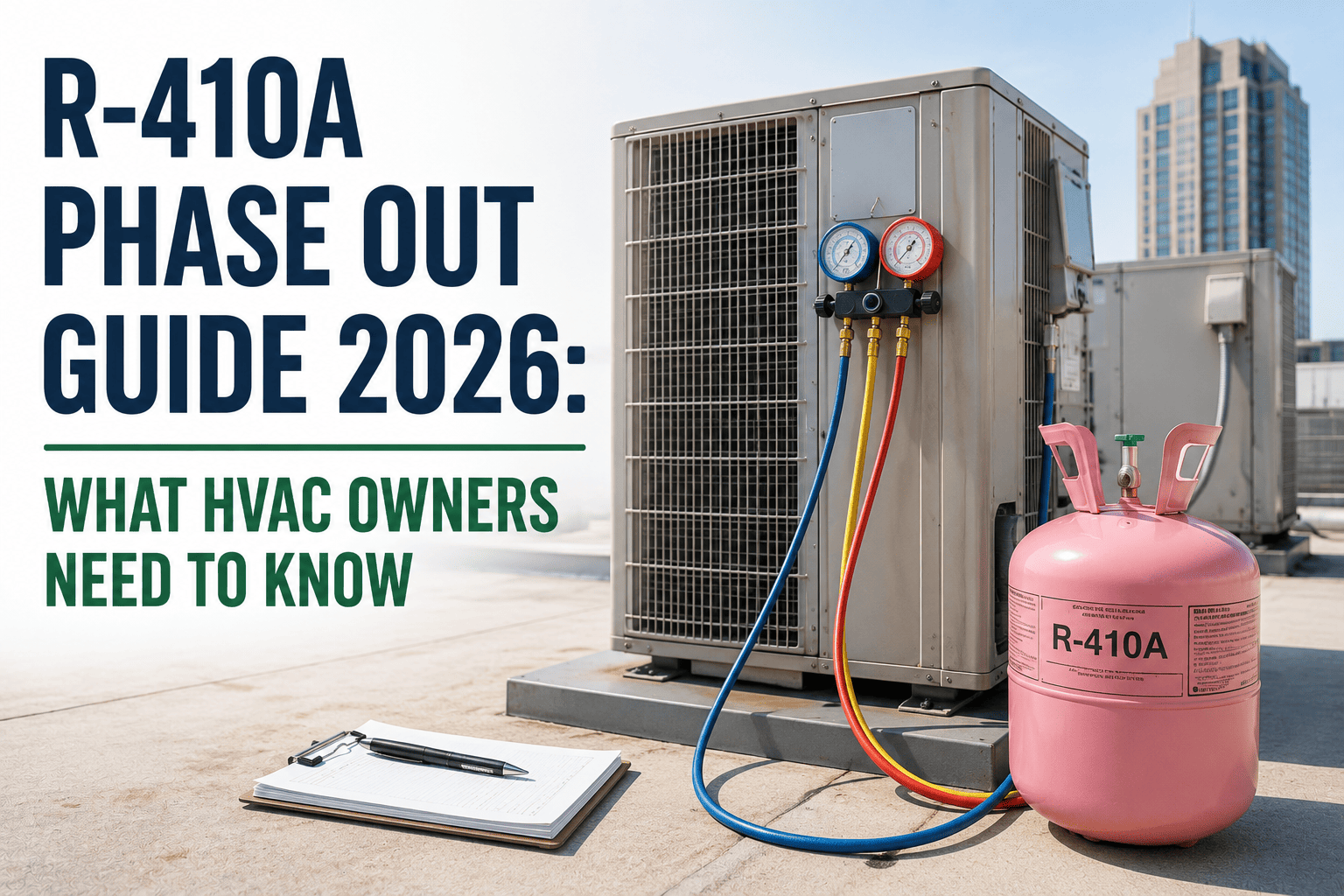
R-410A has not been banned. But the manufacturing cutoff already happened, service refrigerant prices are rising, and the new generation of equipment is here — and costs more. Whether you run one building or a portfolio of facilities, the decisions you make in 2026 about your HVAC assets will determine your maintenance costs, capital exposure, and compliance risk for the next 15 years. This guide cuts through the regulatory noise and tells you exactly where things stand, what it costs, and what to do next. Start free on OxMaint and track your R-410A asset inventory before the next service cycle.
Know Which of Your HVAC Assets Are R-410A Before It Costs You
OxMaint helps facility teams track refrigerant type, service history, and repair costs per asset — so you can plan the transition strategically, not reactively.
The Regulatory Timeline: What Has Already Happened
The phase-out is not a future event — key milestones have already passed. Here is the exact sequence of what changed and when, based on EPA rulemaking under the AIM Act.
December 2020
AIM Act Signed Into Law
The American Innovation and Manufacturing Act mandated an 85% phasedown of U.S. HFC production and consumption — including R-410A — by 2036. This set the entire transition in motion.
January 1, 2025
Manufacturing & Import Ban — Effective
The EPA banned manufacture and import of new residential and light commercial AC and heat pump systems using refrigerants with a GWP above 700. R-410A has a GWP of 2,088 — this effectively ended new R-410A equipment production. Pre-2025 inventory remained legal to sell and install.
May 21, 2026
EPA Removes Installation Deadline — Final Rule
The EPA finalized changes to the Technology Transitions Rule, removing the original January 1, 2026 installation deadline for pre-2025 residential and light commercial R-410A equipment. Pre-manufactured R-410A inventory can still be legally installed. Enforcement focus shifted to manufacturing and import violations, not installations from existing inventory.
Current Status
January 1, 2028
Package Units Compliance Deadline
Commercial packaged units have a later compliance deadline — giving commercial facility teams more runway. Split systems face tighter timelines depending on inventory status and state-level rules.
2036 Target
85% HFC Phasedown Complete
The AIM Act's end target. R-410A service refrigerant will remain available for existing systems throughout this period — but supply tightens progressively and prices will continue rising as production quotas decrease.
The State Exception: California and the Early Movers
Federal enforcement relaxation does not apply everywhere. California and several other states are not waiting for EPA reconsideration. If your facilities are in these markets, the federal timeline is not your actual deadline. Book a demo to see how OxMaint helps you track compliance status by asset and location.
CA
California Has Its Own Timeline
California enforces its own refrigerant transition requirements independent of EPA enforcement priorities. For facilities in California — and other progressive-adopter states — compliance with low-GWP equipment requirements may be enforced more aggressively and on an earlier schedule than the federal rule suggests.
Rule: Always verify your state's specific enforcement timeline — do not assume the federal relaxation applies to your jurisdiction.
R-410A vs. the Replacements: What Facility Teams Need to Know
Two refrigerants have emerged as the primary replacements in new HVAC equipment. Neither is a drop-in replacement for existing R-410A systems — understanding the difference matters for every repair and replacement decision you make from here forward.
Being Phased Down
R-410A
Global Warming Potential
2,088
ClassificationA1 — Non-flammable
New equipmentManufacturing banned 2025
Service refrigerantLegal indefinitely
Cost trendRising — supply tightening
Drop-in swap possibleNo
VS
Primary Replacement — Ducted Systems
R-454B
Global Warming Potential
466
ClassificationA2L — Mildly flammable
GWP reduction78% lower than R-410A
Adopted byCarrier, Trane, Lennox, Rheem, Goodman
Equipment cost premium10–15% above R-410A
Requires new toolingYes — A2L-rated equipment
Primary Replacement — Ductless / Mini-Split
R-32
Global Warming Potential
675
ClassificationA2L — Mildly flammable
Single-componentEasier to recycle and recharge
Adopted byDaikin, Mitsubishi, LG
Global track recordWidely used in Asia and Europe
Drop-in swap possibleNo
What R-410A Refrigerant Costs in 2026 — And Where It Goes Next
R-410A service refrigerant remains legal and available — but the supply trajectory is one-directional. Sign up free on OxMaint to log refrigerant top-ups and track service costs per asset as the price trend continues.
Wholesale Price
$4 – $13
per pound (contractor purchase)
30 lb cylinder: $80–$400 depending on distributor and region
Installed Cost (Technician Labor)
$40 – $100
per pound including labor and callout
Will continue rising as supply contracts — R-22 history shows eventual 10–40x price increase
New A2L Equipment Premium
10 – 15%
above equivalent R-410A equipment cost
Includes safety sensors, sealed relays, A2L-rated components and detection boards
Contractor Tooling Uplift
$2,000 – $5,000
per truck for A2L-rated tooling
Spark-proof recovery machines, A2L leak detectors, left-hand thread adapters — flows into installation invoices
The R-22 Warning: What Rising Refrigerant Prices Actually Look Like
R-22 was phased out on an almost identical regulatory path — and what happened to its price is a clear signal of where R-410A is headed. Facilities that did not track their R-22 assets strategically paid the price repeatedly.
Before manufacturing ban
$5–$10/lb wholesale
Already passed — $4–$13/lb now
2–3 years post-ban
$20–$50/lb wholesale
Approaching — supply quotas tighten annually
5–8 years post-ban
$100–$200/lb wholesale
Projected 2030–2033 for R-410A
Late-stage supply
$400–$600/lb — reclaimed only
R-410A will follow the same trajectory
The Decision Framework: Repair, Retrofit, or Replace
Every R-410A asset on your inventory now needs a simple decision applied to it. This framework is not about compliance panic — it is about making financially sound choices before the cost window closes. Sign up free and OxMaint gives you the asset cost history to run this analysis on your actual equipment.
System is under 8–10 years old
No active leaks requiring large recharges
Repair cost is well below replacement threshold
Annual service maintains documented condition history
Service strategically — small leaks found early cost a fraction of late-stage multi-pound recharges at peak summer rates.
System is 10–15 years old
Repair cost is approaching 40–50% of replacement value
Repeated refrigerant top-ups in the last 24 months
Cumulative maintenance spend trending up year over year
Start the budget process now. New A2L equipment costs 10–15% more — but buys you 15–20 years free from rising R-410A service costs.
System is 15+ years old or past design life
Major component failure — compressor, heat exchanger
Large refrigerant leak requiring multi-pound recharge
Repair cost exceeds 50% of new equipment cost
Putting a large repair investment into aging R-410A equipment locks you into rising service costs. The R-22 precedent is clear — replace before the price curve inflects.
4 Things Facility Managers Must Do in 2026
01
Build Your R-410A Asset Inventory
You cannot plan the transition without knowing which assets run R-410A, their age, condition, and current service cost trajectory. Log every HVAC asset with refrigerant type, install year, and last service record in OxMaint — this is the minimum baseline the next 10 years of decisions depend on.
02
Verify Your State's Enforcement Timeline
Federal enforcement relaxation is not a universal get-out. California and other states enforce their own timelines. Facilities in multiple jurisdictions need jurisdiction-specific compliance tracking — the federal EPA position may not be the standard that applies to your building.
03
Address Small Leaks Before Summer Peak
R-410A refrigerant does not deplete — if you are topping up regularly, you have a leak. Small leaks repaired now cost a fraction of multi-pound recharges at peak summer rates when technician availability tightens and refrigerant prices run highest. Time service for shoulder seasons: October through March.
04
Build the Capital Replacement Case Now
R-410A assets approaching end-of-life need documented cost histories to justify replacement to leadership — not a refrigerant-price-scare narrative. Cumulative repair spend, rising service costs, and condition records from OxMaint create the financial argument that gets capital budget approved before the emergency arrives.
How OxMaint Supports Your Refrigerant Transition
A refrigerant transition managed without asset data is the fastest way to overspend on the wrong systems and underprepare for the right ones. OxMaint builds the per-asset record that makes every decision in this transition defensible, documented, and financially sound. Sign up free — no hardware required to start.
IN
Asset Inventory with Refrigerant Type
Log refrigerant type, install year, equipment model, and location against every HVAC asset. Know your R-410A exposure across your full portfolio at a glance — before your next service call reveals it unexpectedly.
SH
Service and Refrigerant Cost History
Every refrigerant top-up, repair event, and PM cost logged per asset over its full life. Track the cumulative cost trend that shows when continued R-410A service investment stops making financial sense against a replacement.
AL
Repeat Service Alerts
Assets requiring refrigerant top-ups on multiple visits within 12–24 months are flagged automatically — the clearest signal that a leak repair or replacement decision needs to move up the priority list before the next recharge.
RP
Capital Planning Reports
Export per-asset cost histories and condition summaries to build the documented business case for R-410A replacement budgets. Leadership needs numbers — OxMaint gives you the records to provide them, not just a forecast.
Manage the R-410A Transition With Data, Not Guesswork
OxMaint tracks your HVAC asset inventory, refrigerant service history, and repair cost trends — giving your team the evidence to make the right repair-or-replace call on every R-410A asset before rising refrigerant costs make it for you.
Frequently Asked Questions
Is R-410A banned in 2026?
No. R-410A has not been banned. Manufacturing and import of new R-410A residential and light commercial equipment stopped on January 1, 2025 under the EPA's AIM Act Technology Transitions Rule. However, service refrigerant for existing systems remains legal indefinitely, and on May 21, 2026 the EPA finalized removal of the original installation deadline for pre-2025 manufactured equipment. Existing R-410A systems are grandfathered and fully legal to own, operate, service, and repair. The issue for facility managers is not legality — it is the rising cost of service refrigerant as production quotas decrease annually toward the 2036 target. Sign up on OxMaint to track your R-410A service costs per asset.
What replaces R-410A in commercial HVAC equipment?
Two refrigerants have emerged as the primary replacements. R-454B — marketed as Puron Advance by Carrier — has a GWP of 466 (78% lower than R-410A) and is adopted by Carrier, Trane, Lennox, Rheem, and Goodman for ducted systems. R-32, used by Daikin, Mitsubishi, and LG, has a GWP of 675 and is widely used in ductless and mini-split systems with a strong global track record. Both fall under the A2L classification — mildly flammable, low toxicity — and neither is a drop-in replacement for existing R-410A systems. New equipment costs 10–15% more than equivalent R-410A units and requires A2L-rated tooling from servicing contractors. Book a demo to see how OxMaint helps you plan the transition across your asset inventory.
How much will R-410A refrigerant cost going forward?
In 2026, R-410A costs $40–$100 per pound installed (including technician labor and service fees), up from pre-phase-out levels. As HFC production quotas decrease annually under the AIM Act, supply will tighten and prices will rise — following the same trajectory as R-22, which went from roughly $5–$10/lb wholesale to $400–$600/lb reclaimed in its final years of availability. The clearest risk for facility teams is a large refrigerant leak requiring multi-pound recharging on aging equipment — at rising prices that compound with each passing year. Fixing small leaks early and tracking refrigerant top-ups per asset are the most cost-effective responses available now.
Do I need to replace my R-410A HVAC system now?
Not necessarily. The right answer depends on your system's age, condition, and current service cost trajectory. Systems under 8–10 years old with no active leaks should be serviced and maintained normally. Systems 10–15 years old showing rising repair costs or repeated refrigerant top-ups should enter capital planning now. Systems 15+ years old facing major component failures or large recharges are strong replacement candidates — putting significant repair investment into aging R-410A equipment locks your facility into a rising-cost service platform. The decision is financial, not compliance-driven — and it requires per-asset cost data to make correctly.