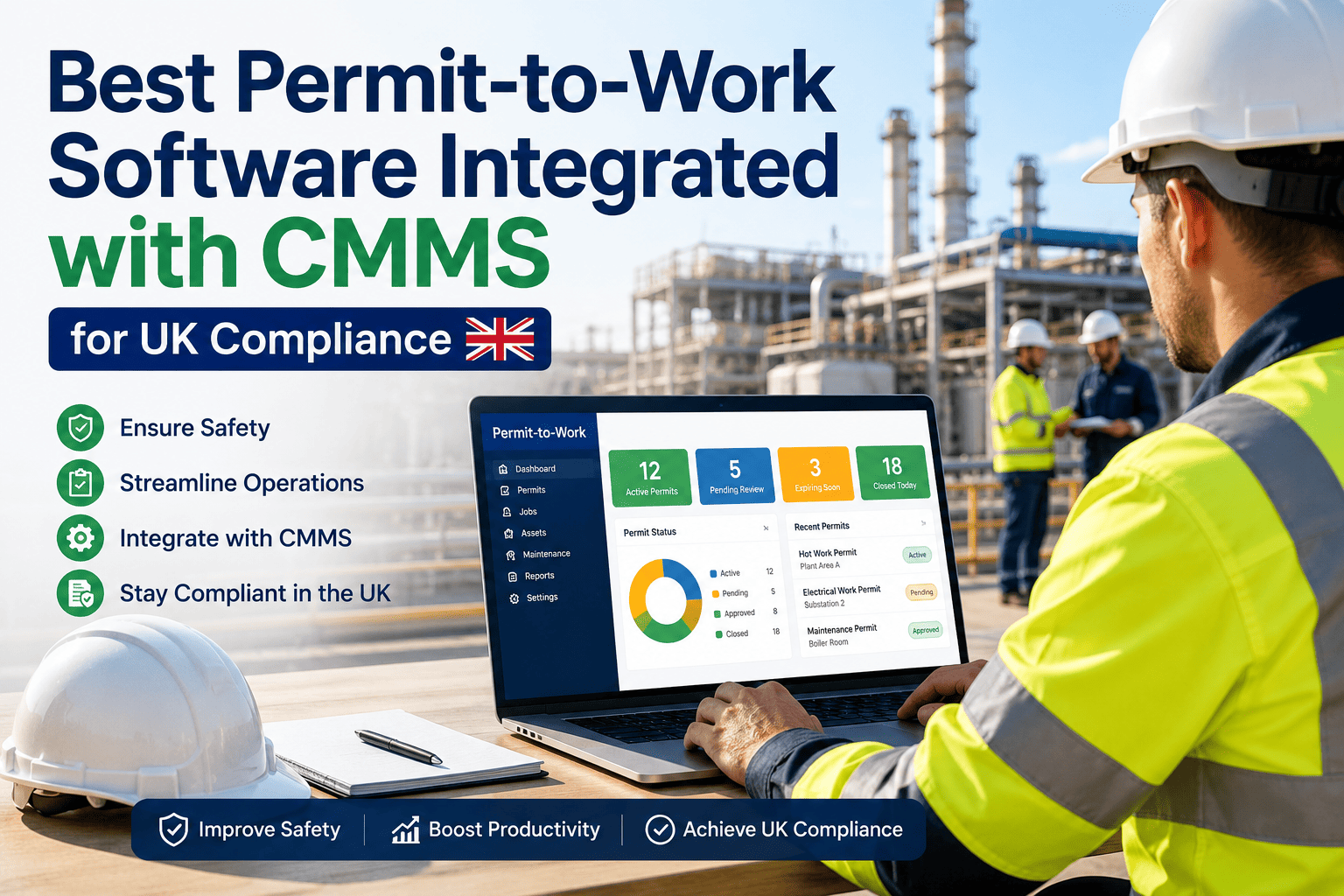
Best Permit-to-Work Software Integrated with CMMS for UK Compliance
By Mark strong on May 22, 2026
Paper permit-to-work systems are one of the last paper-based processes to survive the shift to digital maintenance — and they are the most dangerous one to get wrong. When a hot work permit, confined space authorisation, or electrical isolation sign-off exists only on a paper form, there is no link between that permit and the work order it controls, no audit trail that survives an HSE investigation, and no way for a supervisor to confirm permit status without physically walking the floor. OxMaint integrates permit-to-work control directly into your CMMS — so every permit is attached to its work order, every sign-off is timestamped, and every closure is documented before the job can be marked complete. Sign up free to start your digital PTW programme, or book a demo to see OxMaint's permit-to-work integration in a UK manufacturing environment.
Paper Permits Are a Compliance Risk You Can Eliminate Today
OxMaint connects permit-to-work authorisation directly to CMMS work orders — giving UK manufacturers a complete digital audit trail for every high-risk maintenance task from issue to closure.
What UK Law Actually Requires for Permit-to-Work Systems
There is no single regulation in UK law called the "Permit to Work Regulations." What exists is a legal framework that makes permit systems the practical route to compliance for high-risk maintenance activities. Book a demo to see how OxMaint structures each permit type against the relevant regulatory obligation.
HSWA 1974
Health and Safety at Work Act
Requires safe systems of work for all employees. For high-risk maintenance activities, a documented permit-to-work system is the accepted mechanism for demonstrating a safe system exists.
MHSWR 1999
Management of H&S at Work Regulations
Requires documented risk assessments and arrangements for implementing protective measures. Permit systems operationalise these arrangements for hazardous maintenance tasks.
CSR 1997
Confined Spaces Regulations
Regulation 4 requires a safe system of work for confined space entry — in practice this means a permit system for most confined space maintenance work in UK manufacturing plants.
HSG250
HSE Guidance on PTW Systems
The HSE's definitive practical reference for permit-to-work systems. Not law, but referenced by regulators and courts. UK manufacturing sites are expected to demonstrate their PTW process aligns with HSG250 principles.
The HSE defines a permit to work as "a formal recorded document used to control work which is identified as potentially hazardous." The permit does not make the work safe — it ensures the safety measures are in place before work begins. Without a CMMS link, there is no guarantee the permit has been issued before the work order is started.
The 5 Permit Types UK Manufacturing Plants Must Control
Hot Work Permit
Welding, grinding, cutting, brazing, any open flame or ignition source near combustible materials
Fire, explosion, toxic fume exposure
DSEAR, MHSWR 1999, HSG250
CMMS Integration Requirement
Fire watch sign-off, gas test record, and area clearance confirmation — all linked to the work order before closure is permitted.
Confined Space Entry Permit
Tank cleaning, vessel inspection, sewer entry, any space with restricted access and potential for hazardous atmosphere
Asphyxiation, toxic atmosphere, engulfment
Confined Spaces Regulations 1997, L101 ACOP
CMMS Integration Requirement
Atmospheric test results, standby person assignment, rescue equipment check — mandatory fields before work order can be accepted.
Electrical Isolation Permit (LOTO)
Maintenance on live or previously live electrical equipment, switchgear, panel work, motor maintenance
Electrocution, arc flash, uncontrolled energy release
Electricity at Work Regulations 1989, BS EN ISO 50110
CMMS Integration Requirement
Lockout point confirmation, isolation verification sign-off, authorised person credential check — all timestamped against the work order.
Work at Height Permit
Fragile roofs, unprotected edges, work above other personnel, scaffolding or MEWP operations in unusual circumstances
Falls, dropped objects, structural failure
Work at Height Regulations 2005, PASMA, IPAF
CMMS Integration Requirement
PASMA/IPAF certification check, equipment inspection record, exclusion zone confirmation — linked to technician credentials in CMMS.
Cold Work / General Access Permit
Entry to hazardous areas without ignition sources — some UK sites operate these on the principle that anything entering a controlled zone should be logged and tracked
Unauthorised access, uncontrolled interaction with live plant
MHSWR 1999, site-specific risk assessment
CMMS Integration Requirement
Area controller sign-off and time-bounded authorisation — automatically expired in CMMS if work extends beyond the permitted window.
Every Permit Type. Built Into Your Work Orders.
OxMaint includes pre-built permit templates for hot work, confined space, electrical isolation, and work at height — linked directly to work orders so no job starts without a valid, signed permit. Sign up free to configure your first permit type today.
Many UK manufacturers adopt a permit-to-work application that runs separately from their CMMS. On paper this satisfies the documentation obligation. In practice it creates a dangerous gap: the permit exists in one system, the work order exists in another, and there is no enforced link between them.
Standalone PTW + Separate CMMS
Permit issued in PTW system
Work order raised in CMMS — separately
No enforced link. Technician can start work before permit is issued.
HSE audit requires cross-referencing two systems manually. Gap risk is high.
VS
OxMaint — PTW Integrated with CMMS
Work order raised — permit type auto-assigned by asset risk profile
Permit issued and signed within same work order — CMMS blocks start without valid permit
Work completed. Permit closure sign-off required before work order can close.
Full audit trail — one record, timestamped, tamper-evident, exportable in seconds.
How OxMaint's PTW-CMMS Integration Works in Practice
1
Asset Risk Profile Drives Permit Type
Each asset in OxMaint carries a risk classification. When a work order is raised against a confined space vessel or a welding bay, the system automatically flags which permit type is required — eliminating the risk of a technician starting work without realising a permit is needed.
2
Permit Issued Within the Work Order
The authorising supervisor issues the permit directly from the work order interface. Required pre-work checks — gas test results, atmospheric readings, isolation confirmations — are mandatory fields that must be completed and signed before the permit status changes to active.
3
Technician Credential Check at Assignment
OxMaint stores COMPEX, PASMA, IPAF, and confined space entry certifications per technician. The system flags expired credentials before assignment — so a hot work permit cannot be issued to a technician whose relevant certification has lapsed.
4
Work Order Blocked Until Permit Is Active
The work order status cannot advance to "In Progress" until the associated permit has been issued and signed by both the authorising person and the accepting technician. This single enforcement point closes the most common PTW failure mode in UK manufacturing.
5
Time-Bounded Permits With Auto-Expiry
Every permit carries a validity window. If work extends beyond the authorised period, the permit expires in the system and a supervisor must reauthorise before work continues. This prevents the common paper permit failure of extended validity by assumption.
6
Closure Sign-Off Locks the Audit Record
Work order closure requires permit suspension and formal sign-off that the work area has been made safe. Once closed, the full permit and work order record is locked — tamper-evident, timestamped, and immediately exportable for HSE inspection or incident investigation.
Before OxMaint, a hot work permit lived on a clipboard and a copy went into a filing cabinet. During our last HSE site visit, the inspector asked for all hot work records for a specific asset over the previous 18 months. We pulled the complete export in four minutes. The inspector commented on it specifically.
— Safety Manager, UK Chemical Processing Plant
From Paper Permits to Digital Audit Trail — In One Week
OxMaint's onboarding team configures your permit types, asset risk classifications, and technician credentials before you go live. No IT project, no consultant. Sign up free and see how quickly the transition runs.
PTW Software Comparison: What UK Plants Are Evaluating
Scroll
Capability
OxMaint
Standalone PTW App
CMMS Without PTW
Paper-Based System
Permit linked directly to work order
Yes — enforced
No link to CMMS
No permit capability
Manual cross-reference
Work order blocked until permit active
Yes — automatic
Not possible
Not possible
Not possible
Technician certification check at assignment
Yes
Limited
Depends on CMMS
No
Auto-expiry of time-bounded permits
Yes
Some systems
No
No
HSE-ready audit export (single record)
Yes — seconds
Partial — separate from WO
No permit records
Hours of file searching
UK permit types pre-built (hot work, CS, LOTO)
Yes
Varies
No
Custom forms only
Mobile sign-off on plant floor
Yes — offline capable
Some systems
Depends on CMMS
No
The 7-Step Permit Lifecycle — How OxMaint Manages Each Stage
1
Identification
Work order raised. OxMaint identifies permit requirement automatically from asset risk profile.
2
Assessment
Risk assessment and pre-work checks completed as mandatory fields within the permit form.
3
Preparation
Technician credentials verified. Parts availability confirmed. Permit validity window set.
4
Issue
Authorising supervisor and accepting technician both sign digitally. Work order status advances to Active.
5
Work
Live permit visible to all supervisors. Auto-expiry enforced if validity window closes before completion.
6
Suspension
If work pauses for shift change or emergency, permit is formally suspended — not silently abandoned as with paper systems.
7
Closure
Area made safe. Permit formally closed. Work order locked. Full tamper-evident audit record retained against asset history.
UK Manufacturing — Free to Start
Every Permit. Every Work Order. One Audit Trail.
OxMaint gives UK manufacturing maintenance teams the integrated permit-to-work and CMMS system they need to satisfy HSE obligations, protect technicians, and produce compliance documentation in seconds — not hours.
Is a permit-to-work system legally required in UK manufacturing?
There is no single regulation in UK law named the "Permit to Work Regulations." However, the Health and Safety at Work etc. Act 1974 requires safe systems of work, and for specific activities — confined space entry under the Confined Spaces Regulations 1997, hot work in DSEAR-regulated areas, and electrical isolation under the Electricity at Work Regulations 1989 — a permit-to-work system is the accepted practical route to compliance. HSE guidance document HSG250 is the definitive reference. Book a demo to see how OxMaint structures each permit type against its relevant regulatory obligation.
What is the difference between a risk assessment, method statement, and permit to work?
A risk assessment identifies hazards and evaluates risk — used for every task. A method statement is a step-by-step safe working procedure — used for medium and high risk tasks. A permit to work is a time-bounded, signed authorisation that confirms the safety measures from the risk assessment are actually in place before a specific high-risk task begins. The permit does not replace the risk assessment — it confirms it has been acted upon. OxMaint stores all three against the asset and work order record.
Can OxMaint's permit-to-work system work offline on the factory floor?
Yes. OxMaint's mobile app operates in offline mode — technicians and supervisors can access permit forms, complete required fields, and capture digital signatures without an active network connection. All records sync automatically when the device reconnects to the plant Wi-Fi. This is essential in confined space locations and areas with poor signal coverage where permits are most critical. Sign up free to explore the offline permit functionality.
How does OxMaint handle permit-to-work for contractors and external engineers?
External contractors access OxMaint via a limited mobile login. They receive their work order and associated permit, complete the required pre-work checks, and provide digital sign-off as the accepting party. All contractor permit records are stored against the asset in the same audit trail as internal work orders. Contractor access is permission-controlled and does not expose other plant data. Contractor certification details — PASMA, IPAF, COMPEX — can be uploaded and linked to the contractor account for credential verification at permit issue.
What happens to permits when there is a shift handover mid-job?
OxMaint handles shift handover explicitly within the permit lifecycle. When a shift ends with a job still in progress, the permit is formally suspended — not silently left active as paper systems allow. The incoming shift supervisor reviews the work order and permit status on the live dashboard and reauthorises the permit before work resumes. This closes the most common handover gap in paper-based PTW systems, where permits remain technically valid long after the authorising supervisor has left the site. Book a demo to see shift handover handling demonstrated live.